
Phase (cyclic states in nature and science)
A phase is a particular state within a repeating cycle. This article explains phases in waves, astronomy, matter, and engineering, and how phase differences affect behavior and measurement.
A phase denotes a particular position or state within a repeating process or cycle. Many natural and engineered systems pass through a sequence of states that repeat in time or space; each distinct position within that sequence is called a phase. The idea applies broadly, from the visible cycle of lunar phases to the abstract angle that locates a point on a waveform. For a general introduction see the notion of a cycle.
Image gallery
5 Images
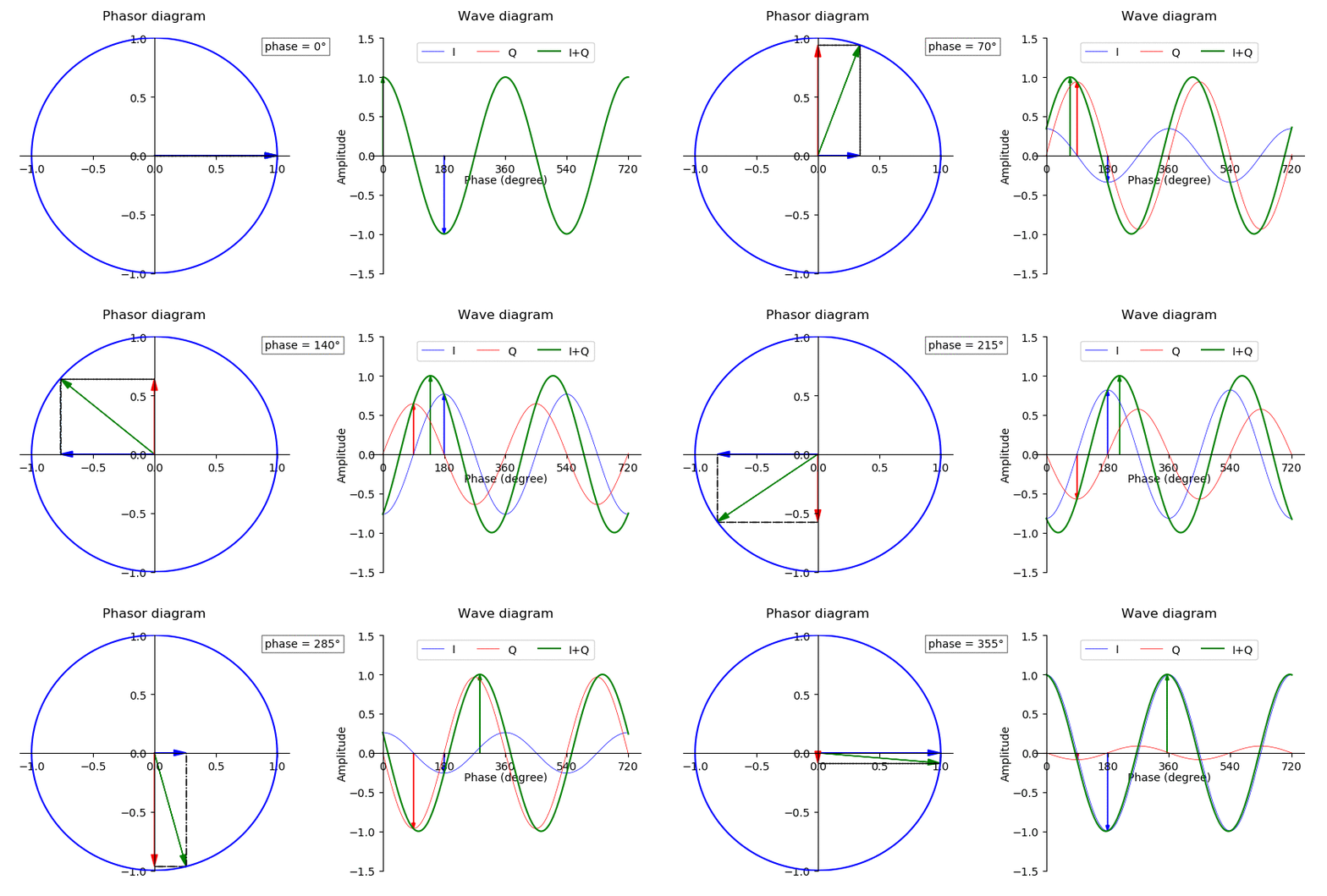

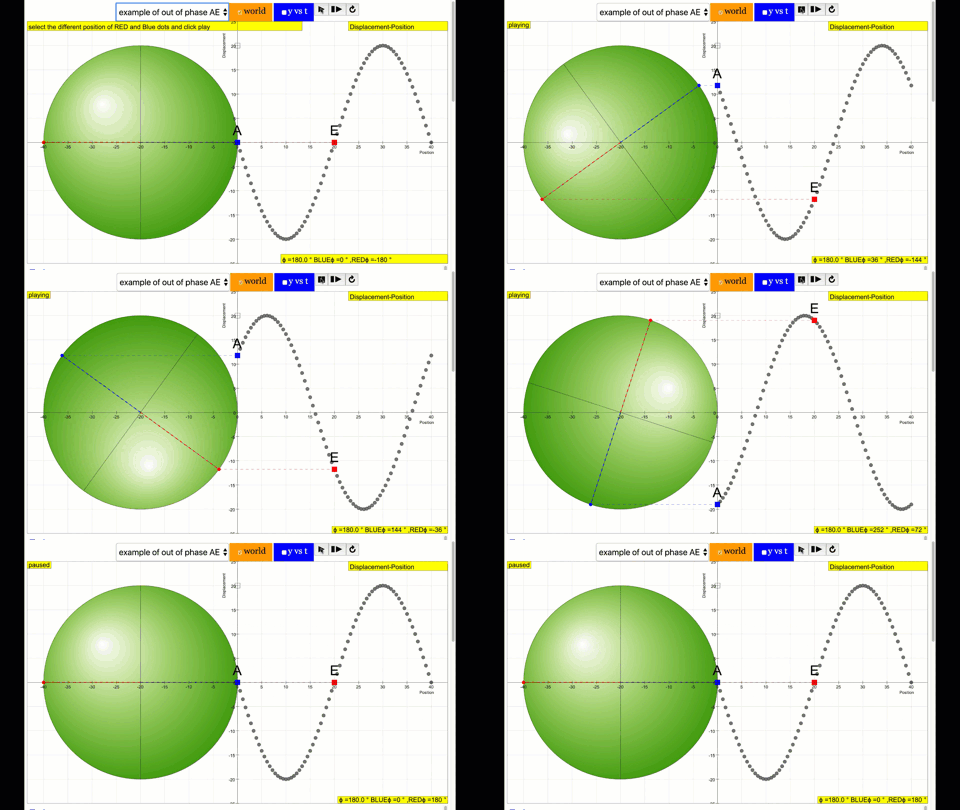

Basic characteristics
Phases are often described by an angle, a fraction of a period, or a named stage (for example, "new" and "full" in lunar phases). Two useful concepts are phase difference and phase shift. If two repeating signals or motions reach corresponding points at the same time, they are said to be "in phase"; when one leads or lags the other they have a phase difference and are "out of phase." In oscillatory systems such as a pendulum, the instantaneous position and motion at a moment correspond to a phase value; an identical pendulum started later will generally be out of phase with the first.
Astronomy and seasonal examples
Astronomical phases are common everyday examples. The Moon displays familiar phases as its illuminated portion visible from Earth changes. Planets such as Venus also exhibit phases; early telescopic observations of these planetary phases contributed to the understanding that planets orbit the Sun rather than the Earth. Seasonal cycles (spring, summer, autumn, winter) can be described as phases in the annual orbit and axial tilt of the Earth.

Waves, signals and measurement
In wave physics and signal processing, phase locates a point on a sinusoid relative to a reference. Engineers measure phase in degrees or radians and use phase relationships to combine signals, cancel noise, or synchronize systems. Phase is central to alternating-current electrical systems, radio communications, and optics, where interference patterns depend on relative phases. Mathematical tools often express phase as an argument of a complex number or as a time shift relative to a period (algebra and trigonometry are typical frameworks).
Phases of matter and transitions
Another meaning of phase appears in chemistry and materials science: a phase of matter is a region with uniform physical and chemical properties, such as solid, liquid, and gas. Phase diagrams map which phases are stable under given conditions of temperature and pressure. A phase transition is the change between these states (melting, vaporization, condensation). These uses of "phase" emphasize stable regimes rather than positions within a periodic cycle, but they share the general idea of distinct, identifiable states.
Applications, distinctions and notable facts
- Practical uses: timing in clocks (clock mechanisms), synchronization of power grids, radar and sonar, and waveform analysis in electronics.
- Distinctions: "phase" in oscillations (an angular position) differs from "phase" as a thermodynamic phase (a homogeneous form of matter).
- Measurement: phase differences can be measured by observing time offsets, by comparing waveform peaks, or by computing the argument of complex-valued signals.
- Historical note: observations of planetary phases helped shift scientific views of the solar system; for more background see astronomical sources on observational history (Moon, Venus).
Understanding phase and phase relationships lets scientists and engineers predict behavior, design synchronized systems, and interpret repeating patterns across disciplines. For further technical treatments see resources on waves, signal processing, thermodynamics, and celestial mechanics (cycles, mathematical methods).
Related reading and technical references are available through educational and scientific portals (solar system context, geocentric vs. heliocentric discussions, and applied engineering texts on oscillations and timekeeping).
Questions and answers
Q: What is a phase?
A: A phase is one part of a cycle or change that goes in a circle.
Q: Can you give an example of something that has phases?
A: The moon, the seasons of the year, and Venus all have phases.
Q: How did Galileo use the phases of Venus to prove something about its orbit?
A: Galileo showed that the phases of Venus meant it must go around the Sun, not the earth.
Q: What can be used to represent things with phases?
A: Graphs can be used to represent things with phases.
Q: How do things with phases change over time?
A: Things that have phases change in some regular way from time to time.
Q: Can two pendulums move together if they are different lengths?
A: No, unless they begin swinging at the same time and place they will not move together. One may be swinging left while the other swings right. When this happens, they are "not in phase."
Related articles
Author
AlegsaOnline.com Phase (cyclic states in nature and science) Leandro Alegsa
URL: https://en.alegsaonline.com/art/76354