
Pasiphaë (Jupiter moon)
Pasiphaë is a distant, irregular retrograde moon of Jupiter discovered in 1908. It is a dark, likely captured object and the namesake of the Pasiphae group of Jovian satellites.
Overview
Pasiphaë is one of the irregular, outer satellites of Jupiter. It follows a distant, elongated orbit in the opposite direction of the planet's rotation (a retrograde orbit) and is notably darker and smaller than the major Galilean moons. Because of its orbit and physical properties, Pasiphaë is commonly interpreted as a captured object rather than having formed in place with Jupiter.
Image gallery
2 Images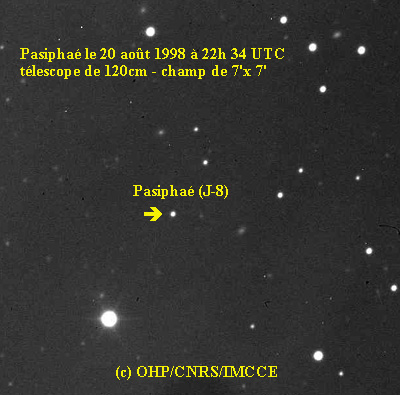
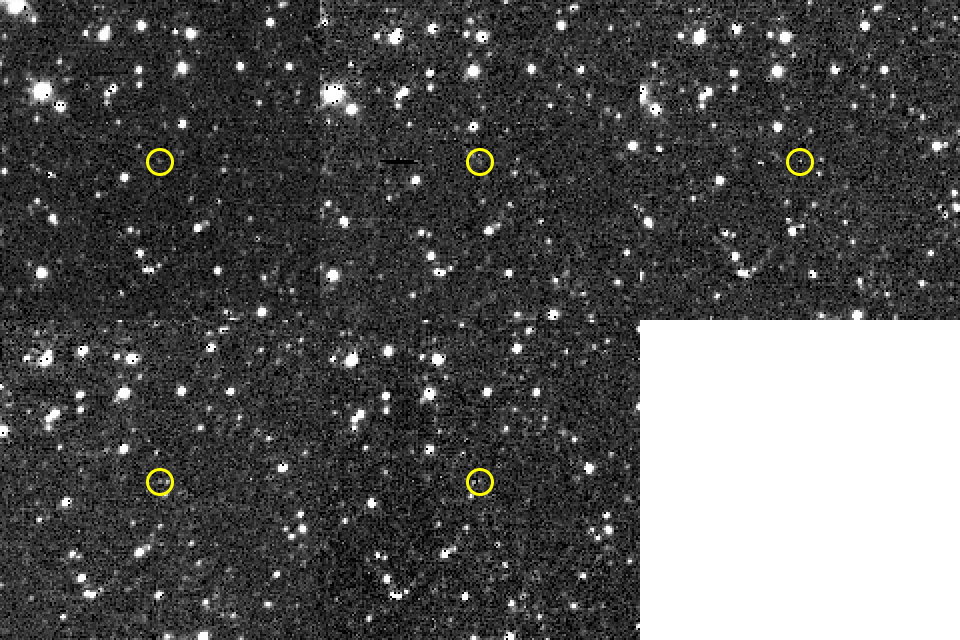
Discovery and name
The moon was discovered in 1908 by the British astronomer Philibert Jacques Melotte and was one of the early known small Jovian satellites. It received the name Pasiphaë from Greek mythology in keeping with the convention of naming Jupiter's moons after characters associated with Zeus (the Greek counterpart of Jupiter). The name honors Pasiphaë, the mythological queen of Crete, who was the wife of Minos and mother of the Minotaur.
Physical characteristics
Pasiphaë is a relatively small, non-spherical body with a dark surface and low reflectivity (albedo). Its color and spectrum suggest a composition similar to many outer Solar System small bodies: primitive, carbon-rich material. Its diameter is on the order of a few tens of kilometers, making it much smaller than the regular satellites of Jupiter.
Orbit and group
The moon is the largest member and namesake of the Pasiphae group, a collection of irregular, retrograde satellites that share broadly similar orbital distances and inclinations. This grouping is interpreted as evidence that these moons may be fragments of one larger body that was captured by Jupiter and subsequently disrupted by collision.
Importance and research
Pasiphaë and the other irregular satellites are important for studies of planetary capture, collisional evolution, and the dynamical history of the Jovian system. They are faint and require substantial telescopic effort to observe, but surveys of their orbits, colors, and sizes continue to refine ideas about how giant planets acquired their retinues of small moons.
Related articles
Author
AlegsaOnline.com Pasiphaë (Jupiter moon) Leandro Alegsa
URL: https://en.alegsaonline.com/art/74911
Sources
- iop.org : "The Orbits of the Outer Jovian Satellites"
- ui.adsabs.harvard.edu : 2000AJ....120.2679J
- doi.org : 10.1086/316817
- ssd.jpl.nasa.gov : "Planetary Satellite Physical Parameters"
- nssdc.gsfc.nasa.gov : "Jovian Satellite Fact Sheet"