
Minos: Mythical King of Crete and Judge of the Dead
Minos, son of Zeus and Europa, is the legendary king of Crete associated with the Minotaur, the labyrinth, and later as a judge in the underworld. His name also inspired the term “Minoan” for Bronze Age Crete.
Overview
In Greek tradition Minos is the most famous of the early rulers of Crete. He is described as a son of Zeus and Europa and appears in many mythic cycles as a powerful monarch, lawgiver and ultimately a supernatural judge of the dead. Ancient sources treat the stories about Minos as mythological rather than documentary history, but his figure became a focal point for later interpretation of Bronze Age Crete and Mediterranean politics.
Image gallery
8 Images



Key myths and narrative
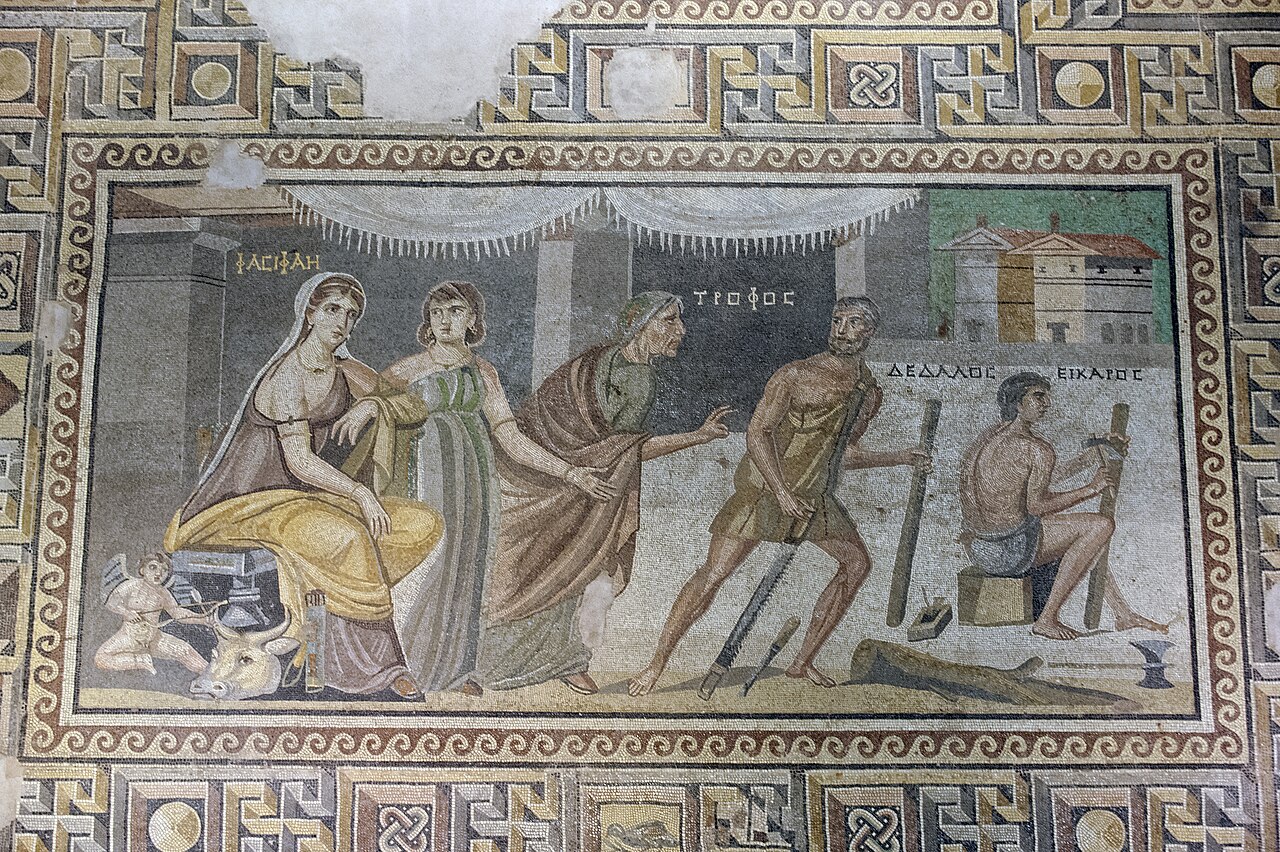
The best-known sequences in Minos’s legend explain the origin of the Minotaur and the construction of the labyrinth. According to the tradition, Minos promised to sacrifice to Poseidon a magnificent bull sent by the god to prove his favor, but he kept the animal and offered a different one instead. In retribution, Poseidon made Minos’s wife, Pasiphae, fall in love with the bull. The craftsman Daedalus then fashioned a hollow wooden cow in which Pasiphae concealed herself, and from the union with the bull the creature later known as the Minotaur was born: half man, half bull.
To confine this monstrous offspring, Minos commissioned a complex maze built by Daedalus and required periodic tribute from subject states: youths who were sent into the structure as a grim offering. The Athenian hero Theseus, aided by Minos’s daughter Ariadne, volunteered to enter, killed the Minotaur and escaped the labyrinth — a story that became central in later literature and art.
Role, functions and historical interpretations
Beyond the sensational episodes, Minos is sometimes described as a wise and authoritative ruler who enacted laws, supervised maritime affairs and secured Cretan dominance in the Aegean. Classical writers occasionally treat “Minos” as a dynastic title used for successive Cretan kings rather than a single historical person; some authors distinguish an earlier, more pious Minos and a later, more tyrannical one. These readings reflect attempts by ancient and modern scholars to reconcile mythic narrative with archaeological remains on the island.
Archaeology, naming and scholarship
Archaeological exploration of Crete in the late 19th and early 20th centuries brought renewed attention to the island’s Bronze Age palaces and artistic traditions. The archaeologist who led excavations at the palace of Knossos coined the term Minoan civilization to describe the distinctive pre-Greek culture he uncovered. That terminology deliberately referenced the legendary king to suggest a native Cretan cultural core, even though direct lines between the mythical Minos and the archaeological record cannot be proven. Scholars today use archaeological, linguistic and textual evidence to study the society that flourished on Crete and influenced the wider Aegean.
Important episodes and characters
- Divine parentage: Minos as descendant of Zeus and Europa anchors him in the Olympian family.
- The Poseidon-bull episode: a moral tale about broken vows and divine retribution involving Poseidon and Pasiphae.
- The Minotaur and labyrinth: engineering, ritual and the figure of Daedalus intersect in this drama.
- Theseus and Ariadne: the Athens–Crete conflict and the hero’s escape are motifs of renewal and civic identity, linked to Theseus and Ariadne.
Legacy
Minos’s image persisted in classical literature, drama and visual arts as both a monarch and an infernal magistrate who judged the dead in Hades alongside figures such as Rhadamanthus and Aeacus. The name also shaped modern archaeology and the popular understanding of Bronze Age Crete through the label “Minoan.” Whether treated as myth, royal title, or symbolic ancestor, Minos remains a central touchstone for stories about Crete, maritime power, ritual practice and the interplay between human rulers and the gods.
Questions and answers
Q: Who was Minos?
A: Minos was the mythical first king of Crete, son of Zeus and Europa.
Q: What did Minos do every nine years?
A: Every nine years, he made King Aegeus pick seven young boys and seven young girls to be sent to Daedalus' creation, the labyrinth, to be eaten by the Minotaur.
Q: Who was Pasophae?
A: Pasophae was Minos' wife.
Q: How did Poseidon punish Minos for cheating him in a sacrifice?
A: Poseidon punished him by having Pasophae fall in love with a bull.
Q: What did Daedalus do to help Pasophae?
A: To help her, Daedalus made a mechanical cow for her, and she got into it. The bull mated with the wooden cow and Pasophae had a child - the Minotaur - which was half human and half bull.
Q: Where did King Minos put the Minotaur?
A: King Minos took the Minotaur and put it in a labrynth or maze built by Daedalus.
Q: Why is the civilization named after him?
A: The Minoan civilization was later named after him by Arthur Evans who discovered and excavated the palace of Knossos in Crete.
Related articles
Author
AlegsaOnline.com Minos: Mythical King of Crete and Judge of the Dead Leandro Alegsa
URL: https://en.alegsaonline.com/art/65302
Sources
- makrigialos.com : makrigialos.com
- maicar.com : maicar.com/GML/Minos2.html
- in2greece.com : in2greece.com/english/historymyth/mythology/names/minos.htm