
Paquita: 19th-century Romantic ballet and its surviving classical variations
Paquita is a two-act Romantic ballet first staged in Paris in 1846. Known for its plot of lost nobility and for Marius Petipa's enduring additions, it remains influential in classical ballet repertoire.
Paquita is a mid-19th-century Romantic ballet originally presented in two acts and three scenes. Its book (scenario) was prepared by Joseph Mazilier in collaboration with Paul Foucher, with music by Édouard Deldevez and original choreography by Mazilier. The premiere took place at the Salle Le Peletier in Paris on 1 April 1846, performed by the Paris Opera Ballet and featuring Carlotta Grisi and Lucien Petipa in leading roles. The work exemplifies the narrative and stylistic features of Romantic ballet: an emphasis on picturesque exoticism, dramatic mime sequences, and a mixture of ensemble dances and virtuoso variations. For a general introduction to the genre see Romantic ballet, and for the original venue consult Salle Le Peletier.
Image gallery
10 Images



Synopsis and themes
The story of Paquita is set in Spain during the period of Napoleonic occupation and follows a young woman raised as a Gypsy who discovers she is of noble birth. As recounted in the original libretto, the heroine, Paquita, saves a French officer named Lucien d'Hervilly from an assassination plotted by a local governor and a Gypsy chief. Through a sequence of revelations and traditional ballet mime, Paquita's true identity—as a cousin of Lucien and a member of the aristocracy—is revealed, and the plot resolves in marriage. The narrative relies on themes common to 19th-century ballets: abduction and rescue, hidden lineage, national and military backdrops, and the contrast between rustic/folk elements and courtly refinement. For geographical and historical context see Spain and the era of Napoleon.
Choreography, music, and structure
Joseph Mazilier's original production combined spoken or mimed action with dance episodes typical of the period. Deldevez's score provided rhythmic and melodic material for character dances as well as lyrical pas de deux. The structure of two acts and three scenes allowed for set-piece divertissements and narrative continuity. The original staging highlighted Carlotta Grisi's dramatic and technical qualities; Grisi was one of the era's leading ballerinas and an important interpreter of Romantic roles.
Russian revivals and Petipa's contributions
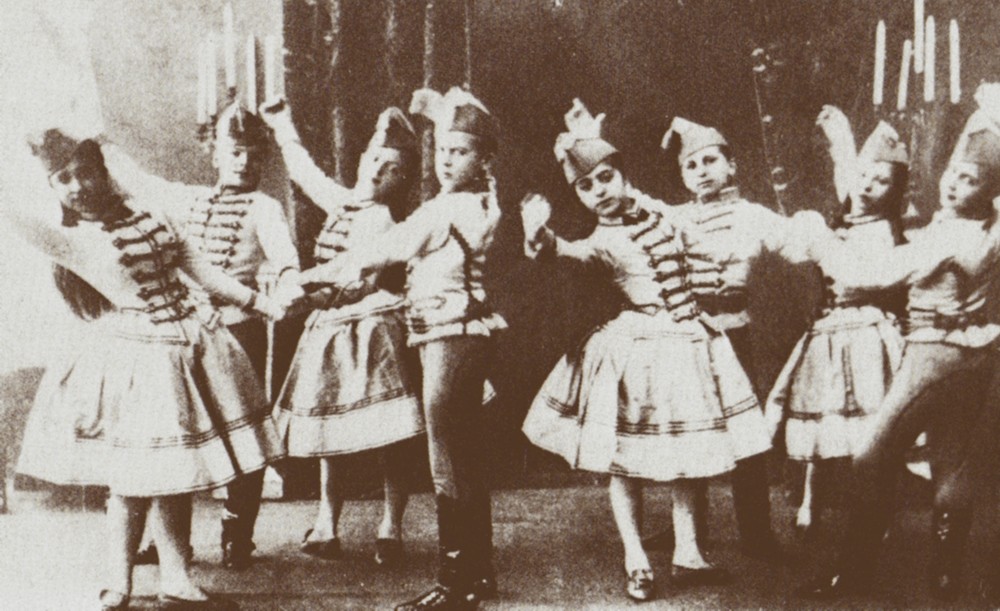
Paquita reached St. Petersburg in 1847 when Marius Petipa and Pierre-Frédéric Malevergne staged it for the Imperial Ballet. Petipa, who would become the dominant choreographer of classical ballet in Russia, revisited the work in 1881 and commissioned additional music by Ludwig Minkus. These additions included a first-act Pas de trois (often cited as the Minkus Pas de trois or Paquita Pas de trois), and for the final act the Paquita Grand pas classique and the Mazurka des enfants (Children's mazurka). Petipa's revised version remained in the Mariinsky Theatre's repertory into the early 20th century. For the choreographer and the company's later associations see Marius Petipa and the Mariinsky Theatre.
Legacy and modern revivals
Although the complete full-length Paquita largely disappeared from many company repertoires in the 20th century, Petipa's 1881 additions—particularly the Grand pas classique—have had a durable life as concert pieces. These extracts showcase classical technique and are frequently performed at gala events and in examination classes; they are considered staples of the classical repertory and are staged independently by companies around the world. A notable attempt to restore and reunify the ballet occurred in 2001, when Ballet Master Pierre Lacotte produced a revival for the Paris Opera Ballet that sought to reconstruct Mazilier's original mime and mise-en-scène while retaining Petipa's later choreographic material. For information on modern production practice and revivals see references to Ballet Masters.
Notable numbers and performance notes
- Pas de trois (Minkus/Petipa) — often performed as a showcase for three dancers.
- Grand pas classique — the most widely preserved extract, used to display classical technique and formal pas de deux structure.
- Mazurka des enfants — a character dance introduced by Petipa for the finale.
Paquita remains important less as a frequently staged full-length drama than as a source of enduring classical choreography. Its history illustrates how ballets of the Romantic era were adapted and expanded in 19th-century Russia, and how later revivals have attempted to balance historical fidelity with modern staging needs. Further reading and archival materials can be consulted through resources that document 19th-century ballet, the Paris Opera Ballet archives, and studies of Petipa's choreographic legacy.
Primary names associated with Paquita include Joseph Mazilier, Paul Foucher, Édouard Deldevez, Carlotta Grisi, Lucien Petipa, Marius Petipa, Ludwig Minkus, and Pierre Lacotte; these figures mark the ballet's path from Parisian Romanticism to Russian classical tradition and into contemporary revival practice.
Related entries and background: Romantic ballet, Salle Le Peletier, Carlotta Grisi, Spain, Napoleon, Marius Petipa, Mariinsky Theatre, Ballet Master.
Questions and answers
Q: What is Paquita?
A: Paquita is a romantic ballet in two acts and three scenes. It was originally choreographed by Joseph Mazilier and first performed in the Salle Le Peletier by the Paris Opera Ballet on 1 April 1846.
Q: Who wrote the story of Paquita?
A: The story of Paquita was written by Joseph Mazilier and Paul Foucher.
Q: Who composed the music for Paquita?
A: The music for Paquita was composed by Edouard Deldevez.
Q: Where does the story of Paquita take place?
A: The story takes place in Spain during the occupation of Napoleon's army.
Q: What is the main character's name in Paquita?
A: The main character's name in Paquita is a young Gypsy girl named Paquita.
Q: When did Marius Petipa stage his version ofPaquita for Imperial Ballet of St Petersburg?
A: Marius Petipa staged his version ofPaquita for Imperial Ballet of St Petersburg in 1847.
Q: What pieces were added to Petipa's versionofPaquitain 1881?
A: In 1881, Petipa added new pieces specially composed by Ludwig Minkus to his version ofPaquitaincludingthe Pas de trois (aka the Minkus Pas de trois or Paquita Pas de trois) for the first act, andthePaquta Grand pas classiqueandtheMazurka des enfants(Children's mazurka)for the last act.
Related articles
Author
AlegsaOnline.com Paquita: 19th-century Romantic ballet and its surviving classical variations Leandro Alegsa
URL: https://en.alegsaonline.com/art/74469