
Pandora (moon of Saturn)
Pandora is a small, irregular moon of Saturn that shepherds the outer edge of the planet's F ring. It is heavily cratered, affects ring structure through gravitational interactions, and was studied by Voyager and Cassini.
Overview
Pandora is a small natural satellite of Saturn known for its role as the outer shepherd of the planet's narrow F ring. It takes its name from the figure in Greek mythology, Pandora. Because of its proximity to the rings and its irregular shape, Pandora is an object of interest for studies of ring dynamics and small-body geology.
Image gallery
4 Images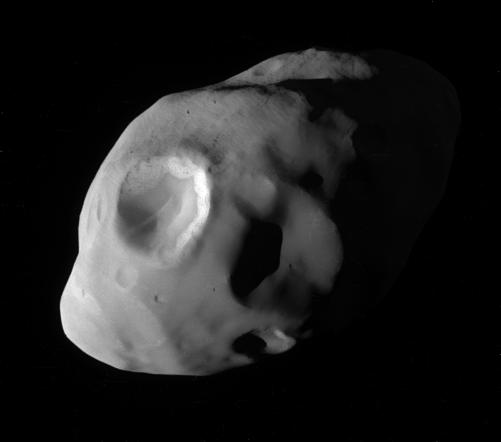


Physical characteristics
Pandora is much smaller than Saturn's major moons and has a non-spherical, heavily cratered surface. Its composition is dominated by water ice with some darker, rock-rich material at the surface. Low gravity gives the moon a porous, battered appearance.
- Size and shape: irregular and small compared with major moons
- Surface: many impact craters and bright icy regions
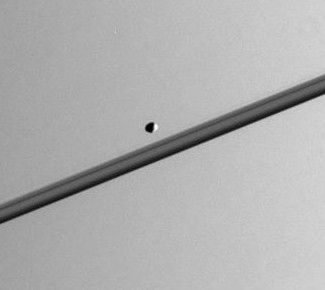
- Orbit: closely follows the F ring, interacting gravitationally
Origin and evolution
Like many small moons, Pandora likely formed during the later stages of Saturn's satellite system, either by accretion from ring material or by fragmentation of a larger body. Its surface preserves a record of impacts and interactions that have modified its shape over time.
Role in ring dynamics
Pandora acts as the outer shepherd satellite of the F ring while Prometheus serves as the inner shepherd Prometheus. Gravitational encounters between these moons and ring particles help confine and sculpt the narrow ring, producing strands, kinks, and temporary structures. Close interactions with Prometheus can lead to orbital perturbations that are of interest to dynamical studies.
Observations and significance
Pandora was observed during spacecraft missions that studied Saturn's system, notably imaged and characterized by missions such as Voyager and later by the Cassini mission. High-resolution images revealed its cratered terrain and allowed comparison with other small Saturnian satellites. Studies of Pandora and its companion shepherds provide insight into how rings and small moons coevolve.
Researchers also catalog its craters and surface features for comparative study of impact processes on low-gravity, icy bodies crater records. Pandora remains an accessible example of moon–ring interactions in the Solar System.
Related articles
Author
AlegsaOnline.com Pandora (moon of Saturn) Leandro Alegsa
URL: https://en.alegsaonline.com/art/74346