
Pallene (moon of Saturn)
Pallene is a small inner moon of Saturn, about 4 km across, discovered by the Cassini Imaging Team in 2004. It orbits between Mimas and Enceladus and supplies material to a faint local dust ring.
Overview
Pallene is one of Saturn's small inner satellites, discovered in 2004 by the Cassini Imaging Team. It orbits in the zone between the larger moons Mimas and Enceladus, and is widely described as a tiny, irregular body roughly 4 km in diameter. Its low gravity and close proximity to Saturn place it among a population of minor moons that interact dynamically with the planet's inner ring system.
Image gallery
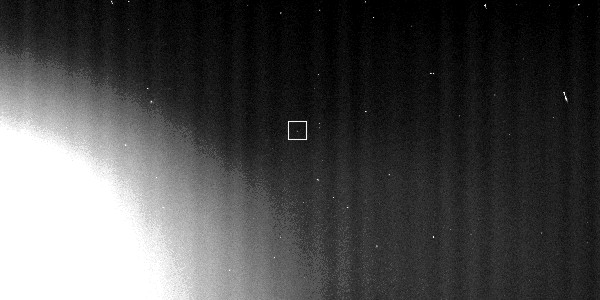
3 Images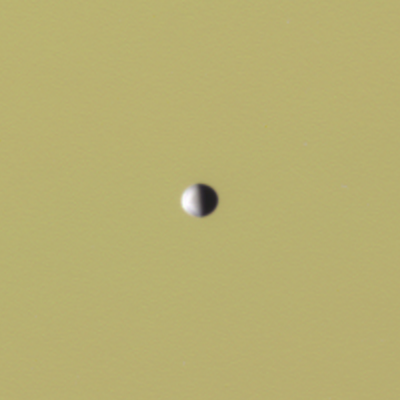

Physical characteristics
Direct imaging shows Pallene to be non-spherical and likely dominated by water ice mixed with darker material. Detailed internal structure is not resolved, but general properties inferred for very small Saturnian moons include:
- Irregular shape due to weak self-gravity.
- Surface dominated by ice with some dark contaminants, consistent with other inner moons.
- No atmosphere and very low escape velocity; dust and ejecta can readily leave the surface.
- Rotation expected to be tidally locked or nearly so, keeping one face toward Saturn.
Orbit and ring
Pallene occupies a stable orbital lane between Mimas and Enceladus, where gravitational perturbations from neighboring moons affect its motion. Micrometeoroid impacts on Pallene's surface produce ejecta that form a tenuous dust ring or ring arc around Saturn. This faint diffuse feature demonstrates how even very small moons contribute particles to the planet's ring environment.
Discovery and naming
First identified in images from the Cassini spacecraft, the object was announced in 2004 by the imaging team and later assigned the name Pallene, following conventions that draw on characters from classical mythology. Further refinements of its orbit and size come from archival and follow-up analyses; see published observational data for details.
Observations and future study
Because of its small size, Pallene is challenging to observe from Earth; most reliable information has come from spacecraft imaging and photometry. Continued analysis of Cassini data and potential future missions could improve knowledge of its surface properties, the particle population of its associated ring, and interactions with nearby satellites.
Scientific importance
Despite its diminutive size, Pallene provides a useful case for studying surface erosion, ejecta dynamics, and ring–moon exchanges in the Saturn system. Investigations of Pallene help scientists test models of how micrometeoroid bombardment, tidal forces, and neighbor perturbations shape small bodies and contribute to planetary rings.
Related articles
Author
AlegsaOnline.com Pallene (moon of Saturn) Leandro Alegsa
URL: https://en.alegsaonline.com/art/74201