
Pacific Northwest (Cascadia): geography, history, ecology, and culture
Northwestern region of North America spanning British Columbia, Washington, Oregon and nearby areas — known for temperate rainforests, mountain ranges, Indigenous nations, ports, and diverse economies.
Overview
The Pacific Northwest, often called Cascadia in cultural and environmental contexts, is the coastal and inland region of northwestern North America. It straddles the border between the United States and Canada and is commonly identified by its shared climate, ecosystems and historical ties to maritime trade and resource industries. The name Cascadia can imply a bioregion, a political-cultural idea, or simply an informal geographic label.
Image gallery
10 Images


Geography and climate
The region includes the U.S. states of Washington, Oregon, parts of Idaho and western Montana, the Canadian province of British Columbia, and parts of southeastern Alaska. To the west it is bordered by the Pacific Ocean. The interaction between moist Pacific air and mountain ranges creates a variety of climates — from temperate rainforests along the coast and wet western slopes to drier interior basins.
Mountains, rivers and landscapes
Prominent ranges include the Coast Mountains and the volcanic Cascade Range, which in northern Washington is commonly called the North Cascades and extends into southern British Columbia as the Canadian Cascades. Steep relief, glaciers and heavy precipitation feed numerous rivers and estuaries. These waterways historically supported prolific runs of anadromous fish such as salmon, and they remain central to ecology and local livelihoods.
Human history and settlement
Indigenous peoples have inhabited the region for millennia and developed rich, place-based cultures tied to salmon, cedar and coastal resources; many nations continue to assert cultural, legal and territorial rights today. European exploration and commercial entry began in the 18th century, followed by the fur trade, missionary activity and later overland exploration such as the Lewis and Clark expedition. Urban growth and settlement accelerated in the 19th and 20th centuries, producing major metropolitan centers.
Cities, economy and modern importance
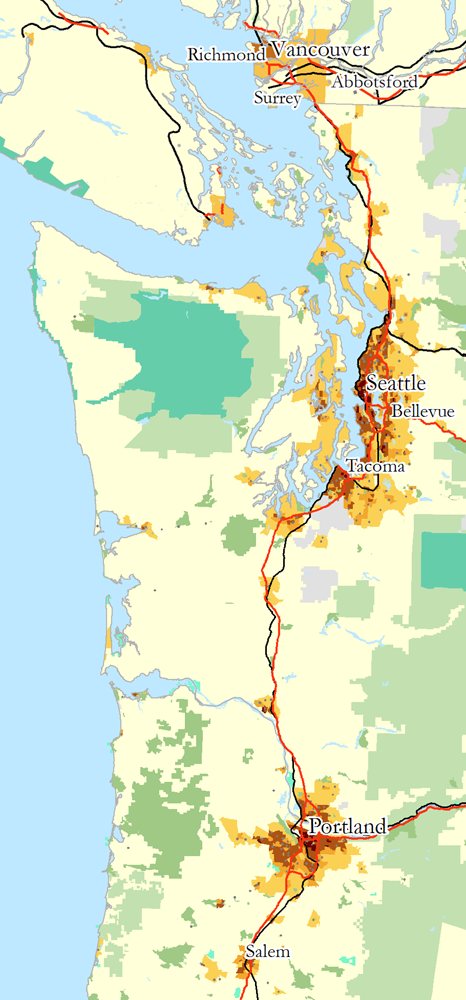
Major cities include Vancouver, Seattle and Portland, which anchor regional trade, technology, education and culture. The modern economy blends technology and services with traditional sectors such as forestry, fishing, agriculture, shipping and hydropower. Hydroelectric development and dams altered river systems and fisheries, prompting long-standing debates about restoration and sustainable management.
Culture, languages and biodiversity
English is the dominant language across Canada and the United States portions of the region, but the area remains linguistically diverse. Historically, trade languages such as the Chinook Jargon facilitated communication among Indigenous peoples, European settlers and newcomers. Significant immigrant communities, including speakers of Chinese languages and many others, contribute to urban cultural life. Ecologically, the Pacific Northwest contains distinctive temperate rainforests, rich marine ecosystems and high biodiversity, making conservation and Indigenous stewardship central issues.
Distinctive notes and resources
The Pacific Northwest is frequently studied as a coherent bioregion because of its connected coastal and mountain systems, shared climate patterns and intertwined human histories. Rivers and estuaries remain focal points for restoration, while political and cultural movements sometimes use the term Cascadia to express regional identity. For readers seeking further orientation, consult regional maps, Indigenous nation resources and provincial/state information to understand the varied boundaries and definitions in use.
- Cascadia (term)
- United States (context)
- Canada (context)
- Washington
- Oregon
- Idaho
- Montana (western)
- British Columbia
- Alaska (southeast)
- Pacific Ocean
- Indigenous peoples
- Major rivers
- Vancouver
- Seattle
- Portland
- Cascade Range
- North Cascades
- Salmon (ecology)
- English (language)
- Chinook Jargon
- Chinese languages
Questions and answers
Q: What is the Pacific Northwest?
A: The Pacific Northwest, also referred to as Cascadia, is a region on the west coast of North America. It refers to the northwestern corner of the United States and the southwestern part of Canada.
Q: What states are in the southern part of Pacific Northwest?
A: The U.S. states of Washington, Oregon, Idaho and western Montana are in the southern part of the Pacific Northwest.
Q: What provinces are in northern part?
A: The Canadian province of British Columbia and the southeastern part of the U.S. state of Alaska is in the northern part.
Q: Who were some early settlers in this region?
A: Historically, Native Americans settled along the coastline and along major rivers starting from about 15,000 years ago. From 1500s to 1700s Europeans explored this region beginning with discovery of Oregon and Washington while Lewis and Clark expedition arrived in Washington State during early 1800s.
Q: What mountains make up this region?
A: The rugged mountains consist of Coast Range nearer to coast line and Cascade Range which is called North Cascades in Northern Washington or Canadian Cascades in British Columbia respectively.
Q: How does climate affect rivers here?
A: Due to wet climate caused by trapping wet air from Pacific Ocean by mountains there are many rivers resulting from it but large power dams have been built on many rivers affecting salmon runs adversely .
Q:What languages are spoken here ?
A:The main language spoken here is English both in US & Canada whereas Chinook Jargon among Native Americans & Chinese among Asian immigrants has become more common recently .
Related articles
Author
AlegsaOnline.com Pacific Northwest (Cascadia): geography, history, ecology, and culture Leandro Alegsa
URL: https://en.alegsaonline.com/art/73924
Sources
- bivouac.com : "Canadian Cascades (Cascade Mountains)"
- ccrh.org : "Columbia River"