
Out of Africa: modern human origins and global dispersal
Overview of the Out of Africa model: evidence from genetics, fossils and archaeology, timing and routes of Homo sapiens expansions, interactions with archaic humans, and outstanding questions in the field.
Out of Africa is the term used for the scientific model that anatomically modern humans (Homo sapiens) originated in Africa and later dispersed to other continents. Multiple independent lines of evidence — genetic patterns in living populations, ancient DNA, the anatomy of fossils, and archaeological remains — converge on Africa as the principal region where modern human morphology and many hallmarks of modern behaviour first appear. The model explains broad global patterns of human diversity but leaves open many details about timing, the number of dispersals, and the exact migration routes.
Image gallery
10 Images





Core lines of evidence
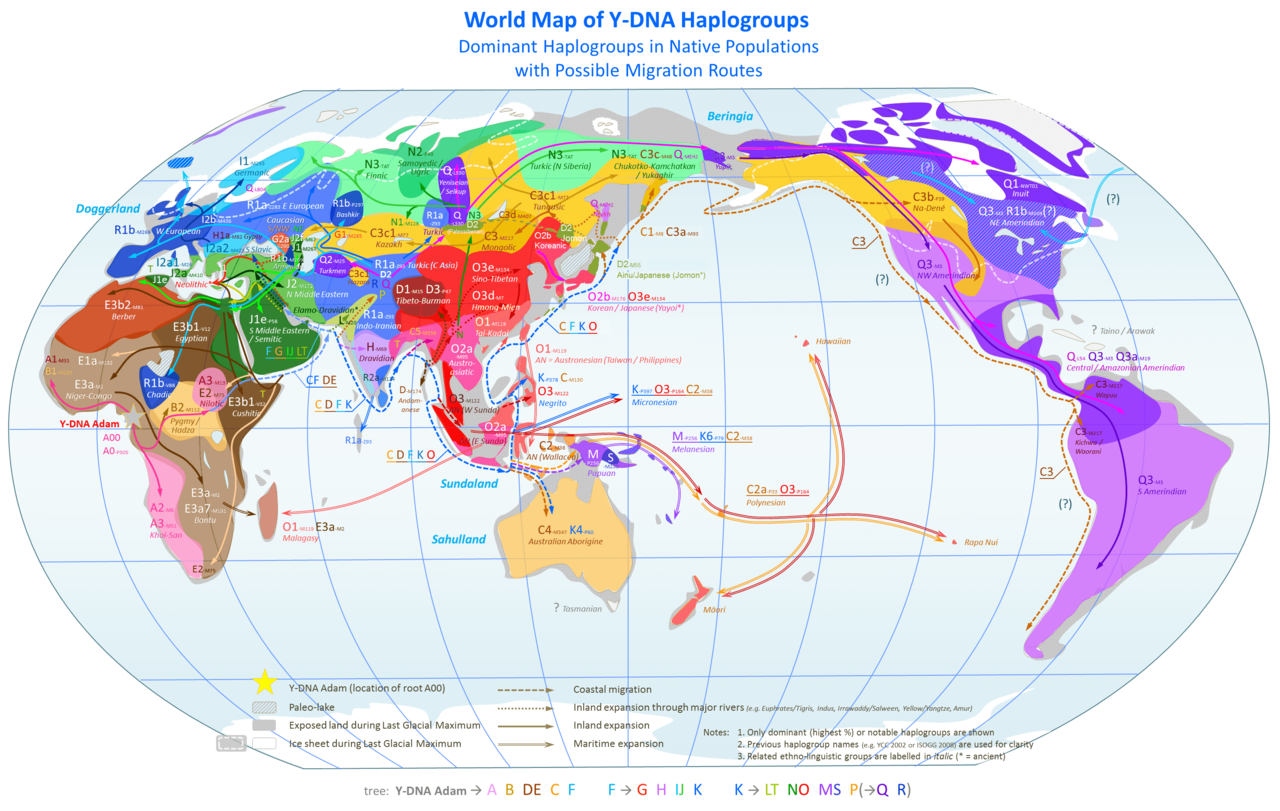
Genetic studies provide some of the clearest signals supporting an African origin. Analyses of mitochondrial DNA, Y-chromosome markers and whole nuclear genomes show greater genetic diversity within African populations than outside Africa, a pattern expected when a population has persisted in a region for a long time and some of its descendants founded new populations elsewhere. Ancient DNA recovery from fossils has directly documented genetic relationships between archaic groups and later humans, revealing episodes of interbreeding and replacement. Physical anthropology — the study of skeletal remains — shows a succession of anatomically modern specimens in Africa that precede comparable forms elsewhere.
Chronology and broad timing
Current evidence places the emergence of early anatomically modern humans in Africa roughly between about 200,000 and 130,000 years ago. From this deep African record, one or more waves of expansion took humans into Asia, Europe and beyond. Genetic and archaeological data indicate that some movement into parts of Eurasia occurred well before the most widely cited late dispersal; evidence for human presence in regions of the Near East and Arabia at intervals between about 125,000 and 90,000 years ago suggests early excursions. A major, widely referenced expansion that contributed ancestry to most present-day non‑African populations is often placed at a later date, near 60,000 years ago, though these numbers are approximate and under active revision as new data emerge.
Possible migration routes
Scholars generally consider two broad corridors out of Africa. The northern route led from North Africa into the Levant and onward into Eurasia, while a southern or coastal route involved crossing from the Horn of Africa or the southern Red Sea into Arabia and following coastal environments eastward. Both pathways likely operated at different times and under varying climatic conditions. Periods of lower sea level and wetter climates could open corridors that were closed at other times, and archaeology from the Arabian Peninsula has become an important source of evidence about these early movements.
Archaeological and fossil record
Archaeologists document human presence through stone tools, hearths, ochre and symbolic objects such as beads, which together illuminate behaviour and mobility. In Africa, a long record of varied and increasingly complex material culture parallels the anatomical sequence toward modernity. Outside Africa, layers of tools and fossil remains in the Near East, South Asia, Southeast Asia and Australasia provide snapshots of dispersal and adaptation. The arrival of Homo sapiens in Australia and the peopling of many Pacific and island systems required seafaring capabilities and represent significant achievements in navigation and adaptation.
Interactions with archaic humans
When migrating humans met established hominin populations, the outcomes were complex. Genetic analyses reveal that non‑African populations carry traces of ancestry from Neanderthals and that some populations in parts of Asia and Oceania carry additional ancestry related to Denisovans. These results indicate episodes of interbreeding, as well as periods of cultural and ecological competition that in many regions led to the disappearance of local archaic groups. The term "replacement" is sometimes used, but in many places the process appears to have included admixture, local population decline and cultural exchange.
Single dispersal versus multiple dispersals
Debate continues about whether a single major dispersal out of Africa explains all non‑African genetic diversity, or whether multiple distinct migrations at different times contributed in varying degrees. Some genetic, archaeological and climatic records support at least one successful late dispersal that left the greatest genetic legacy outside Africa, while other early dispersals may have left limited or regionally confined descendants. Increasingly detailed ancient DNA studies, combined with refined archaeological chronologies, are helping to resolve these questions.
Regional perspectives and North African evidence
Recent work has paid more attention to North Africa as a possible locus for early modern human populations that participated in expansions. The region forms a geographic bridge to southwestern Asia and Mediterranean Europe, and its archaeological and fossil record has been re-evaluated with new dating and analytical methods. The complex interaction of climatic shifts, coastal and inland habitats, and human adaptations makes the role of North Africa an important element in understanding routes and timings.
Methods and ongoing research
Research integrates genetics, archaeology, paleoclimatology and geology. Radiometric dating and stratigraphic work anchor archaeological layers in time; paleoclimate reconstructions inform which corridors were viable; and ancient DNA permits direct comparisons between ancient individuals and living populations. As methods improve and more ancient genomes and well-dated sites are analyzed, the chronology and complexity of early human dispersals continue to be refined.
Outstanding questions
Key unresolved issues include how many dispersal waves contributed to the ancestry of present populations, the relative importance of coastal versus inland routes, the demographic sizes and structures of migrating groups, and the precise nature and frequency of interactions with Neanderthals, Denisovans and other archaic humans. Researchers also work to reconcile regional archaeological sequences with genetic models, and to increase sampling in underrepresented areas such as parts of Africa, South and Southeast Asia, and the Arabian Peninsula.
Significance
The Out of Africa framework places the biological and cultural roots of living humans largely within Africa while recognizing the complexity of subsequent expansions and interactions. It helps explain patterns of genetic diversity, the distribution of fossil forms, and how Homo sapiens became a globally dominant species. At the same time, the model is dynamic: new discoveries, better dating and broader ancient DNA sampling continually refine our understanding of when, how and why early humans dispersed across the planet.
Further reading and resources
- Genetic studies of mitochondrial DNA
- Large-scale sequence analyses
- Physical anthropology and fossil assessments
- Archaic fossil records
- North Africa and early modern human evidence
- Expansion into Eurasia
- Neanderthal research
- Peopling of Europe
- Colonization of Australia
- Migration to the Americas
- Hunter-gatherer lifeways
- African origins of anatomically modern humans
- Replacement and admixture with earlier Homo
- Homo erectus and other contemporaries
Questions and answers
Q: What is Out of Africa about?
A: Out of Africa is about the recent African origin of modern humans.
Q: What evidence supports the idea that modern humans originated in Africa?
A: The idea is supported by a study of present-day mitochondrial DNA, and other sequence analysis, as well as evidence based on the physical anthropology of archaic fossil remains.
Q: How long ago did the first truly modern humans appear?
A: The first truly modern humans seem to have appeared between 200,000 and 130,000 years ago.
Q: When did Homo sapiens reach western Europe?
A: By about 42 to 44,000 years ago Homo sapiens had reached western Europe, including Britain.
Q: When did Homo sapiens arrive in Australia?
A: At roughly the same time they arrived in Australia - around 42 to 44,000 years ago.
Q: When did they arrive in the Americas? A: Their arrival in the Americas was much later - about 15,000 years ago.
Q: How long has Homo sapiens been evolving into anatomically modern humans solely in Africa? A: Genetic studies and fossil evidence show that archaic Homo sapiens evolved to anatomically modern humans solely in Africa between 200,000 and 60,000 years ago.
Related articles
Author
AlegsaOnline.com Out of Africa: modern human origins and global dispersal Leandro Alegsa
URL: https://en.alegsaonline.com/art/73638
Sources
- ncbi.nlm.nih.gov : "A geographically explicit genetic model of worldwide human-settlement history"
- doi.org : 10.1086/505436
- pubmed.ncbi.nlm.nih.gov : 16826514
- doi.org : 10.1126/science.308.5724.921g
- ui.adsabs.harvard.edu : 2003Natur.423..692S
- doi.org : 10.1038/423692a
- pubmed.ncbi.nlm.nih.gov : 12802315
- actionbioscience.org : "Origins of modern humans: multiregional or out of Africa?"
- asa3.org : "Modern Humans – Single Origin (Out of Africa) vs Multiregional"
- ui.adsabs.harvard.edu : 2011Sci...331...20B
- doi.org : 10.1126/science.331.6013.20
- pubmed.ncbi.nlm.nih.gov : 21212332
- ncbi.nlm.nih.gov : "A revised root for the human Y chromosomal phylogenetic tree: the origin of patrilineal diversity in Africa"
- doi.org : 10.1016/j.ajhg.2011.05.002