
Palm (unit of length)
The palm is a traditional anthropic unit based on the breadth of the human hand, commonly equal to about three inches (≈7.62 cm). It underlies several related measures such as digit, span and cubit.
Overview
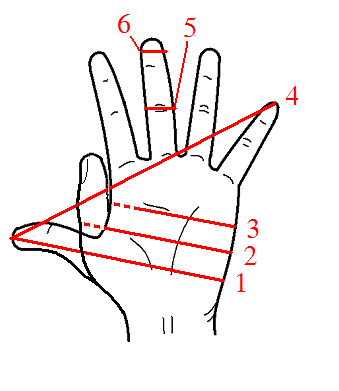
The palm is a historical unit of length derived from the width of the human palm. In many traditional systems it was taken as the span across four fingers or roughly three inches, and was used for everyday measuring before standardized tools became widespread. The name and precise value varied between cultures, but the concept—an easily judged, body-based measure—was common across Europe, the Near East and beyond.
Image gallery
5 Images



Measurements and variants
As a practical rule of thumb, the palm is often equated with three inches (international inch) or about 7.62 cm, though regional standards produced slightly different values. It was commonly described as the width of four digits (four fingers). Smaller and larger related measures were defined as simple fractions or multiples of the palm to make conversions convenient.
Relation to other anthropic units
- Digit — typically 1/4 of a palm.
- Finger — historically given as 7/24 of a palm in some schemes.
- Hand — sometimes expressed as 4/3 palms; the hand is another still-used measure for horse height; more details at hand.
- Shaftment — about 2 palms.
- Span — usually 3 palms; see span for related usage.
- Cubit — generally 6 palms; see cubit for ancient applications.
- Ell — a longer commercial unit of about 15 palms in some traditions.
History and use
Palms, like other anthropic units, arose because body parts were convenient, universally available references for measurement. Craftspeople, traders and builders used palm-based measures for textiles, small woodworking tasks and rough distance estimates. Over centuries many regions formalized these measures, producing official standards and rules for converting palms into local inches or other units. The palm gradually fell out of formal use as decimal and metric systems spread, but it remains of interest in the study of historical documents, archaeology and traditional crafts.
Notes and modern context
When converting historical measures, it is important to identify the cultural source because a "palm" in one period or place may not equal the palm in another. For quick reference the palm is often treated as equal to three inches (international inch), but any precise reconstruction requires checking local standards. General discussions of related units and their relationships can be found via resources on the international inch and on topics such as hand, span and cubit.
Related articles
Author
AlegsaOnline.com Palm (unit of length) Leandro Alegsa
URL: https://en.alegsaonline.com/art/74228