
Orphans of the Storm (1921): Griffith’s historical melodrama
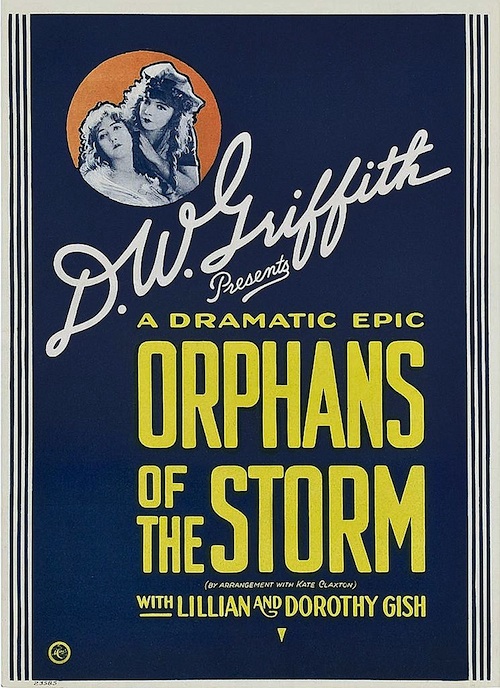
Orphans of the Storm is a 1921 silent historical melodrama directed by D. W. Griffith, starring Dorothy and Lillian Gish. It dramatizes two sisters’ trials during the French Revolution and explores class conflict.
Orphans of the Storm is a 1921 American silent film directed by D. W. Griffith. Released at the height of the silent era, it pairs sisters Dorothy Gish and Lillian Gish in a large-scale historical melodrama. The story follows two orphaned sisters, one of whom is blind, who are separated amid the disorder of the French Revolution. Their separate ordeals and eventual reunion provide the emotional core of the picture while the film stages broad tableaux of revolution, spectacle and personal danger.
Image gallery
3 Images

Overview and plot elements
The narrative centers on sibling devotion and endurance. After being torn apart by villains and events beyond their control, the sisters endure imprisonment, false accusations and daring rescues before finding each other again. The film uses melodramatic incidents common to the period—kidnapping, mistaken identity, and courtroom or prison scenes—to drive the plot, and relies on expressive acting, intertitles and carefully composed images rather than spoken dialogue.
Production, style and themes
Griffith assembled large crowd scenes and elaborate sets to recreate late 18th-century France, favoring spectacle and broad staging that were characteristic of his later career. Technically, the film employs techniques associated with Griffith—cross-cutting for tension, staged crowd movement and close-ups for emotional moments—adapted to a historical epic. Thematically, Griffith framed the Revolution as both a historical event and a warning: contemporary critics and scholars have noted that he used the past to comment on modern political upheaval and class conflict, urging sympathy across social divisions rather than celebrating mob violence. Discussions of the film often point to its critique of destructive hatred and its implied opposition to revolutionary extremes.
Cast, sources and relation to other films
- Director: D. W. Griffith
- Stars: Lillian Gish and Dorothy Gish
- Setting: the French Revolution
- Source and remake: adapted from stage pieces and earlier films; it is often described as a remake of the 1915 film The Two Orphans
- Central concerns: class tensions, family bonds, injustice
Reception, legacy and notable facts
At the time of release, the film drew attention for its length, production values and the Gish sisters’ performances. It is frequently cited as among Griffith’s last commercially significant features and was the final film to pair the Gish sisters under his direction. Contemporary reaction combined praise for spectacle with some criticism of its political overtones and melodramatic excess. Unlike the earlier 1915 version starring Theda Bara, which is largely lost, Orphans of the Storm survives in archives and has been the subject of restoration efforts and scholarly study.
Why the film matters
The picture remains of interest to historians of silent cinema for its mixture of personal melodrama and historical pageantry, and for the way Griffith used history to comment on his own times. As an example of early 20th-century filmmaking it illustrates how directors balanced spectacle and sentiment, and how popular entertainment could be shaped to address political anxieties. For students of performance, the Gish sisters’ work shows how silent-era actors conveyed complex relationships without audible speech. For those studying film history, the film is a window into debates about class, revolution and cinematic representation during a turbulent period of world politics.
Related articles
Author
AlegsaOnline.com Orphans of the Storm (1921): Griffith’s historical melodrama Leandro Alegsa
URL: https://en.alegsaonline.com/art/73241