
Orientability in topology and geometry
Orientability describes whether a surface or manifold admits a consistent choice of 'direction' (orientation). It distinguishes orientable shapes from non‑orientable ones like the Möbius strip.
Overview
Orientability is a fundamental concept in topology and geometry that captures whether a surface or higher‑dimensional manifold admits a consistent sense of "side" or direction. Informally, a surface is orientable when it is impossible to move a figure around the surface and return it as its own mirror image. The notion generalizes to n‑dimensional manifolds and has practical consequences in areas ranging from differential geometry to physics.


Image gallery
5 Images

Characteristics and formal criteria
Formally, a manifold is orientable if it admits a continuous, nowhere‑vanishing choice of orientation for each tangent space. In more concrete terms this can be tested in several equivalent ways:
- By checking whether an atlas of coordinate charts has transition maps with positive Jacobian determinants everywhere.
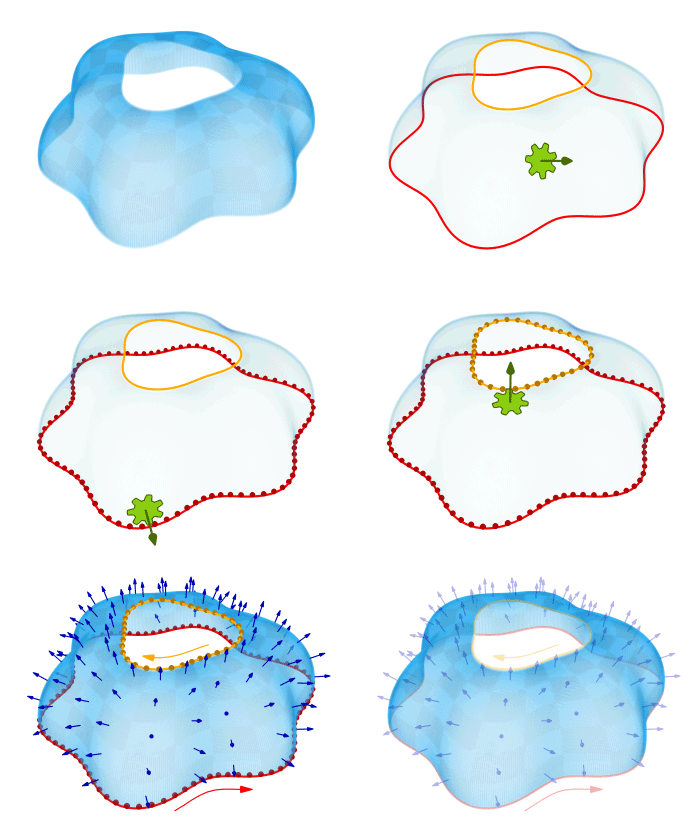
- By attempting to choose a continuous normal vector field on a surface; if such a normal exists globally the surface is orientable.
- Topologically, by seeing whether a loop reverses orientation when transporting a local basis around it.
These criteria are used in both elementary geometry and in advanced settings like differential forms, where orientability determines whether one can define integrals of top‑degree forms without ambiguity.
Examples, contrasts, and chirality
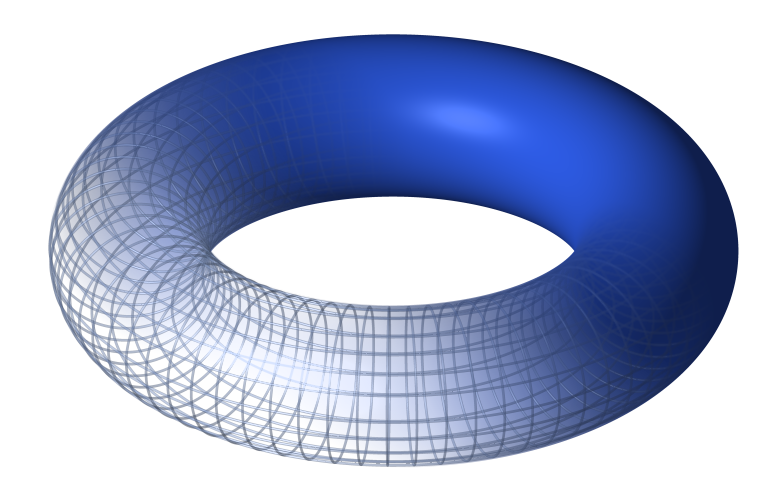
Simple examples clarify the distinction. The plane, the sphere and the torus are orientable: a small arrow or a labeled figure can travel anywhere and return unchanged. In contrast, the Möbius strip and the Klein bottle are classical non‑orientable surfaces: transporting a small oriented patch around certain loops produces its mirror. Related but distinct is the notion of chirality in objects: a human right hand and left hand are mirror images and cannot be rotated into each other, so they are chiral rather than orientation‑reversible.
Understanding orientability matters in practice. In physics, orientation affects sign conventions for fields and integrals (for example, flux and handedness). In computer graphics and mesh processing, consistent face orientation is needed for correct normal calculations and rendering. In topology, orientability is an invariant that helps classify surfaces and manifolds.
Historically, the distinction between orientable and non‑orientable surfaces drew attention in the 19th century as mathematicians such as Möbius and Listing studied surfaces with surprising properties. Today orientability remains a standard concept in undergraduate courses and a tool across mathematics and science for deciding when a global "direction" or volume element can be chosen consistently.
Related articles
Author
AlegsaOnline.com Orientability in topology and geometry Leandro Alegsa
URL: https://en.alegsaonline.com/art/73124