
Auger electron spectroscopy: surface-sensitive elemental analysis
Auger electron spectroscopy (AES) is a surface-sensitive analytical technique that identifies elements and probes their chemical environment by measuring energies of emitted Auger electrons.
Auger electron spectroscopy (AES) is an analytical method used to determine the elemental composition and near-surface chemistry of solids. It is highly surface-sensitive because the emitted Auger electrons originate from the top few atomic layers of a material. AES is routinely applied in materials science, thin-film analysis, semiconductor fabrication, corrosion studies, and surface contamination investigations.
Image gallery
3 Images

Basic principle
AES relies on the Auger effect: when an inner-shell electron is removed from an atom, a higher-energy electron drops into the vacancy and the excess energy can be transferred to a third electron. That third electron is emitted with a well-defined kinetic energy characteristic of the element and the electronic states involved. In AES the vacancy is most often created by an incident energetic electron beam; the emitted electrons are then energy-analyzed to produce an Auger spectrum. The positions of peaks identify elements, while their shapes and small energy shifts can reflect chemical bonding and local environment.
Typical instrumentation and measurement
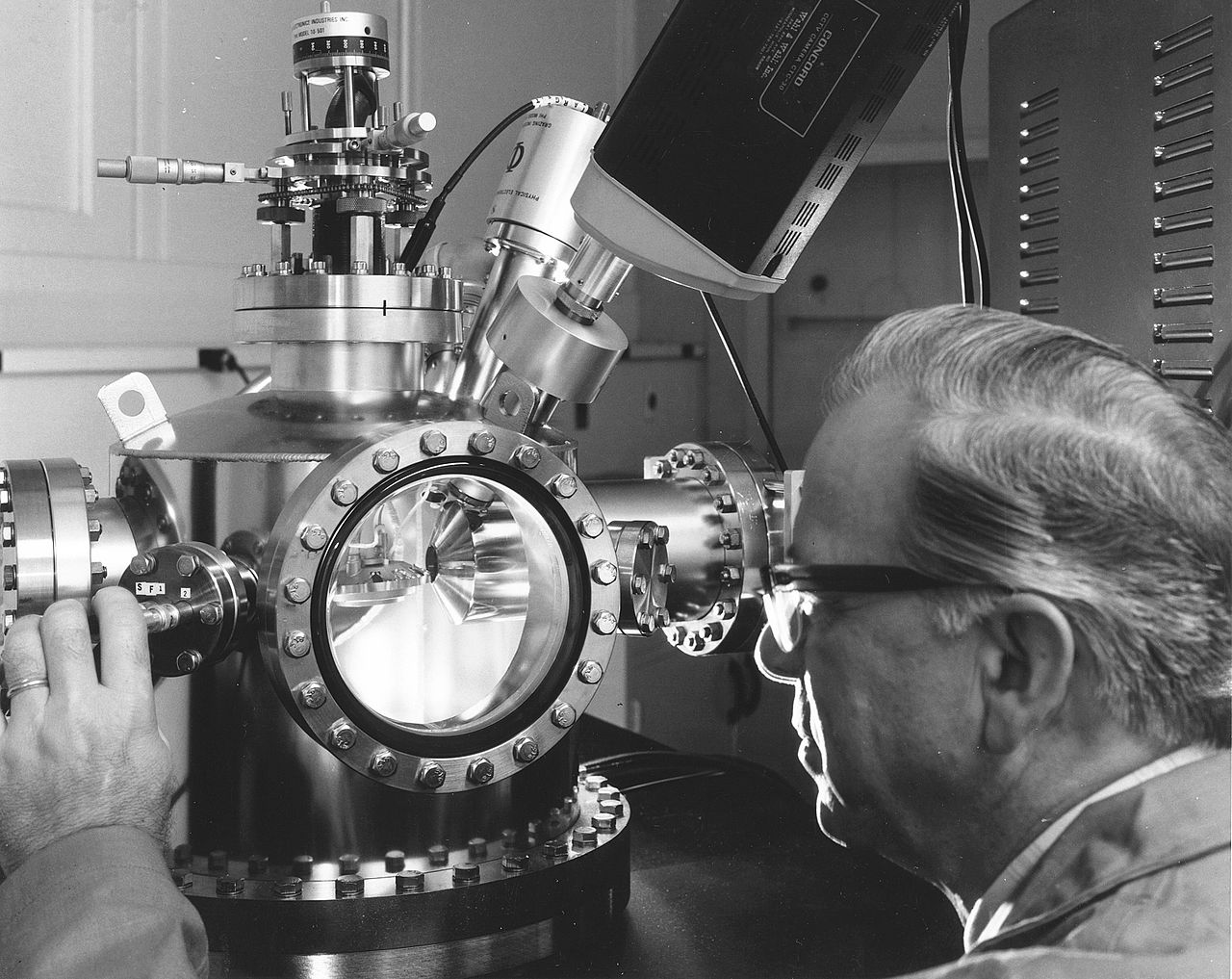
An AES instrument combines a focused primary electron beam, an electron energy analyzer, and an ultrahigh-vacuum analysis chamber. The primary beam removes core electrons and stimulates Auger emission. The energy analyzer collects the emitted electrons and records intensity as a function of kinetic energy, producing peaks corresponding to specific transitions. Because Auger electrons have low kinetic energies, only electrons from the outermost atomic layers escape without energy loss, making AES a surface-specific probe.
What AES reveals and how it is used
- Elemental identification: characteristic peak energies indicate which elements are present at the surface.
- Surface chemistry: variations in peak intensities and small energy shifts give clues about chemical state and bonding.
- Depth profiling: combining AES with controlled ion sputtering reveals composition versus depth through layered structures.
- Imaging: scanning the electron beam across a sample can map elemental distributions with micrometer-scale resolution.
Strengths, limitations and practical notes
AES offers excellent surface sensitivity and spatial resolution for conductive and semiconducting samples. It is less effective for insulating materials unless charge compensation is used, and vacuum and beam-induced damage can be constraints. Chemical-state information is generally subtler than in techniques that measure binding energies directly, so AES is often used alongside complementary methods such as X-ray photoelectron spectroscopy. For an introduction to the electron processes involved see electron transitions and Auger emission, and for instrumentation overviews consult surface analysis resources.
Historical and comparative context
The Auger effect is named after the physicist who investigated and popularized the phenomenon in the early 20th century. Over subsequent decades AES became a practical analytical tool as vacuum technology and electron optics improved. Compared with other surface-sensitive techniques, AES is notable for using an electron beam to create the initial vacancy rather than X-rays and for providing high lateral spatial resolution; readers can compare methods in introductory surveys of surface analysis available at further reading.
Related articles
Author
AlegsaOnline.com Auger electron spectroscopy: surface-sensitive elemental analysis Leandro Alegsa
URL: https://en.alegsaonline.com/art/7279