
Occipital lobe
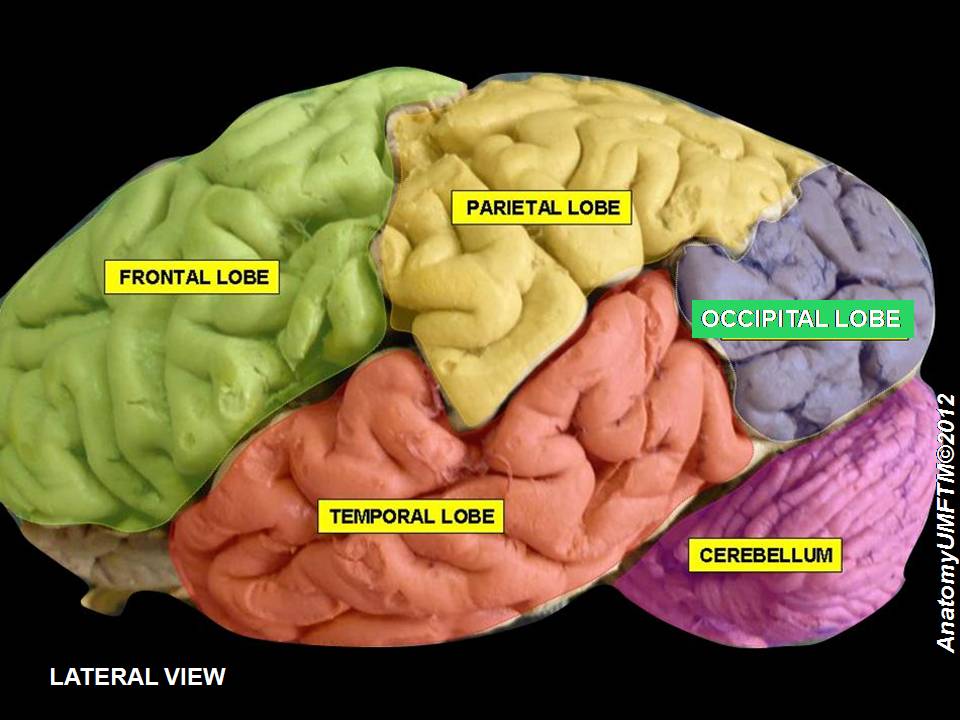
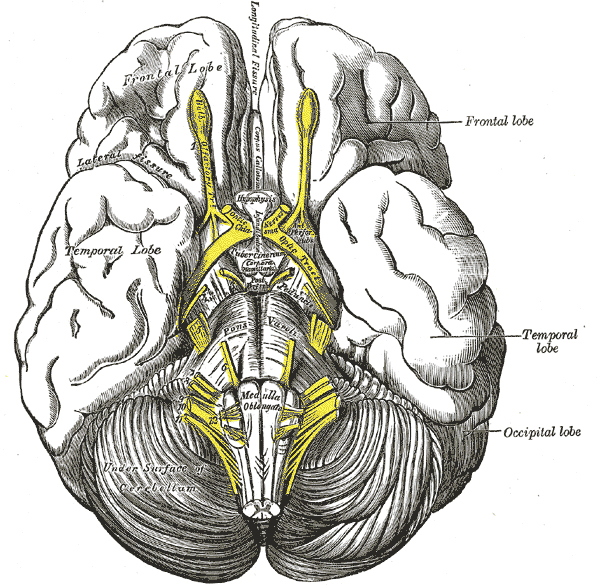
The occipital lobe is the posterior region of the cerebral cortex that primarily processes visual information, containing the primary visual cortex and several visual association areas.
Overview
The occipital lobe is the rear portion of the cerebral hemisphere found in vertebrates, most prominent in primates. It forms the main visual processing center of the mammal brain and contains much of the anatomical region commonly called the visual cortex. Its principal role is to receive, interpret and organize information originating from the eyes.
Image gallery
7 Images




Structure and organization
Anatomically the occipital lobe includes the primary visual cortex (often called V1 or the striate cortex) and multiple surrounding visual association areas (V2, V3, V4, V5/MT and others). Neurons in these regions are arranged in maps that reflect the spatial layout of the retina, a property known as retinotopy. Major input arrives via the lateral geniculate nucleus of the thalamus and is then processed through successive cortical stages.
Functions and pathways
Processing in the occipital lobe supports many visual abilities. Early stages detect basic features such as edges, orientation and contrast. Later association areas analyze color, motion, depth and complex form. Two widely described functional streams arise from occipital cortex:
- Dorsal stream (toward parietal cortex): spatial processing and motion — the "where/how" pathway.
- Ventral stream (toward temporal cortex): object recognition and color — the "what" pathway.
Development and evolution
The occipital lobe develops postnatally in many mammals, with organization shaped by genetic programs and visual experience. Across vertebrates and especially in primates the visual cortex shows expansion and specialization that support high-acuity vision, binocular stereopsis and complex pattern recognition.
Clinical relevance
Damage to occipital regions can produce a range of visual deficits. Common consequences include partial or complete cortical blindness, loss of specific parts of the visual field (hemianopia), and disorders of visual recognition such as agnosia. Lesions limited to association areas may impair color perception, motion detection or face and object recognition while leaving basic sight intact.
Notable facts and distinctions
Although the occipital lobe is primarily visual, it interacts extensively with other cortical areas: visual information is combined with attention, memory and motor planning systems. The term "visual cortex" is sometimes used interchangeably with occipital cortex, but strictly speaking visual cortex denotes the set of cortical areas specialized for visual processing, which extend beyond the occipital lobe in some species.
Related articles
Author
AlegsaOnline.com Occipital lobe Leandro Alegsa
URL: https://en.alegsaonline.com/art/71820
Sources
- sparknotes.com : "SparkNotes: Brain Anatomy: Parietal and Occipital Lobes" · web.archive.org