
Nuclear force: the interaction that binds atomic nuclei
The nuclear force is the short-range interaction that holds protons and neutrons together inside atomic nuclei. It is a residual effect of the strong interaction and underpins nuclear stability, fission, and fusion.
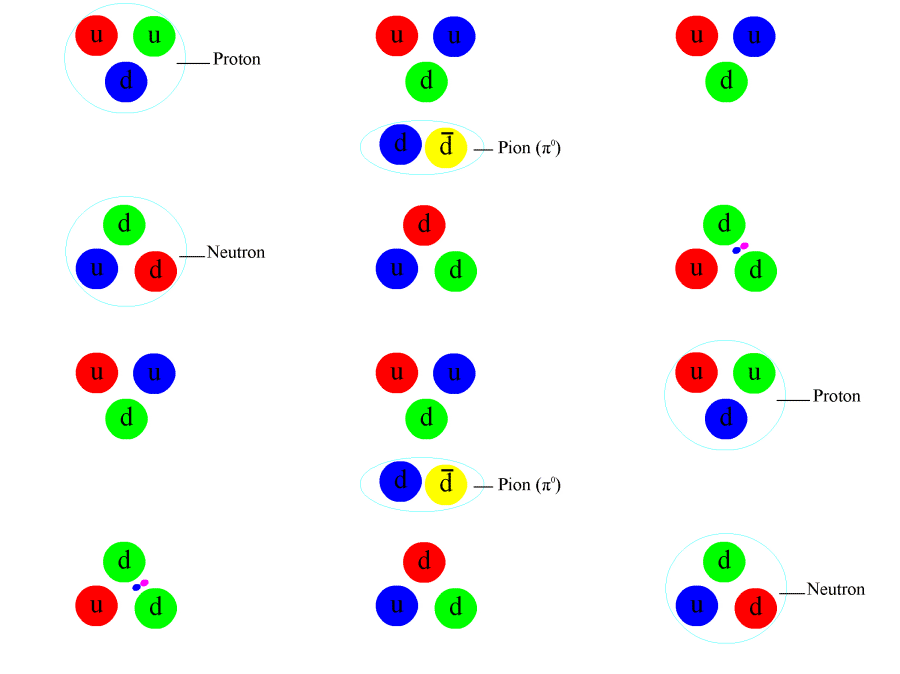
The nuclear force is the interaction responsible for holding together the constituents of atomic nuclei. It acts between nucleons—protons and neutrons—and overcomes the electromagnetic repulsion between positively charged protons so that nuclei can exist as bound systems. Although often called the strong nuclear force in everyday usage, the term can refer either to the residual force between whole nucleons or to the underlying fundamental strong interaction that binds quarks inside protons and neutrons.
Image gallery
4 Images


Key characteristics
- Range: The nuclear force is extremely short-range, becoming negligible beyond a few femtometers (10^-15 m).
- Strength: It is far stronger than the electromagnetic force at very short distances, which is why it can hold protons together despite their electric repulsion.
- Behaviour: Generally attractive at typical nucleon separations but strongly repulsive at very short distances, giving nuclei a finite size and preventing collapse.
- Dependence: The force depends on spin, isospin and the relative arrangement of nucleons, producing effects such as pairing and the saturation of binding energy.
At a more fundamental level the nuclear force is understood as a residual effect of the strong interaction described by quantum chromodynamics (QCD). Historically, Hideki Yukawa proposed that exchange of particles (mesons) could explain the force between nucleons; pions were later observed and used in phenomenological models that reproduce many features of nucleon interactions.
History and theoretical development
The concept of a nuclear force emerged in the early 20th century to explain why atomic nuclei remained intact despite electrostatic repulsion. In the 1930s Yukawa suggested a particle-mediated force, and subsequent experiments discovered particles consistent with that idea. From the 1960s onward, developments in particle physics and QCD reframed the nuclear force as a residual interaction arising from quark and gluon dynamics inside nucleons. Modern nuclear physics combines effective models, meson-exchange potentials and ab initio methods to predict nuclear properties.
Practical consequences of the nuclear force include the binding energies that determine which isotopes are stable, the processes of nuclear fission and fusion that release large amounts of energy, and the behavior of matter in extreme environments such as neutron stars. Nuclear reactors and weapons exploit controlled or uncontrolled fission chains; stars generate energy by fusing light nuclei in their cores.
For further basic definitions and related topics see nucleons, protons, neutrons, and how they form atoms. For a discussion of processes that break or rearrange nuclear bonds see nuclear fission.
Related articles
Author
AlegsaOnline.com Nuclear force: the interaction that binds atomic nuclei Leandro Alegsa
URL: https://en.alegsaonline.com/art/71358