
Nucleosynthesis: formation and origins of the chemical elements
Nucleosynthesis is the set of astrophysical processes that create atomic nuclei from lighter particles. Covers Big Bang, stellar, explosive, and neutron-capture pathways and their role in cosmic element abundances.
Overview
Nucleosynthesis denotes the physical processes that produce atomic nuclei heavier than hydrogen and helium. These processes transform lighter particles—protons, neutrons and small nuclei—into heavier nuclei through nuclear reactions. Nucleosynthesis takes place in several astrophysical environments and at different epochs, from the first minutes after the Big Bang to ongoing processes in stars and explosive events.
Image gallery
1 Image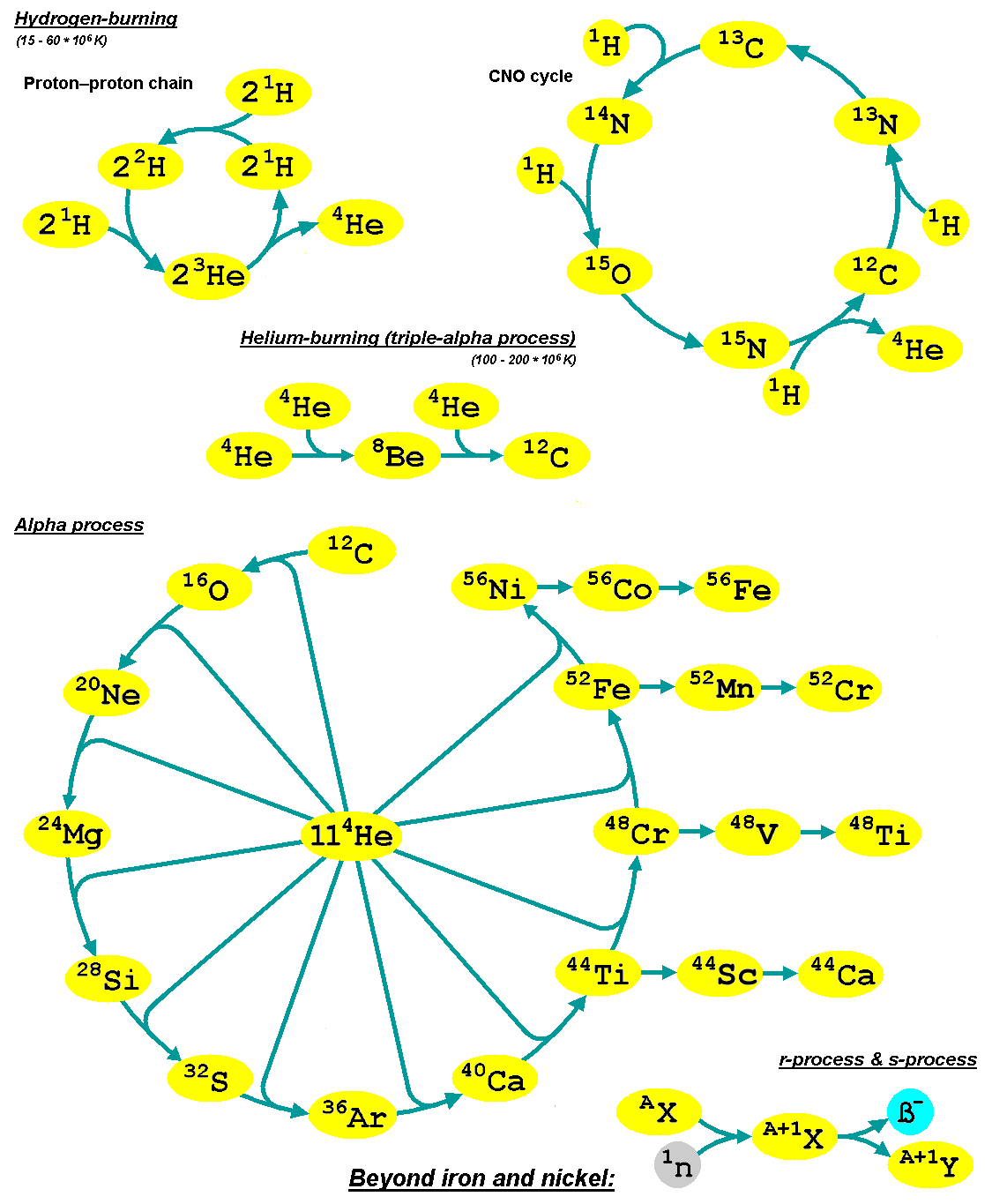
Primary processes
Several distinct mechanisms are responsible for building the elements found in the universe. Key processes include:
- Big Bang nucleosynthesis — formation of the lightest nuclei (mainly hydrogen, helium, and trace lithium) in the first minutes after the Universe began.
- Stellar fusion — sequential fusion of hydrogen to helium and of heavier fuels in stellar cores and shells, producing carbon, oxygen and elements up to iron in massive stars.
- Neutron-capture processes — slow (s-process) and rapid (r-process) capture of neutrons on seed nuclei, creating many of the elements heavier than iron.
- Explosive nucleosynthesis — production of new nuclei during supernovae, novae, and kilonovae where high temperatures and densities alter nuclear reaction pathways.
Sites and chronology
Chronologically, nucleosynthesis began with the Big Bang and continued inside stars over billions of years. Low- and intermediate-mass stars contribute s-process elements during asymptotic giant branch phases. Core-collapse supernovae and neutron-star mergers are primary candidates for r-process synthesis of the heaviest elements. Cosmic-ray spallation also creates some light nuclei such as lithium, beryllium and boron.
Importance and observational evidence
Nucleosynthesis explains the observed elemental abundances in stars, interstellar gas and the Solar System. Measurements of primordial helium and deuterium constrain cosmological models. Spectroscopy of stellar atmospheres, meteoritic composition, and transient electromagnetic signals from explosive events provide empirical tests of nucleosynthetic predictions.
Notable distinctions and further reading
Important distinctions include fusion-driven synthesis up to the iron peak—limited by nuclear binding energy—and neutron-capture pathways that produce the heaviest stable and long-lived isotopes. Different astrophysical sites yield distinctive abundance patterns used to trace stellar evolution and galactic chemical enrichment. For introductions and reviews see general overview, detailed discussions of stellar processes at stellar nucleosynthesis resources, Big Bang constraints at cosmology references, and observational data compilations at abundance databases.
Related articles
Author
AlegsaOnline.com Nucleosynthesis: formation and origins of the chemical elements Leandro Alegsa
URL: https://en.alegsaonline.com/art/71388