
NOT gate (Inverter): definition, function, implementations and uses
A NOT gate (inverter) is the fundamental logic element that outputs the opposite of its single input. Article covers definition, symbols, physical implementations, typical uses and notable variants.
A NOT gate, commonly called an inverter, is a basic digital logic element that produces the logical complement of its single input. If the input is interpreted as logical ‘‘1’’ (true, high voltage), the output is logical ‘‘0’’ (false, low voltage), and vice versa. In Boolean algebra the operation is written as Y = ¬A, Y = A', or Y = NOT A. The inverter is the simplest form of logic gate and is widely used as a building block in larger digital circuits.
Image gallery
3 Images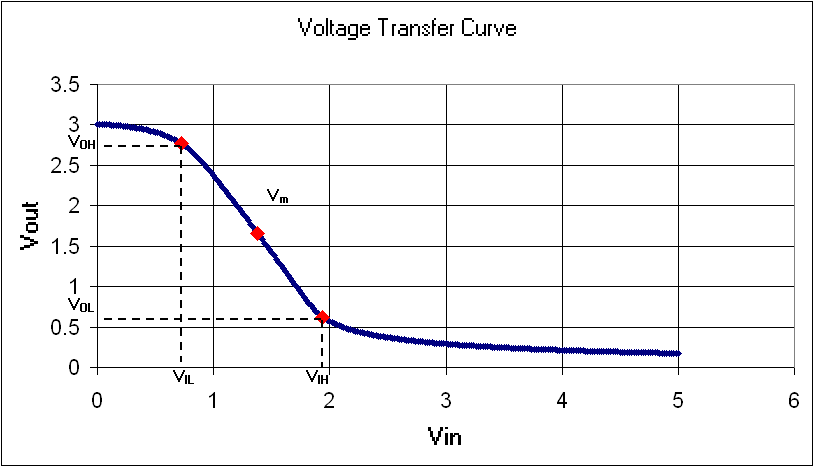
Characteristics and symbols
The inverter has one input and one output. Its behavior is usually represented by a small circle (bubble) on the output of a buffer symbol or by the standard triangle-with-bubble symbol found in logic diagrams. The truth table is:
- Input 0 → Output 1
- Input 1 → Output 0
Important electrical characteristics of a practical inverter include propagation delay (time between input change and output change), input threshold voltage, noise margins, output drive (fan-out) and power consumption. Designers often contrast an inverter with a non-inverting buffer, which preserves the input value rather than reversing it.
Physical implementations and history
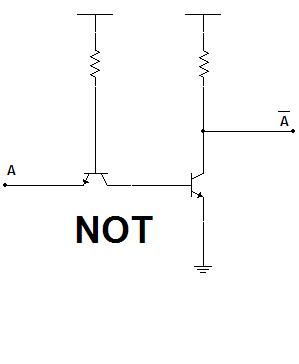
Early digital inverters were implemented with vacuum tubes and then with discrete transistors and passive components. Throughout the 20th century a common approach was a single-transistor stage plus resistors. Later, integrated circuits allowed many inverters to be packaged together; families such as TTL and CMOS provided standard inverter cells. Modern CMOS inverters use a complementary pair of MOSFETs (one p-channel, one n-channel) and are energy-efficient because static current is small when inputs are steady. For historical and technical context see discussions of the transistor and integrated circuits, and of logic primitives such as the logic gate.
Uses, examples and importance
Inverters serve many roles: they implement logical negation in computations, generate complementary control signals (for example active-low resets), form stages in oscillators (a ring oscillator formed from an odd number of inverters), and combine into more complex gates. Because NAND and NOR gates are functionally complete, inverters are implicit in constructing arbitrary logic functions. In analog and mixed-signal contexts, an inverter can act as a simple signal amplifier or threshold detector when sized appropriately.
Variants and practical notes
Common variants include the Schmitt-trigger inverter, which adds hysteresis to clean noisy inputs, and buffered inverters with greater output drive. When choosing or designing inverters engineers consider speed, power, loading (fan-out), and voltage levels. In digital design, inverters are often used redundantly to correct phase or to meet timing constraints, and their simple behavior makes them fundamental to synchronous and asynchronous circuits alike.
Notable fact: despite its conceptual simplicity, the inverter's electrical implementation determines much of a digital system's speed and power profile, so it remains a central element in semiconductor design and education.
Related articles
Author
AlegsaOnline.com NOT gate (Inverter): definition, function, implementations and uses Leandro Alegsa
URL: https://en.alegsaonline.com/art/71151