
Northern California: geography, cities, history and economy
An overview of Northern California covering its landscape, major cities and regions, historical development, economic roles, and cultural and environmental distinctions.
Overview
Northern California refers to the northern portion of the U.S. state of California. Exact boundaries vary by context, but the term commonly includes the San Francisco Bay Area, the state capital Sacramento, the northern coastal counties, the Sierra Nevada foothills and portions of the Central Valley. The region is home to roughly ten million people and combines dense urban centers with vast rural and wild landscapes.
Image gallery
2 Images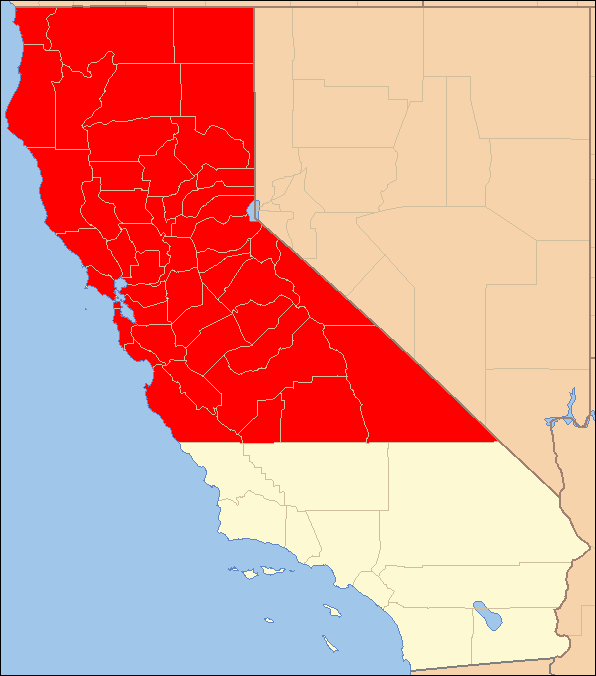

Geography and natural features
Northern California contains a wide range of environments: foggy Pacific coastline, redwood forests, the agricultural valleys of the Sacramento region, and the high mountains of the Sierra Nevada. Prominent natural landmarks include the coastal redwoods, Lake Tahoe, and the volcanic and glacial terrain of the northern Sierra. Climate varies from cool maritime to hot inland summers and snowy mountain winters.
Major subregions and cities
- San Francisco Bay Area – the dense metropolitan and economic hub surrounding San Francisco and including Oakland and San Jose.
- Sacramento Valley – the political center and a major agricultural area.
- North Coast and Cascade foothills – timberlands, fisheries and tourism along rugged coastline.
- Sierra Nevada – mountain communities, recreation, and watershed areas.
History and development
The region has been inhabited for millennia by diverse Indigenous peoples. European contact began in the 18th century with Spanish missions and later Mexican rule; the mid-19th century Gold Rush triggered rapid migration, city founding, and economic transformation. Railroads and later highways linked the coast and interior, shaping settlement and growth.
Economy, culture and importance
Today Northern California is economically diverse: technology and innovation in and around the Bay Area, government and services in Sacramento, large-scale agriculture in the valley, and tourism tied to natural and cultural attractions. The area is influential in politics, industry, higher education and environmental conservation, and it plays a central role in statewide transportation and water systems.
Notable distinctions
In contrast to Southern California, Northern California is often associated with cooler coastal climates, a concentration of high-technology firms, and a more varied topography that includes major mountain ranges and large tracts of forested land. Conservation of old-growth forests, wildfire management and water resources are recurring regional concerns.
Related articles
Author
AlegsaOnline.com Northern California: geography, cities, history and economy Leandro Alegsa
URL: https://en.alegsaonline.com/art/71008