
Nintendo e-Reader
A Game Boy Advance add-on that read data-encoded paper cards to unlock games, levels, items and minigames. Launched in 2001–2002, it had broader support in Japan than in North America.
Overview
The Nintendo e-Reader is a cartridge-shaped accessory for the Game Boy Advance family of handhelds. It was created to read specially printed paper "e-Reader cards" that carried encoded data. The device was released in Japan in December 2001 and later in North America in September 2002. It represents an early experiment in distributing small amounts of game content using a physical collectible medium instead of a traditional ROM cartridge.
Image gallery
4 Images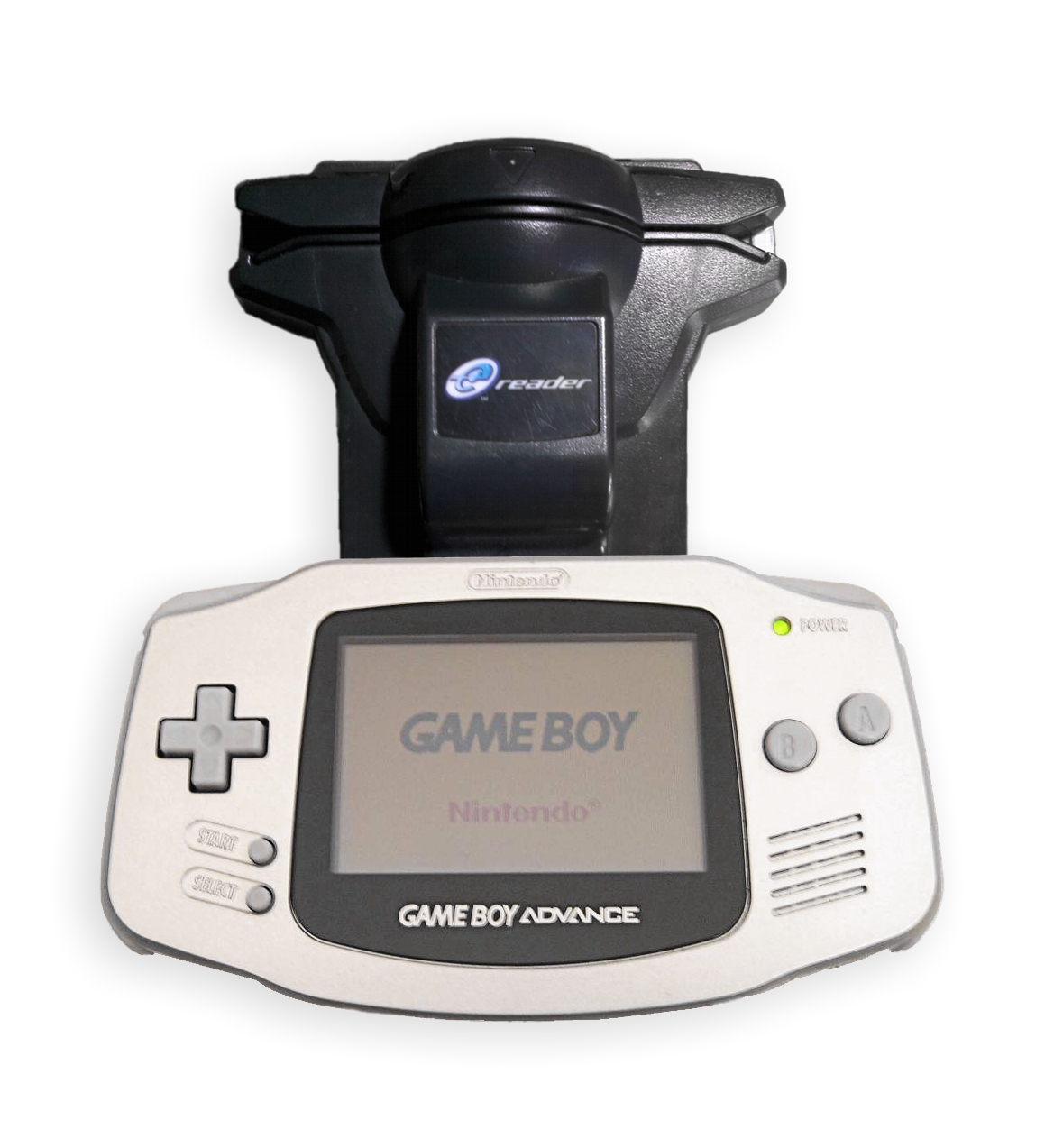


Hardware and operation
The e-Reader plugs into the GBA cartridge slot and provides an optical strip reader on its side where users swipe a paper card. Each card holds a long printed pattern of tiny marks that encode binary data. When a card is swiped, the e-Reader decodes the marks and transfers the resulting data into the host console's memory. Single cards could provide small items, patterns or minigames; multiple cards could be swiped in sequence to combine data and assemble larger payloads. Some combinations allowed users to reconstruct entire small games or expanded levels by sequentially loading segments from several cards.
Card types and content
- Ports and re-releases of classic formats such as NES titles and simplified retro games.
- Additional levels, power-ups and modifications for licensed GBA titles, notably bonus content for Super Mario Advance 4: Super Mario Bros. 3.
- Cosmetic items, design patterns and event data for life-simulation games such as Animal Crossing.
- Trainer data, new opponent encounters and other supplemental content tied to Pokémon cartridges, usable during link play.
- Standalone minigames and short experiences, including titles associated with party franchises like Mario Party and other simple interactive pieces.
- Recreations of simple handheld formats such as Game & Watch style games.
Use and compatibility
Many e-Reader cards were designed to work with particular GBA games, where swiping a card while the target game was running could inject content or unlock features. Other cards contained self-contained minigames that ran directly from RAM until the system was powered off. Users sometimes needed to swipe several cards in order and with precise timing to assemble larger items; this multi-swipe process was a distinguishing characteristic but also seen by some as a usability hurdle. The e-Reader required the original cartridge to remain in the slot for compatibility with some titles and would not expand the base hardware beyond the data it could temporarily load into system memory.
Regional releases and reception
The e-Reader saw a broader and more sustained release program in Japan, where a larger variety of cards were produced and marketed. In North America and other regions, fewer card sets were localized and availability was more limited. While some collectors and fans embraced the novelty and the collectible aspect of the cards, commercial adoption outside Japan was modest, and production for certain regions ended after a relatively short period.
Limitations and criticisms
Contemporaneous responses often highlighted both the innovation and the practical drawbacks of the system. Benefits included low-cost physical distribution and the ability to release bite-sized content; drawbacks included a limited catalog in some regions, the inconvenience of multiple swipes to assemble larger content, and the temporary nature of some loaded data. The approach also arrived during a period of rapid change in handheld gaming, as alternative distribution methods began to emerge.
Collector interest and preservation
Because many cards were region-exclusive and some were produced in limited runs, the e-Reader and its cards became an object of interest for collectors and preservationists. Enthusiast communities have documented card lists, swipe sequences and methods to archive card data. Efforts to preserve and emulate the content aim to record the formats and make the historic material accessible for study, while also noting legal and technical complexities tied to copyrighted games and proprietary formats.
Legacy
Although the accessory had limited commercial impact outside Japan, the e-Reader is notable as an early example of blending physical collectibles with unlockable digital content. It anticipated later ideas about distributed downloadable extras and micro-distribution of content, and it remains a topic of interest among historians of gaming distribution, retro collectors and fans of the GBA era. For related topics and further reading, consult pages about Nintendo, the Game Boy Advance platform, classic NES re-releases and specific games that used e-Reader content such as Super Mario Advance 4 and entries in the Pokémon series.
Further notes
The e-Reader is often referenced when discussing physical media that carried encoded digital information and when tracing the evolution of content delivery on handheld consoles. It remains a useful case study in product design, regional marketing and the trade-offs involved in novel distribution media. Additional background material can be found in gaming histories, collector databases and community documentation that track card catalogs and technical specifications for the device and its media.
Related resources: minigame examples, party game cards, retro handheld formats.
Related articles
Author
AlegsaOnline.com Nintendo e-Reader Leandro Alegsa
URL: https://en.alegsaonline.com/art/70296