
Atlas (moon) — Saturn's small ring‑edge satellite
Atlas is a small irregular moon of Saturn that orbits just outside the A ring. Discovered in Voyager images, it has a distinctive equatorial ridge and helps illustrate ring–moon interactions.
Overview
Atlas is a tiny natural satellite of Saturn that orbits close to the outer edge of the planet's A ring. It is notable for its unusually flattened, disk‑like appearance and for its intimate relationship with Saturn's ring system. Atlas receives attention as an example of how small moons and rings interact and evolve.
Image gallery
6 Images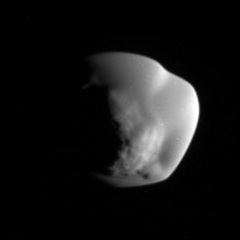




Discovery and name
The object was identified from images taken by the Voyager 1 spacecraft and reported by researchers in 1980 (discovery data). It was later given the name Atlas after the figure from Greek myth Atlas, following the convention of naming Saturnian satellites for characters from classical mythology (mythological background).
Physical characteristics
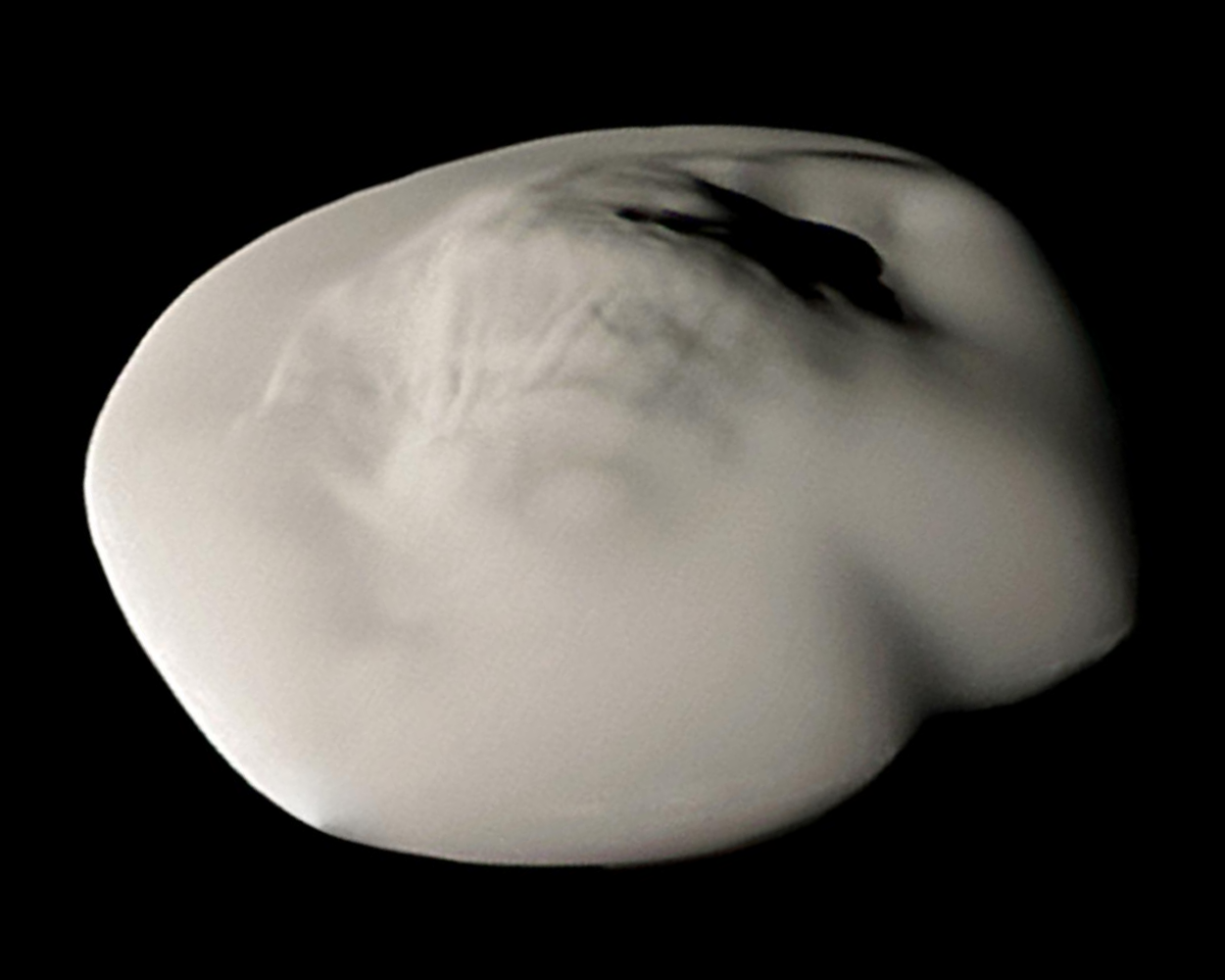
Atlas is a small, low‑mass body only tens of kilometres across. High‑resolution images obtained by later missions revealed a pronounced equatorial ridge that gives the moon a rounded, saucer‑like silhouette. This ridge is interpreted as accumulated ring material or as a consequence of the moon's low gravity and rapid rotation, producing a visible concentration of loose particles around the equator. Its surface is thought to be primarily water ice with a porous, rubble‑pile structure rather than a solid, dense rock.
Orbit and role with the rings
Atlas orbits just outside Saturn's A ring and acts as one of the small moons that helps define or influence the ring edge. Its proximity to dense ring material means it both shepherds particles and exchanges material with the rings, a process that can build or reshape features such as the equatorial bulge. Atlas is often compared to other ring‑edge moons with similar ridges, which suggests a common formation mechanism tied to ring interactions.
Scientific importance
Studying Atlas improves understanding of ring dynamics, satellite accretion, and the limits of gravitational cohesion in tiny bodies. Observations of Atlas inform models of how ring particles collect on small moons and how such moons affect ring structure. Future observations and missions could refine knowledge of its composition, internal structure, and the ongoing exchange between Saturn's rings and their neighbouring satellites.
- Type: Small inner moon near A ring
- Shape: Flattened with equatorial ridge
- Interest: Ring–moon interaction, accretion processes
Related articles
Author
AlegsaOnline.com Atlas (moon) — Saturn's small ring‑edge satellite Leandro Alegsa
URL: https://en.alegsaonline.com/art/7014