
Barnard's Galaxy (NGC 6822): a nearby barred irregular galaxy
NGC 6822 (Barnard's Galaxy) is a dwarf barred irregular galaxy in Sagittarius, one of the nearest Local Group members and historically important for distance measurements using Cepheid variables.
Barnard's galaxy, catalogued as NGC 6822 and sometimes listed as IC 4895 or Caldwell 57, is a dwarf barred irregular galaxy in the constellation Sagittarius. Located at a distance of roughly 1.6 million light-years from the Sun, it belongs to the Local Group of galaxies but is not a bound satellite of the Milky Way. Because of its proximity and relatively simple structure, NGC 6822 has been studied as a nearby laboratory for star formation, stellar populations, and chemical evolution.
Image gallery
8 Images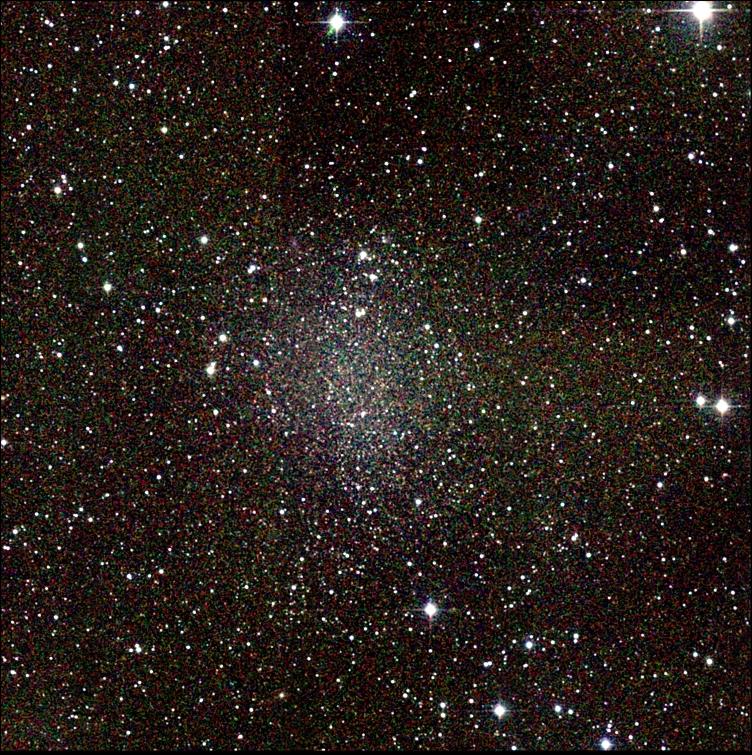


General characteristics
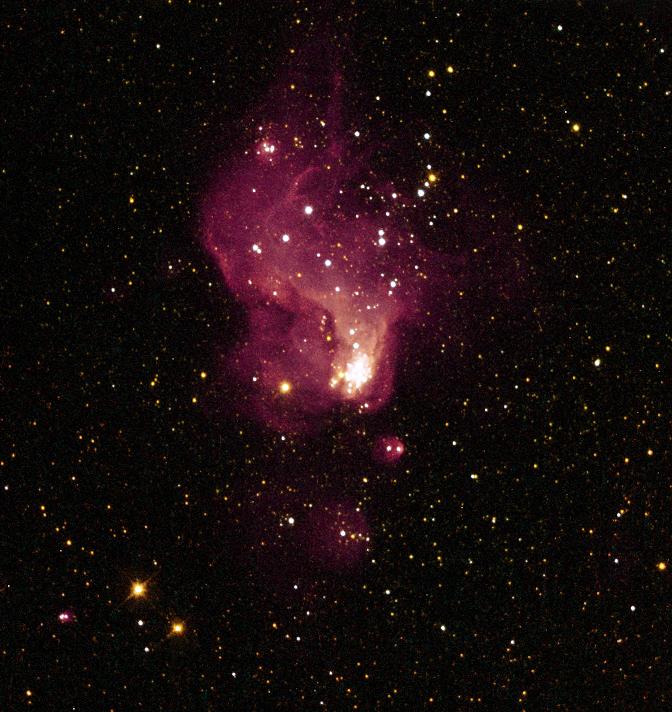
NGC 6822 spans about 7,000 light-years across and is classified variously as a barred irregular or dwarf irregular galaxy. Its appearance is dominated by an irregular, elongated bar of stars and scattered patches of bright, young star clusters and emission nebulae. The galaxy is metal-poor compared with large spirals like the Milky Way, indicating a relatively slow chemical enrichment history. Several prominent H II regions—sites of active star formation—stand out in optical and radio images, while older red giant stars populate a more extended halo.
Structure and notable regions
- Central bar and stellar distribution: the galaxy shows an asymmetric bar-like stellar concentration rather than a well-defined spiral pattern.
- H II regions and young clusters: compact, luminous regions such as the ones catalogued by Hubble are visible where gas is forming new stars.
- Old stellar population: red giant branch stars and variable stars reveal the galaxy's extended, older component.
Discovery and historical importance
American astronomer E. E. Barnard discovered the object in 1884 using a small refracting telescope, leading to the informal name Barnard's galaxy; it is also listed in the Caldwell catalog as Caldwell 57. The galaxy rose to great prominence in the early twentieth century when Edwin Hubble identified Cepheid variable stars within it. Hubble measured their periods and apparent brightnesses, using the Cepheid period-luminosity relation to determine a distance much greater than the size of the Milky Way. Those observations, reported in the 1920s, provided key evidence that so-called "spiral nebulae" were separate galaxies, helping to settle the extragalactic nature of many nebulae and expanding the scale of the known universe. For this role, Barnard's galaxy is often mentioned alongside the Small and Large Magellanic Clouds in discussions of early extragalactic astronomy; see the work of E. E. Barnard and Edwin Hubble for primary accounts.
Scientific importance and modern study
Today NGC 6822 is important for several reasons. Its proximity makes it possible to resolve individual stars, enabling detailed studies of stellar evolution, variable stars such as Cepheid variables, and the initial mass function in environments with low metal content. The galaxy's H II regions and young star clusters are used to investigate how star formation proceeds in small systems. Its membership in the Local Group provides a nearby comparison to both dwarf satellites and isolated dwarf galaxies, helping astronomers test models of galaxy formation and the role of environment.
Observation and notable distinctions
Observationally, Barnard's galaxy can be seen with modest amateur telescopes from dark sites as a faint, irregular patch; longer exposures with modern CCDs reveal its star-forming knots and extended stellar halo. It is often compared with the Small Magellanic Cloud because both are relatively metal-poor, irregular, and actively forming stars, but NGC 6822 is isolated and smaller than typical spiral galaxies. Its relative closeness to the Milky Way and membership in the Local Group make it a key target for studies of galactic chemical evolution, the distance scale, and the interplay between gas, stars, and star formation.
For further details on the galaxy's structure, star-forming regions, and its role in calibrating cosmic distances, consult observational catalogues and surveys that compile photometry and spectroscopy for Local Group members. Amateur observers can locate it by consulting star charts and lists in popular observing catalogs; professionals continue to observe NGC 6822 across wavelengths to refine our understanding of dwarf galaxy evolution.
Questions and answers
Q: What is Barnard's galaxy also known as?
A: Barnard's galaxy is also known as NGC 6822, IC 4895, or Caldwell 57.
Q: How far away is Barnard's galaxy?
A: Barnard's galaxy is about 1.6 million light-years away.
Q: What is the Local Group of galaxies?
A: The Local Group of galaxies is a group of galaxies that includes the Milky Way and several other nearby galaxies.
Q: Who discovered Barnard's galaxy and when?
A: Barnard's galaxy was discovered by E.E. Barnard in 1884 with a six-inch refractor telescope.
Q: What is the diameter of Barnard's galaxy?
A: The diameter of Barnard's galaxy is about 7,000 light-years.
Q: Why is Barnard's galaxy famous?
A: Barnard's galaxy is famous because it is where cepheid variables were used to find out how far away the galaxy was, settling a great debate in the 1920s about the scale of the universe and the nature of spiral galaxies.
Q: What did Edwin Hubble discover using cepheid variable stars in Barnard's galaxy?
A: Edwin Hubble found 11 cepheid variable stars in Barnard's galaxy, and used them to find the distance to the galaxy, settling a great debate in the 1920s about the scale of the universe and the nature of spiral galaxies.
Related articles
Author
AlegsaOnline.com Barnard's Galaxy (NGC 6822): a nearby barred irregular galaxy Leandro Alegsa
URL: https://en.alegsaonline.com/art/9032
Sources
- apod.nasa.gov : NGC 6822: Barnard's Galaxy