
Barnard's Loop — the large emission arc in Orion
Barnard's Loop is a vast emission nebula in Orion: a faint red arc of ionized hydrogen about 1,600 light-years away and roughly 300 light-years across, shaped by stellar winds and past energetic events.
Barnard's Loop is a large, faint emission nebula that forms a sweeping arc across much of the constellation Orion. The feature is classified as an emission nebula because its light is produced when hydrogen and other gases are ionized and then recombine, emitting characteristic radiation. The loop is commonly placed at a distance of roughly 1,600 light-years from Earth and is a component of the broader Orion complex, a nearby site of active star formation.
Image gallery
6 Images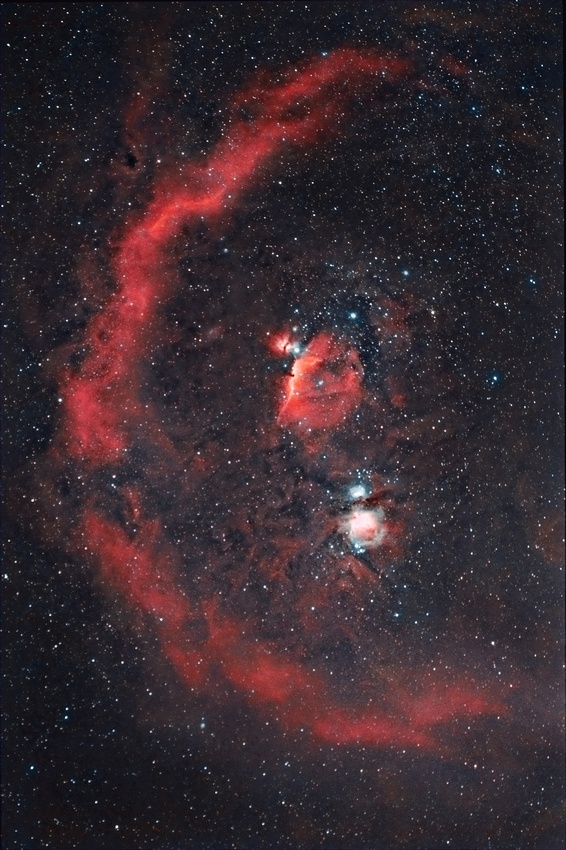


Appearance and composition
Seen in long-exposure and narrowband images, Barnard's Loop appears as a wide, faint semicircular arc that spans many degrees on the sky. Its visible emission is dominated by hydrogen recombination, especially the Hα line, which gives the nebula its characteristic red hue in many photographs. The emitting material is hot, ionized gas or plasma, and spectra show hydrogen lines together with emission from low-ionization species. The commonly quoted linear size of the structure is on the order of a few hundred light-years (often cited as about 300 light-years across), though exact boundaries and projection effects make precise measurements uncertain.
Location and relationships
Barnard's Loop partially surrounds and intermingles with familiar objects in Orion. Within the general area delineated by the arc lie the Orion Nebula and, along dense dust lanes, the Horsehead Nebula. These smaller nebulae and dark clouds are physically related to the same complex of molecular clouds and young stars that produced the loop. The loop also connects to structures associated with the Orion OB1 association, where massive stars and clusters influence their surroundings.
Origin and evolution
The feature is named after the American astronomer Edward Emerson Barnard, who photographed faint nebulosity and made early studies of the region. Modern work suggests the arc is a shell-like or filamentary structure produced by energetic feedback from massive stars: strong stellar winds, ionizing radiation, and possibly one or more past supernova explosions have swept up interstellar material to form the visible loop. Estimates of the loop's age vary; it is generally considered to be much older than individual bright nebulae like the Orion Nebula but still within the timescales of stellar associations (millions to tens of millions of years), and its precise history remains a subject of study.
Observing and scientific importance
Barnard's Loop is faint to the unaided eye and is best appreciated with long-exposure imaging or through telescopes equipped with hydrogen-alpha filters. Observations across multiple wavelengths — optical Hα, infrared, and radio — help trace the ionized gas, heated dust, and molecular material. Astronomers study the loop as a nearby laboratory for stellar feedback: it illustrates how energy and momentum from massive stars restructure the interstellar medium, influence subsequent star formation, and create large-scale shells and bubbles in the Galaxy.
- Type: emission nebula
- Constellation: Orion
- Distance: ~1,600 light-years
- Approximate span: ~300 light-years across
- Composition: ionized plasma, mainly hydrogen (Hα gives the red color)
- Associated region: Orion complex and Orion OB association
For images, spectral studies and detailed maps, consult astronomical surveys and outreach resources that cover the Orion star-forming regions. Additional contextual material and annotated photographs are available through observatory archives and educational sites that present the large-scale structure of the Orion molecular clouds and their filaments. Readers seeking introductory material can follow outreach descriptions, while research summaries and survey papers provide more technical detail on the loop's kinematics and origin: see resources linked here and in specialist literature for deeper coverage (general reference, morphology notes, arc studies, Orion Nebula context, dark nebula relations, emission imaging, spectral lines, nebula types, distance discussions, Orion surveys, plasma physics, constellation maps).
Questions and answers
Q: What is Barnard's Loop?
A: Barnard's Loop is an emission nebula in the constellation of Orion.
Q: How far is Barnard's Loop from Earth?
A: Barnard's Loop is about 1,600 light-years away from Earth.
Q: What is the Orion complex?
A: The Orion complex is a group of nebulae and stars in the constellation of Orion.
Q: How big is Barnard's Loop?
A: Barnard's Loop is a semicircular arc that is about 300 light-years across.
Q: What are the two nebulae located in the center of Barnard's Loop?
A: The two nebulae located in the center of Barnard's Loop are the Orion nebula and the Horsehead nebula.
Q: What is Barnard's Loop made of?
A: Barnard's Loop is made up of plasma.
Q: What is the mainly red color in Barnard's Loop caused by?
A: The mainly red color in Barnard's Loop is caused by hydrogen gas.
Related articles
Author
AlegsaOnline.com Barnard's Loop — the large emission arc in Orion Leandro Alegsa
URL: https://en.alegsaonline.com/art/9033