
Atlas (C1) — the first cervical vertebra of the spine
The atlas (C1) is the first cervical vertebra that supports the skull and enables nodding and rotation. This article explains its structure, function, development, clinical importance and the origin of its name.
The atlas, designated C1 in anatomical notation, is the uppermost cervical vertebra that directly supports the skull and links it to the cervical spine. In human anatomy it is uniquely adapted for stability and a wide range of head movements. For general context see anatomy and the role of vertebrae in the spine.
Image gallery
10 Images


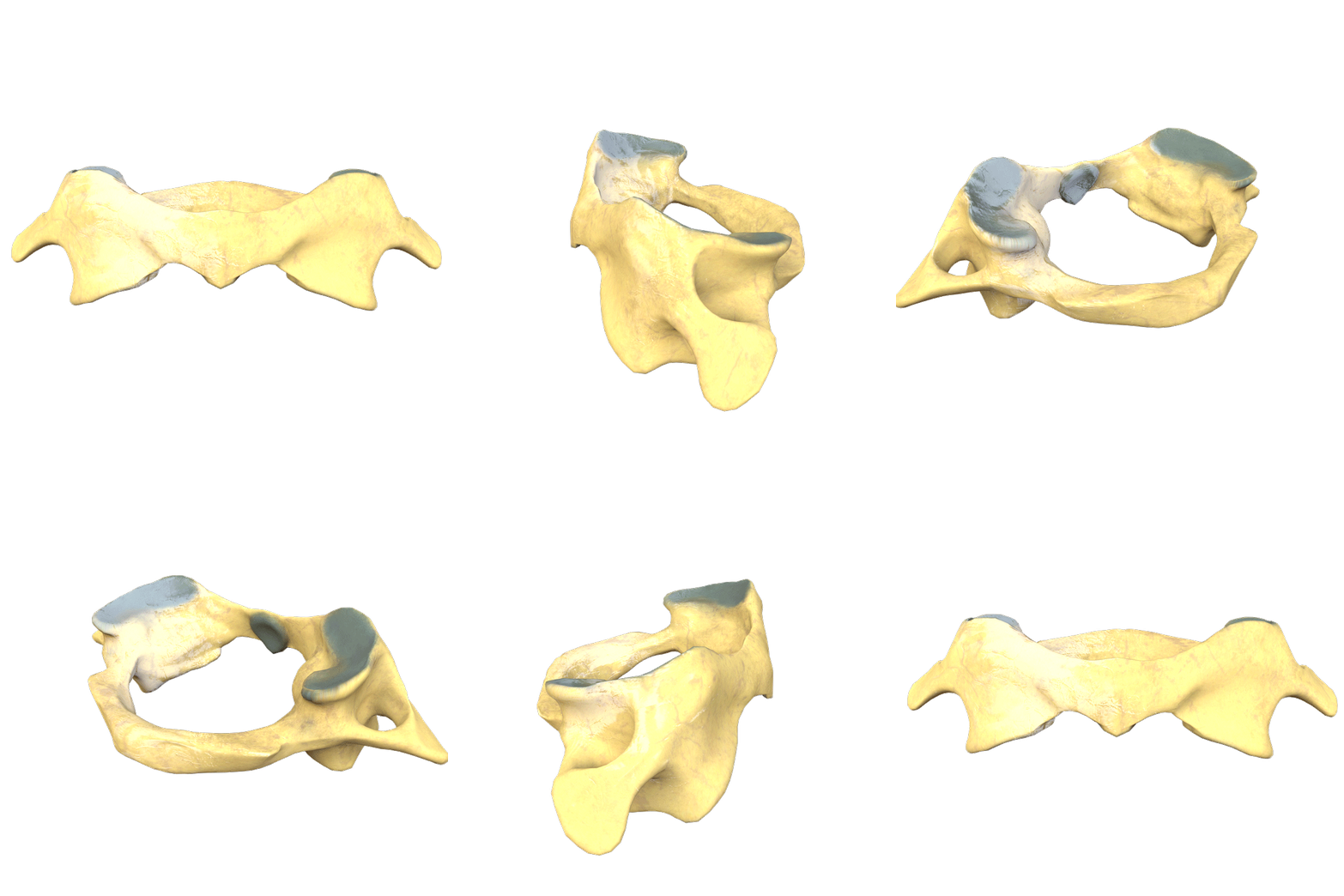


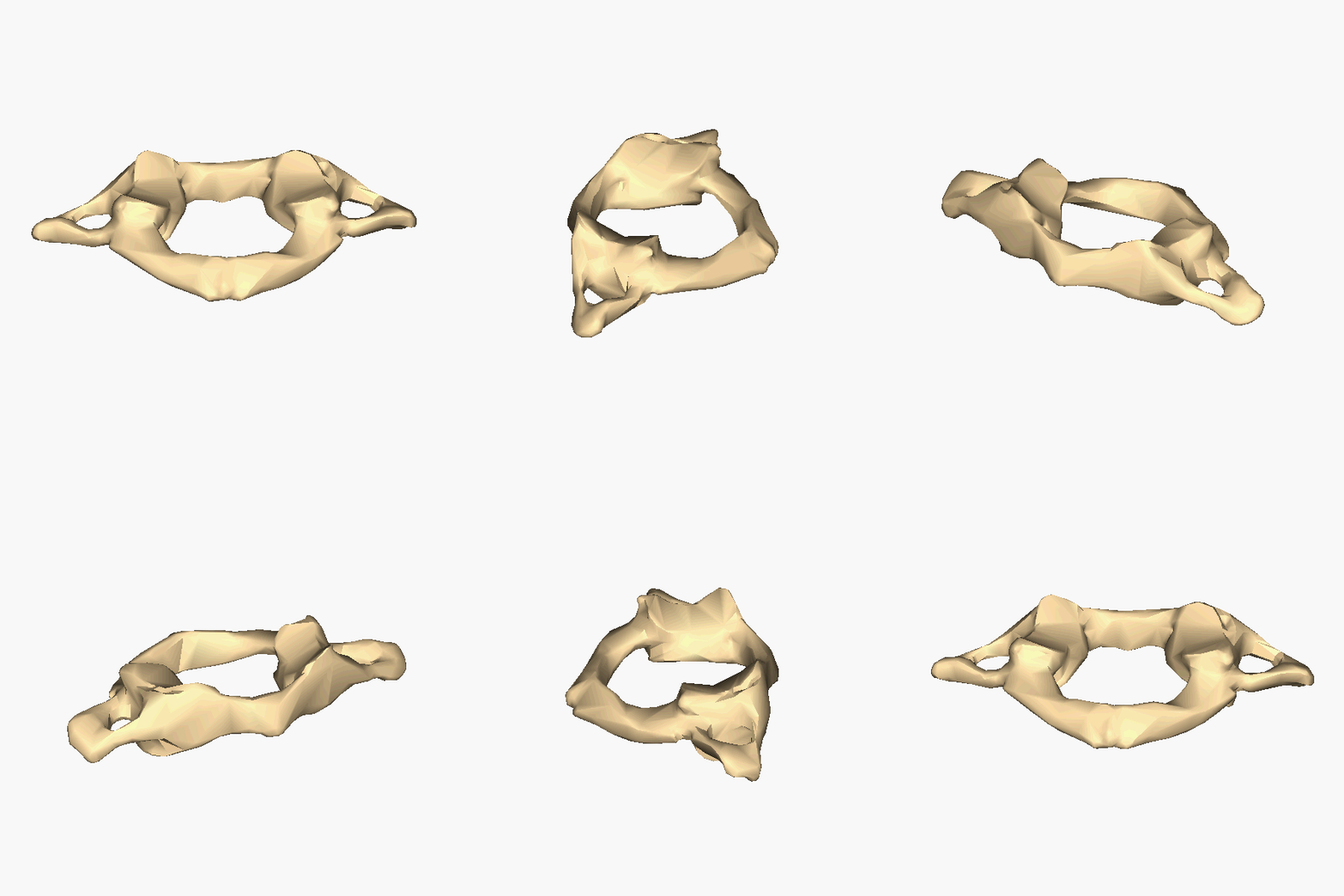

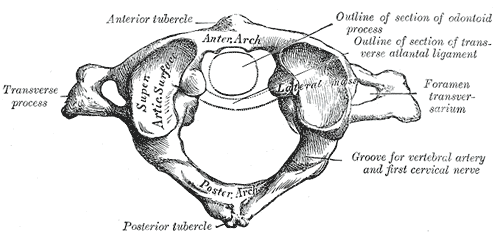
Structure and distinguishing features
Unlike typical vertebrae, the atlas lacks a true vertebral body and spinous process. It consists primarily of an anterior arch and a posterior arch joined by two lateral masses. The lateral masses contain the superior articular facets that receive the occipital condyles of the skull, forming the occipitoatlantal joint, and inferior facets that articulate with the axis (C2). The transverse processes have transverse foramina that transmit vertebral arteries and veins.
Function and movement
The joint between the atlas and the skull permits the nodding motion of the head (flexion and extension), while the atlas–axis complex allows considerable rotation. The axis bears the odontoid process (dens), which projects into the ring formed by the atlas and acts as a pivot. Together these two vertebrae provide a balance of mobility and support that protects the spinal cord while allowing the head to turn and tilt.
Development, variation and name origin
The atlas develops from separate ossification centers that fuse during childhood; variations occur and can include incomplete arches or partial fusion with the occiput (assimilation). Its common name derives from classical mythology: it was likened to the titan Atlas because it literally supports the head in the manner of holding up a burden — see Atlas of mythology and the anatomical description of the head.
Clinical relevance
Injuries and congenital anomalies of the atlas can have significant consequences because of its proximity to the brain stem and vertebral arteries. Notable conditions include:
- Fractures: Burst fractures of C1 are sometimes called Jefferson fractures and result from axial loading.
- Atlanto‑axial instability: Increased mobility between C1 and C2, which may be congenital or acquired.
- Congenital anomalies: Partial fusion with the occiput or clefts in the arches.
Evaluation commonly uses radiography, computed tomography or magnetic resonance imaging to assess alignment, fractures and neural structures. Surgical and non‑surgical treatments aim to stabilize the region while preserving as much motion as possible.
For additional information on cervical vertebrae and clinical guidelines, consult standard anatomy and orthopedic references via anatomic resources or specialty clinical sources such as spine and neurosurgery overviews. Further reading on related bones and joints is available through detailed skeletal texts at head and skull references as well as comparative anatomy resources at axis and historical discussions at Atlas of mythology.
Author
AlegsaOnline.com Atlas (C1) — the first cervical vertebra of the spine Leandro Alegsa
URL: https://en.alegsaonline.com/art/7009