
Vertebra: structure, regions, development and clinical significance
A vertebra is one of the bones forming the vertebral column. This article explains vertebral anatomy, regional differences, development, evolution, and common clinical issues affecting the spine.
A vertebra (plural: vertebrae) is one of the individual, often irregular bones that together form the vertebral column, the central bony axis of vertebrate skeletons. Vertebrae protect the spinal cord, support the body's weight, and permit flexible movement. The spinal cord passes through a central opening in each vertebra called the vertebral foramen; adjacent vertebrae also create passages (intervertebral foramina) through which spinal nerve roots exit. For a basic reference on bone types see irregular bones.
Image gallery
10 Images




Anatomy and key parts
Most vertebrae share a common plan, even though size and shape vary by region. Typical parts include:
- Vertebral body — the large anterior mass that bears weight and is separated from neighbors by intervertebral discs (intervertebral discs).
- Vertebral arch — formed by pedicles and laminae; it surrounds the vertebral foramen and provides attachment for muscles and ligaments.
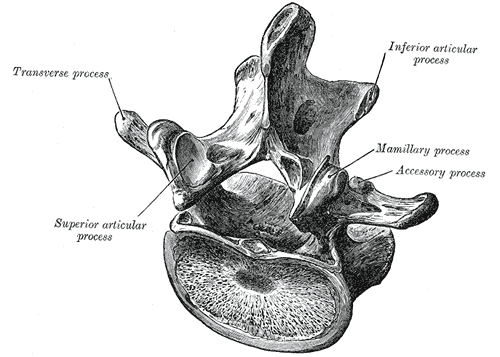
- Processes — spinous and transverse processes project from the arch for muscle attachment; superior and inferior articular processes form facet joints with adjacent vertebrae.
- Facets and foramina — articulate to allow controlled motion and create openings for nerve roots.
Regional groups and distinguishing features
In humans the vertebral column is conventionally divided into regions that differ in form and function. The upper three mobile regions house most movement and together comprise 24 separate vertebrae: cervical (7 vertebrae, specialized for head motion with the atlas and axis), thoracic (12 vertebrae, each articulating with ribs), and lumbar (5 vertebrae, larger bodies for load bearing). Below these are the sacrum and coccyx, formed by fused vertebrae: the sacrum (commonly five fused vertebrae; see sacrum) and the coccyx or tailbone (typically several fused coccygeal bones; coccygeal or tailbone).
Development and evolution
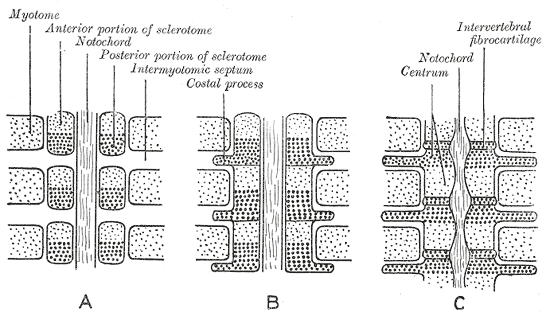
Vertebrae arise in the embryo from segments of paraxial mesoderm called somites; cells of the sclerotome form the cartilaginous precursors that later ossify. Evolutionarily, vertebrae are a defining feature of vertebrates, developing around or replacing the notochord in many groups to provide increased protection for the central nervous system and support for more active locomotion.
Clinical relevance and common conditions
Because vertebrae support weight and surround the spinal cord (spinal cord), they are involved in many medical conditions: intervertebral disc herniation, vertebral fractures, degenerative arthritis of the facet joints, spinal stenosis (narrowing of spinal canals), and spinal deformities such as scoliosis. Imaging with X‑ray, CT and MRI is used to evaluate vertebral alignment, fractures, and soft tissues. Surgical and non-surgical treatments aim to relieve nerve compression, stabilize the column, and restore function.
Notable facts and variations
Normal vertebral counts and patterns are well established but can vary among individuals and species. The cervical region nearly always contains seven vertebrae in mammals, while the number of thoracic or lumbar vertebrae may differ. The interplay of vertebral shape, intervertebral discs, ligaments and muscles creates the spinal curves (lordosis and kyphosis) that optimize balance and shock absorption.
For further reading on vertebral anatomy, comparative evolution, or clinical management consult specialist sources or anatomical texts via links such as bone and anatomy guides and regional summaries at sacrum overview, disc structure, coccyx details, tailbone information, and spinal cord resources.
Questions and answers
Q: What are vertebrae?
A: Vertebrae are individual irregular bones that make up the spinal column.
Q: How many vertebrae do humans typically have?
A: Humans typically have 33 vertebrae.
Q: How are the vertebrae separated?
A: The vertebrae are separated by intervertebral discs, except for the five that form the sacrum and the four coccygeal bones that form the tailbone.
Q: What are the three regions that the vertebrae are grouped under?
A: The vertebrae are grouped under the names cervical (7 vertebrae), thoracic (12 vertebrae) and lumbar (5 vertebrae), according to the regions they occupy.
Q: Does each vertebra have a hole?
A: Yes, each vertebra has a hole, which allows for the spinal cord to pass through.
Q: What is the function of the spinal column?
A: The spinal column is a flexuous and flexible column that protects the spinal cord and supports the body.
Q: What are the bones that form the tailbone?
A: The four coccygeal bones form the tailbone.
Related articles
Author
AlegsaOnline.com Vertebra: structure, regions, development and clinical significance Leandro Alegsa
URL: https://en.alegsaonline.com/art/104750
Sources
- bartleby.com : Gray's Anatomy
- bartleby.com : The Vertebral column
- bartleby.com : Bartleby
- isracast.com : Smart implant will help broken vertebra