
Normal force: definition, behavior on surfaces, and common examples
Overview of the normal force: the contact force perpendicular to a surface, its magnitudes on flat and inclined planes, role in friction and scales, and practical examples.
The normal force is the contact force exerted by a surface on an object that prevents the object from penetrating that surface. It always acts perpendicular to the local surface geometry and arises from the electromagnetic interactions between atoms in the two contacting materials. Because it is a response to contact, the normal force is often called a constraint force: its magnitude and direction adjust so that the object does not move through the surface.
Image gallery
1 Image
Direction and basic properties
By definition the normal force is perpendicular to the surface at the point of contact. This perpendicular direction is often referred to as the surface normal; the word "normal" in this context means "at right angles." The normal force acts at the area of contact and, for extended bodies, it may be distributed rather than concentrated at a single point. In many simple problems the distributed force is replaced by a single resultant normal force acting at the center of pressure.
Magnitudes in common situations
On a horizontal, non-accelerating surface with no other vertical forces present, the normal force equals the object's weight: N = m g, where m is mass and g is gravitational acceleration. On an inclined plane the component of weight perpendicular to the plane is reduced by the angle θ between the plane and the horizontal, giving N = m g cos θ for a block at rest on a frictional or frictionless slope. These expressions assume the contact surface is rigid and the object is not accelerating perpendicular to the surface.
If additional vertical forces or vertical acceleration are present, the normal force changes to satisfy Newton's second law in the direction normal to the surface. For example, a person standing on a scale in an accelerating elevator reads N = m (g + a) when the elevator accelerates upward with acceleration a, and N = m (g - a) when it accelerates downward. Likewise, pushing down on an object increases the normal force; lifting slightly reduces it.
Role in friction, work, and measurements
The magnitude of the normal force determines the maximum static and kinetic frictional forces between surfaces, since frictional force is typically proportional to N via the coefficient of friction μ: F_friction ≤ μ N (static) or F_friction = μ_k N (kinetic). Because the normal force acts perpendicular to the surface, it does no work on an object that moves purely along the surface of a rigid body; work can be done by the normal force, however, if the surface moves or if the point of contact moves in the normal direction.
Examples and notable facts
- Book on a table: the table's normal force balances the book's weight, N ≈ m g, so the book remains at rest.
- Block on an incline: normal force N = m g cos θ, and the downhill component of gravity m g sin θ tends to make the block slide.
- Person on a scale: the scale measures the normal force; apparent weight changes if the person or scale accelerates.
- Rolling tire: the contact patch supports the vehicle via a distributed normal force; its distribution affects traction and wear.
For further reading on contact forces and related mechanics topics see general introductions to contact mechanics and Newtonian mechanics. For the word "normal" in geometry and physics, consult resources that discuss perpendicular vectors and surface normals: surface normal. For practical discussions about contact forces and friction, see introductory materials on friction and contact forces. For explanations and examples of surfaces and constraints, consult pages about surfaces and supports.

Beam Theory
→ Main article: Beam theory
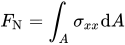
In 1st order bar theory, the normal force is the longitudinal force parallel to the bar axis direction:
Questions and answers
Q: What is normal force?
A: Normal force is the force that the ground (or any surface) pushes back up with.
Q: What would happen if there was no normal force?
A: If there was no normal force, you would slowly seep into the ground.
Q: How is the normal force on an object related to its weight?
A: On a flat surface, the normal force of an object is equal to its weight (the object's mass multiplied by the force of gravity).
Q: How does an inclined plane affect the normal force?
A: On an inclined plane, the normal force is reduced by the angle, and it can be calculated using m g c o s θ.
Q: What does θ represent in this equation?
A: θ represents the angle of inclination in this equation.
Q: When would cosθ be 1?
A: cosθ would be 1 when θ (angle)is 0, which occurs on a flat surface.
Q: How do these two equations compare to each other? A: The two equations are equal when on a flat surface.
Related articles
Author
AlegsaOnline.com Normal force: definition, behavior on surfaces, and common examples Leandro Alegsa
URL: https://en.alegsaonline.com/art/70737