
Kilogram: SI base unit of mass
The kilogram is the International System (SI) base unit of mass. Defined in 2019 by fixing the Planck constant, it underlies science, engineering and commerce and is realized by precision instruments.
The kilogram is the International System of Units (SI) base measure for mass. It is the primary unit used worldwide in scientific research, industry, trade and everyday life. In practical terms the kilogram serves as the reference for other metric mass units such as the gram and the tonne. Its importance spans laboratory metrology, manufacturing, medicine and commerce, linking physical measurement to agreed international standards (SI, science, engineering, commerce).
Image gallery
5 Images


Definition and modern redefinition
Since 20 May 2019 the kilogram is defined by fixing the numerical value of the Planck constant to exactly 6.62607015×10⁻³⁴ joule seconds (J·s). Because the metre and the second are already defined in terms of physical constants, fixing the Planck constant provides an exact, invariant basis for the kilogram. This replaced the earlier artifact-based definition that relied on the International Prototype Kilogram (IPK), a platinum–iridium cylinder stored near Paris.
How the kilogram is realized in practice
Modern laboratories implement the kilogram definition using precision methods that connect mass to the fixed Planck constant. Two widely used approaches are:
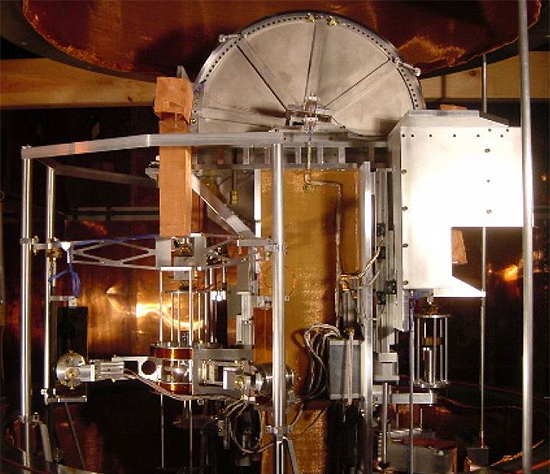
- Kibble balance (formerly called a watt balance): an electromechanical instrument that compares mechanical power to electrical power referenced to quantum electrical standards. The balance relates mass to electrical measurements traceable to the fixed Planck constant.
- Avogadro or silicon-sphere method: highly pure, nearly perfect spheres of silicon-28 are measured to determine the number of atoms and the lattice spacing. That atom-counting approach links macroscopic mass to a defined quantity of atoms (atoms).
Historical background
Before the 2019 redefinition, the kilogram was represented by the International Prototype Kilogram (IPK), created in the late 19th century. Over time small mass differences appeared between the IPK and national copies, motivating a shift to a definition based on unchanging constants of nature. Earlier still, metric ideas in the 18th and 19th centuries tied the gram to the mass of a volume of water (the litre), with water's maximum density near 4 °C playing a historical role in defining mass units (litre, sea level conditions).
Common relations and conversions
Practical comparisons and everyday conversions include: one kilogram is slightly more than two pounds—about 2.20462 pounds. One kilogram subjected to standard gravity (9.80665 m/s2) corresponds to a weight of about 9.80665 newtons. The metric hierarchy uses the gram as 1/1000 of a kilogram and the tonne (or metric ton) equals 1,000 kilograms.
Distinctions and notable facts
It is important to distinguish mass from weight: mass (measured in kilograms) is an intrinsic property of matter; weight depends on local gravity. The 2019 redefinition makes the kilogram stable and the same anywhere in the universe because it is tied to fundamental constants rather than a physical object. The fixed value of the Planck constant now anchors mass measurements to the same immutable framework that defines the metre and the second.
Key practical points include:
- The kilogram is the SI base unit of mass.
- It is realized experimentally by instruments such as the Kibble balance and atom-counting techniques using silicon spheres.
- Historically linked to the mass of a litre of water at a temperature near 4 °C, a relation that helped establish the gram in the 18th century.
For further technical information and national metrology resources see metrology organizations and review articles (unit definition, SI, scientific context).
Questions and answers
Q: What is the base unit of mass in the International System of Units (SI)?
A: The kilogram is the base unit of mass in the International System of Units (SI).
Q: How is the definition of a kilogram currently determined?
A: As of May 20, 2019, the definition of a kilogram is based on the Planck constant as 6.62607015×10⁻³⁴ kg⋅m2⋅s−1.
Q: Are there any other methods for defining a kilogram?
A: Yes, there are attempts to define a kilogram in other ways. For example, one method specifies a number of atoms of a certain substance at a certain temperature.
Q: How many pounds does one kilogram equal?
A: One kilogram equals slightly more than 2.2 pounds.
Q: How many kilograms are in one tonne?
A: One tonne is equivalent to one thousand kilograms.
Q: What is the weight of one litre water at sea level and 3.98°C (39.16°F; 277.13K)?
A: At sea level and 3.98°C (39.16°F; 277.13K), one litre water weighs almost exactly one kilogram .
Q: When was this basis for defining grams established?
A: This basis for defining grams was established in 1795 .
Related articles
Author
AlegsaOnline.com Kilogram: SI base unit of mass Leandro Alegsa
URL: https://en.alegsaonline.com/art/53428
Sources
- bipm.org : Draft Resolution A "On the revision of the International System of units (SI)" to be submitted to the CGPM at its 26th meeting (2018)
- bipm.org : Decision CIPM/105-13 (October 2016)
- bipm.org : "Practical realization of the definition of the kilogram"