
National Palace Museum (Taipei)
Major museum in Taipei preserving nearly 700,000 works from imperial Chinese collections, renowned for jade, ceramics, painting, calligraphy, conservation, research and international exhibitions.
Overview
The 國立故宮博物院 (国立故宫博物院, Guólì Gùgōng Bówùyuàn) is a national museum located in the Shilin district of Taipei in the Republic of China. It houses one of the world's largest and most important collections of Chinese art and artifacts, assembled over centuries by imperial collectors and later managed as a public institution. The museum combines permanent displays with rotating exhibitions, educational programs and scholarly activities.
Image gallery
10 Images
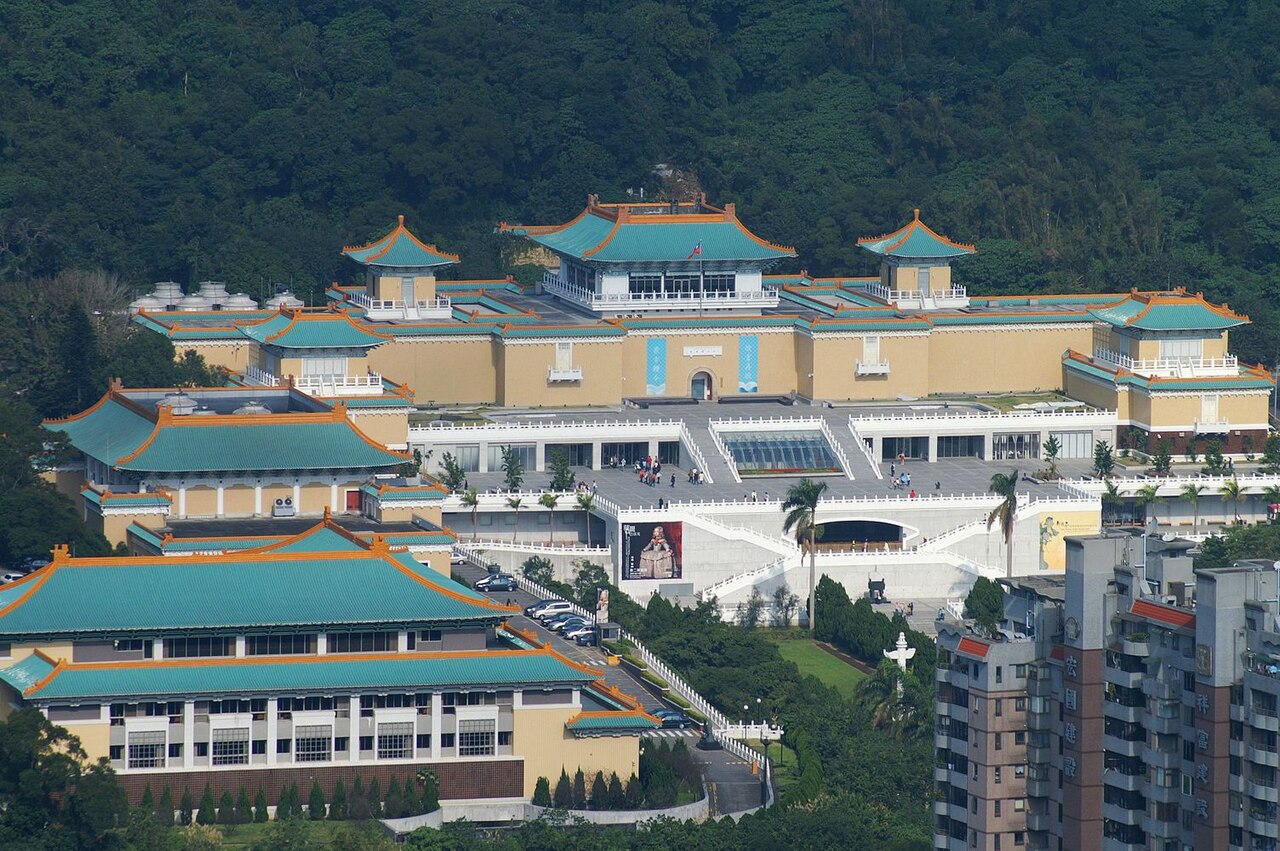


Collection and highlights
The museum's holdings number nearly 700,000 items and span many millennia of material culture. The collection includes Neolithic pottery, ritual bronzes, finely worked jades, imperial porcelains, textiles, lacquerware and scholar's objects, along with an extensive library of paintings and calligraphy. Among the best known pieces are the Jadeite Cabbage and the Meat-shaped Stone, both celebrated examples of naturalistic carving and material virtuosity.
- Jade and hardstone carvings — exceptional workmanship and courtly taste.
- Bronzes and ceramics — archaeological and artistic evidence of technological change.
- Paintings and calligraphy — representative works by leading masters across dynasties.
- Minor arts and textiles — court robes, inlaid objects and decorative arts.
History and development
The museum's origins lie in imperial repositories that became public collections in the early 20th century. During the upheavals of the mid‑20th century, portions of these collections were relocated to Taiwan to preserve them. The institution established its present identity in Taipei in the mid‑20th century and has since developed modern facilities, conservation laboratories and exhibition spaces. A southern branch was later opened to broaden public access and regional outreach.
Research, conservation and outreach
Beyond exhibition, the museum is an active research and conservation centre. Specialists work on preventive conservation, scientific analysis and cataloguing, and the institution publishes research, catalogues and educational materials. Programs for schools, workshops for the public, digital catalogues and travelling exhibitions help make the collection accessible to different audiences and connect the holdings with international scholarship.
Visiting and significance
The museum attracts visitors from around the world and is a focal point for the study of traditional Chinese art and history. Its galleries are arranged to show chronological and thematic developments, and special exhibitions highlight particular artists, techniques or historical themes. Practical visitor information, current exhibition schedules and scholarly resources are maintained by the institution's official channels and publications.
For institutional names and language forms see the traditional name 國立故宮博物院, the simplified form 国立故宫博物院 and the pinyin entry Guólì Gùgōng Bówùyuàn. The museum is situated in Shilin, Taipei, and remains one of the principal cultural repositories of the Republic of China, with active participation in international loans and exhibitions.
Related articles
Author
AlegsaOnline.com National Palace Museum (Taipei) Leandro Alegsa
URL: https://en.alegsaonline.com/art/68670
Sources
- npm.gov.tw : "List of Categories in the Collection"
- npm.gov.tw : "Visitor figures 2016"
- npm.gov.tw : National Palace Museum Annual Report 2015
- theartnewspaper.com : "Top 10 Art Museum Attendance"
- npm.gov.tw : "List of Categories in the Collection"
- chinapost.com.tw : "National art collection evokes hard history"
- wikidata.org : wikidata.org/wiki/Q540668
- catalogue.bnf.fr : cb12329271m
- data.bnf.fr : (data)
- d-nb.info : 50510-9
- isni.org : 0000 0001 2188 6945
- id.loc.gov : n81062107
- aleph.nkp.cz : olak2003164587
- nla.gov.au : 36605114
- idref.fr : 074520296