
Neue Wache — Schinkel's Neoclassical Guardhouse and German War Memorial
The Neue Wache in central Berlin, designed by Karl Friedrich Schinkel, is a prominent example of German neoclassicism and has served as a national memorial to victims of war and tyranny.
Overview
The Neue Wache (New Guard) stands on the north side of the Unter den Linden in central Berlin. Its location is often given by the coordinates 52°31′03″N 13°23′44″E. Designed by the eminent architect Karl Friedrich Schinkel, the building dates from the early 19th century and is widely cited as a leading example of German neoclassicism. Originally constructed as a guardhouse for the troops attached to the palace of the Crown Prince of Prussia, it has been repurposed through history and is now a national memorial within the territory of Germany.
Image gallery
8 Images
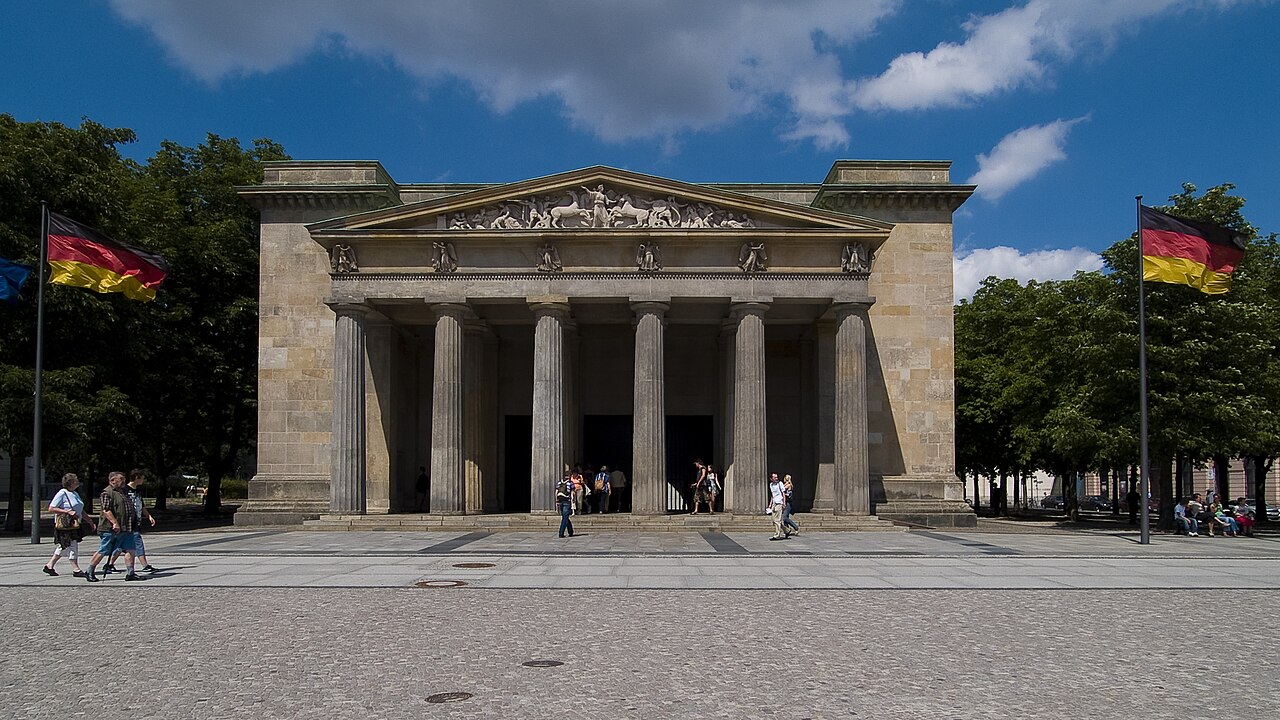


Design and architectural features
Schinkel's composition deliberately evokes the simplicity and monumentality of classical temple architecture. The exterior presents a restrained, temple-like façade with a portico and a spare, balanced silhouette. The interior is a single, uncluttered chamber, intended to focus attention and encourage solemn reflection. The compact layout and classical language give the structure an austere dignity that has made it suitable for ceremonial and commemorative functions.
Historical development
Commissioned by King Frederick William III to replace an older guardhouse, the Neue Wache represented Schinkel's first major Berlin commission and reflected the reforming spirit of the Prussian state in the post-Napoleonic period. Over time its role shifted from a functional military building to a site of public memory. In 1931 the structure was formally adapted to serve as a war memorial, and during the 20th century it continued to be used for official acts of remembrance. During the period when the city was divided, the Neue Wache lay in the eastern sector and functioned within that political context; after German reunification it was again reinterpreted as a central site of national remembrance.
Contemporary function and symbolism
Today the Neue Wache is commonly described as the Central Memorial of the Federal Republic of Germany for the Victims of War and Tyranny. Its spare interior, often illuminated from a small opening above, concentrates attention on a single sculptural work placed at the center. The building is used for state commemorations, wreath-laying ceremonies and quiet personal visitation; its restrained form and central location on the historic boulevard of Unter den Linden make it a focal point for public memory in Berlin.
Notable facts and visitor information
- The Neue Wache is a prominent example of early 19th-century neoclassical architecture in Germany and marks an important commission in Schinkel's career.
- Its transformation from guardhouse to memorial reflects broader shifts in how nations commemorate conflict and loss.
- Located on a major ceremonial axis of the city, the building remains a frequent venue for official remembrance events.
For those researching the site, primary references include architectural histories of Berlin and published work on Schinkel. The site's layered history—from royal guardhouse to national memorial—illustrates how built monuments are reinterpreted to meet changing civic needs and collective memory.
Coordinates · Berlin · Germany · Unter den Linden · Karl Friedrich Schinkel · Neoclassicism · Crown Prince of Prussia · Frederick William III
Questions and answers
Q: What are the coordinates of the Neue Wache?
A: The coordinates of the Neue Wache are 52°31′03″N 13°23′44″E / 52.51750°N 13.39556°E / 52.51750; 13.39556.
Q: Who designed the Neue Wache?
A: The architect Karl Friedrich Schinkel designed the Neue Wache.
Q: When was it built?
A: The Neue Wache was built in 1816.
Q: What style is it an example of?
A: The Neue Wache is a leading example of German neoclassicism.
Q: What was its original purpose?
A: It was originally built as a guardhouse for the troops of the Crown Prince of Prussia.
Q: Who ordered its construction?
A: King Frederick William III of Prussia ordered its construction as a guard house for the nearby Palace of the Crown Prince, to replace the old Artillery Guard House.
Related articles
Author
AlegsaOnline.com Neue Wache — Schinkel's Neoclassical Guardhouse and German War Memorial Leandro Alegsa
URL: https://en.alegsaonline.com/art/69302