
Multiplexer: devices that select and combine multiple signals
A multiplexer (mux) selects one of several input signals for forwarding over a single output. Article covers types, operation, implementations, history, applications and relation to demultiplexers.
Overview
A multiplexer, often shortened to mux, is an electronic or signal-processing device that selects one of many input signals and forwards the chosen input into a single output line. The complementary device that performs the reverse operation—taking a single input and routing it to one of many outputs—is called a demultiplexer or demux. Together they enable multiple information sources to share a common resource by time- or frequency-based arrangements, by selection logic, or by other multiplexing strategies.
Image gallery
7 Images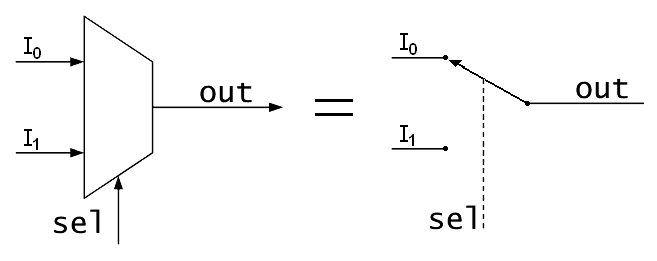



Basic operation and types
At its simplest, a multiplexer is a controlled switch: a set of input channels is connected to a single output under the control of selector inputs. In digital electronics the selector is a binary code that chooses which input is passed through; common configurations are 2:1, 4:1, 8:1 and larger, where the ratio indicates inputs to single output. An analog multiplexer routes continuous voltages or currents and must preserve waveform fidelity, while a digital multiplexer routes discrete logic signals. In wider communications and signal-processing contexts a multiplexer can also combine many low-rate channels into a higher-rate composite signal using time, frequency, or wavelength division techniques.
Implementation and characteristics
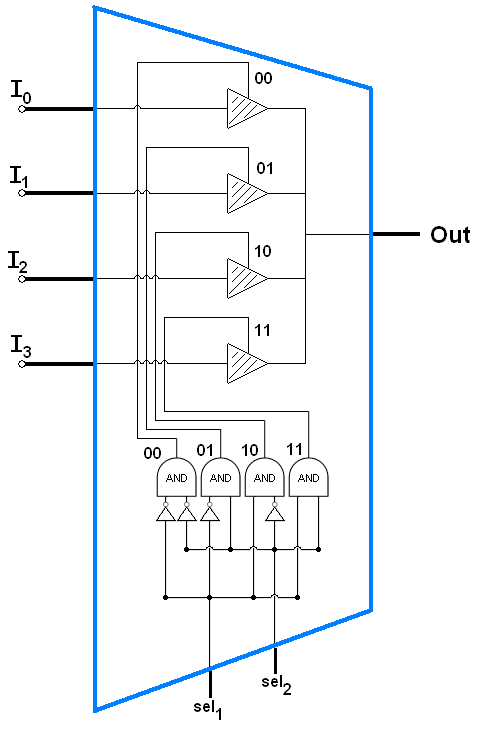
Physical implementations vary according to application. Digital muxes are often built from logic gates, transmission gates, or tri-state buffers; small integrated circuits implement selectable trees of switches. Analog muxes use pass transistors, CMOS transmission gates, or specialized analog switches to minimize distortion and leakage. In telecommunications, multiplexing can be achieved by circuitry and signaling protocols that interleave or superpose channels.
Key performance attributes to consider include:
- Insertion loss or on-resistance: affects amplitude and bandwidth for analog signals.
- Propagation delay: important in digital switching and timing-sensitive systems.
- Isolation and crosstalk: the degree to which unused channels affect the selected channel.
- Bandwidth and linearity: critical for audio, radio-frequency and high-speed data applications.
Common uses and examples
Multiplexers are widely used wherever several sources must share a limited resource. Typical examples include sharing one analog-to-digital converter among many sensor inputs, selecting video sources for a single display, routing signals in digital logic and processors, and constructing configurable interconnect in programmable logic devices. In telecommunications, multiplexers combine channels for transmission over a single communication channel, then a demultiplexer at the far end separates them again.
Other practical uses include:
- Time-division multiplexing in digital telephony and packet networks.
- Wavelength-division and frequency-division multiplexing in optical and radio systems.
- Statistical multiplexing in packet-switched networks to make efficient use of bandwidth.
- Control and routing logic in CPUs and microcontrollers where multiple data sources feed a single arithmetic unit.
Relation to demultiplexers and network examples
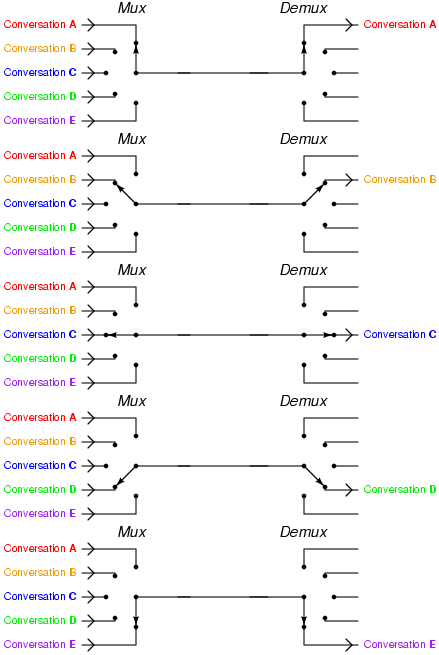
A multiplexer is logically the inverse of a demultiplexer. In many systems a mux at the sender is paired with a demux at the receiver to recreate the original set of channels. In some network architectures, however, the receiving side performs additional processing instead of a literal demultiplexing step. For example, techniques such as network address translation allow many private hosts to share a single public IP address, effectively multiplexing multiple logical streams onto a single network identifier without a simple one-to-one demultiplex operation for each host. Multiplexing concepts therefore appear at both the physical and protocol layers of modern communications stacks.
History and noteworthy facts
Multiplexing concepts have evolved alongside telecommunication and computing technologies. Early telephone systems used simple forms of multiplexing to increase the number of conversations carried by a single cable. With the growth of digital electronics, precise digital multiplexers and time-division techniques became common. In optics, advanced ways of combining channels rely on dividing the spectrum into wavelengths. Within digital design, multiplexers are also used as universal function generators: by choosing the appropriate input values a mux can implement arbitrary Boolean functions, which makes it a versatile building block in combinational logic.
Design considerations and distinctions
When selecting or designing a multiplexer, engineers balance complexity, cost and signal integrity. Analog muxes demand attention to nonidealities such as offset, distortion and leakage current, while digital muxes are chosen for low delay and low gate count. The term "mul-dex" is sometimes used informally for a multiplex/demultiplex pair. For further technical background on core electronic concepts see general references on electronics and on signal and systems material in signal processing. Additional reading about multiplexing strategies is available in sources that treat multiplexing techniques in telecommunications and networking. Practical networking examples include sharing multiple hosts behind a private network gateway, which demonstrates how multiplexing principles operate across layers.
Related articles
Author
AlegsaOnline.com Multiplexer: devices that select and combine multiple signals Leandro Alegsa
URL: https://en.alegsaonline.com/art/67483