
Network Address Translation (NAT): purpose, operation, types and effects
Network Address Translation (NAT) rewrites IP addresses in packet headers to conserve IPv4 addresses, enable private networks, and control traffic. Covers operation, types, uses, limitations, and relation to IPv6.
Network Address Translation (NAT) is a technique used by routers and gateway devices to modify IP address information in the headers of packets as they pass between different networks. NAT was developed as a pragmatic response to IPv4 address scarcity: by remapping private address spaces to one or more public addresses, many hosts can share a limited number of routable IPv4 addresses. Beyond address conservation, NAT provides a simple form of network isolation and can be combined with packet-filtering functions to control what internal resources are reachable from outside.
Image gallery
1 Image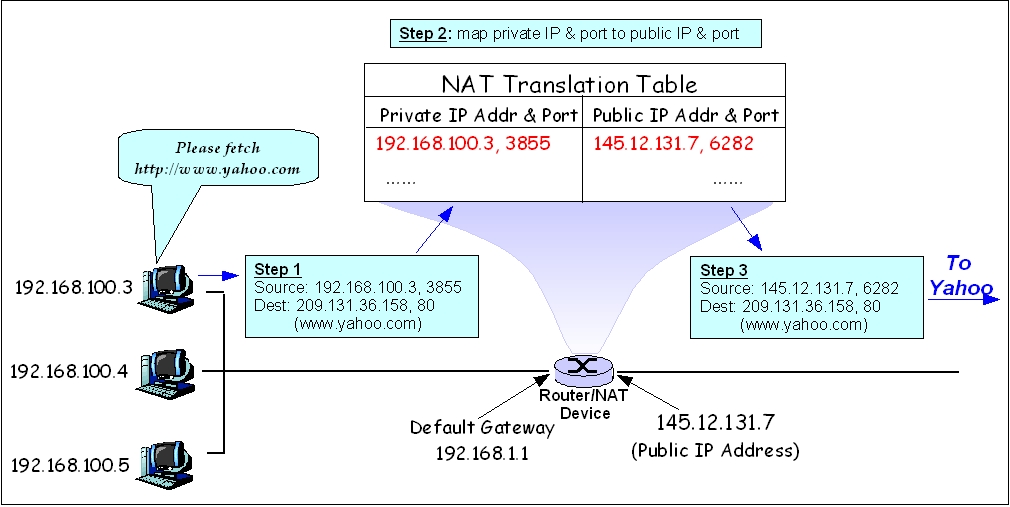
How NAT operates
A NAT-capable device maintains a translation table that records active mappings between internal (private) addresses and ports and external (public) addresses and ports. When an internal host initiates an outbound connection, the device replaces the source IP address (and often the source port) with a public address visible on the wide-area interface, and it records the mapping. When a reply arrives from the external host, the NAT uses the stored mapping to rewrite the destination address and port so the packet is delivered to the original internal host. This behaviour requires the NAT device to inspect and rewrite IP packet headers and to keep per-connection or per-flow state.
Translation entries are typically temporary and expire after a timeout period unless traffic refreshes them. Many devices allow administrators to create persistent mappings for selected hosts to ensure consistent inbound reachability; this is commonly called static NAT or port forwarding. NAT devices may also implement logging, connection limits and state inspection to support operational and security requirements.
Common NAT types and variants
- Static NAT: A permanent one-to-one mapping between an internal and external address. Often used to expose servers to the public Internet while keeping their internal addresses private.
- Dynamic NAT: Internal addresses are mapped on demand to an available address from a pool of public addresses. No port translation occurs unless combined with port address techniques.
- Port Address Translation (PAT) / NAT overload: Multiple internal hosts share a single public IP by using distinct source ports. This is the most common mode in home and small-office routers.
- Carrier‑Grade NAT (CGN): Large-scale NAT operated by an Internet service provider to serve many subscribers when public addresses are scarce. A dedicated address block (100.64.0.0/10) is reserved for carrier NAT use, and operators may deploy special logging or mapping rules to aid traceability.
- Protocol‑specific translation: Mechanisms such as NAT64 perform translation between IPv6 and IPv4 address families to enable interoperability during transition phases. Variants and helpers exist for protocols that embed addresses in payloads.
Operational effects and limitations
NAT changes the end‑to‑end addressing model of the Internet. Protocols or applications that embed IP addresses or expect incoming connections to a public address can fail without additional support. To cope with this, operators use application-level gateways (ALGs), protocol-aware helpers, or traversal techniques such as UPnP, STUN, TURN and ICE. These approaches allow peer-to-peer and real-time applications (voice, video, gaming) to discover mappings or relay traffic when direct connectivity is not possible.
Common operational issues include "double NAT" (when two NAT devices are chained), which can complicate port forwarding and troubleshooting, and "hairpin NAT" requirements when internal hosts need to reach an internal server via the external address. NAT also affects security and logging: while it can hide internal hosts from casual scanning, it does not replace proper firewalling and can hinder forensic tracing unless the NAT device maintains detailed logs or mapping records.
Configuration, troubleshooting and best practices
Administrators should document mappings, use descriptive rule names, and configure appropriate timeouts and connection limits. For services that require inbound access, use static NAT or explicit port forwarding rules and consider authentication and filtering at the application layer. When troubleshooting, verify translation tables, check for overlapping private address ranges, and test for NAT traversal behaviour with representative client applications. Vendor documentation and platform-specific guides are important references for commands and feature differences; for broader conceptual context see resources on networking, addressing and routing.
Relationship to IPv6 and standards
IPv6 was designed to provide a far larger address space so that globally routable addresses are available for individual devices, reducing the need for address-conserving NAT. Nevertheless, translation mechanisms such as NAT64 are used when IPv6-only and IPv4-only networks must interoperate. Private address architecture for IPv4 is defined in standards such as RFC 1918 and discussions about IPv4 exhaustion and address allocation remain relevant when deploying NAT; see general discussions on IPv4 exhaustion and on private networks for background.
Summary
NAT is a widely deployed, stateful packet‑translation technique that enabled continued growth of IPv4 networks by conserving public addresses and providing simple topology hiding. It introduces operational trade-offs affecting end‑to‑end connectivity, application compatibility and traceability, so its use should be planned along with firewalling, logging and migration strategies to IPv6. For practical setup and detailed standards, consult vendor manuals, protocol specifications and community resources; many administrators link practical guides and RFCs from operator pages and documentation portals (firewall and management references).
Related articles
Author
AlegsaOnline.com Network Address Translation (NAT): purpose, operation, types and effects Leandro Alegsa
URL: https://en.alegsaonline.com/art/69275