
Digital signal
A signal that represents information with discrete values or as a sequence of samples; fundamental to digital electronics, communications, computing, and signal processing.
Overview
A digital signal is any representation of information using discrete values or discrete time samples rather than a continuous range. The term is used in two closely related ways: to describe a waveform that takes on a limited set of amplitude levels (commonly binary 0 and 1) and to describe a sequence of numeric samples defined at separate instants in time. In practice the two meanings often overlap: sampled, quantized values are conveyed as level-based waveforms that travel through electronic or optical systems.
Image gallery
5 Images



Key characteristics
Digital signals are characterized by several technical properties that affect how they are generated, transmitted, and processed:
- Discrete amplitudes: Values are chosen from a finite set (binary is most common).
- Sampling and quantization: When derived from analog sources, continuous signals are sampled in time and quantized in amplitude.
- Bit and symbol rates: The speed of data represented by the signal (bits per second) and the rate at which symbols occur.
- Timing and synchronization: Precise clocking or recovery is required to interpret discrete samples correctly; jitter and skew matter.
- Bandwidth and noise behavior: Digital formats trade off spectral occupancy and robustness; error detection and correction can mitigate noise.
History and development
Concepts underlying digital signaling have roots in telegraphy and switching systems of the 19th and early 20th centuries and matured with the advent of electronic computing and communications. The formal understanding of sampling and information transmission—expressed in the sampling theorem and information theory—guided the design of practical conversion techniques (analog-to-digital and digital-to-analog) and coding schemes. The rise of semiconductor integrated circuits and digital modulation methods made digital signaling dominant in modern electronics and networks.
Uses and examples
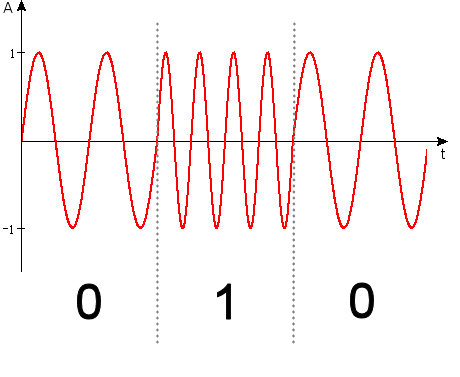
Digital signals appear in many applications: internal computer buses and logic gates, serial data links (USB, Ethernet), digital audio (PCM samples), video streaming, storage media, and wireless communications. On a physical link a digital bitstream may be represented by voltage pulses, light pulses in fiber, or changes in a carrier using modulation methods (e.g., amplitude, frequency, or phase modulation adapted for digital symbols).
Distinctions and practical notes
It is important to distinguish digital from analog signals and to separate the ideas of discrete-valued (levels) and discrete-time (samples). Digital systems offer advantages such as easier regeneration, error correction, and compatibility with logic and computing, but they introduce quantization error, potential latency, and requirements for careful clock recovery. Converters (ADC and DAC), encoders, and line codes (for instance NRZ or Manchester-style encodings) are central tools when bridging analog and digital domains.
Related articles
Author
AlegsaOnline.com Digital signal Leandro Alegsa
URL: https://en.alegsaonline.com/art/27391