
Multiplexing: methods for combining multiple signals on one channel
Multiplexing combines several information signals into a single transmission medium. This article explains common methods, historical development, typical applications, and key technical trade-offs.
Overview
Multiplexing is a family of techniques used to send multiple independent information streams across a single physical channel or medium. A device that performs the combining is called a multiplexer; at the receiving end a demultiplexer separates the streams back into their original channels. Multiplexing increases the effective capacity of cables, optical fibers, radio frequencies and other links by sharing resources efficiently, reducing cost and simplifying infrastructure.
Image gallery
1 Image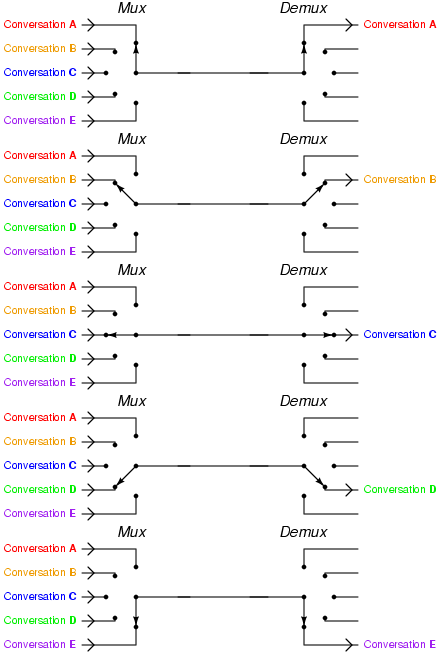
Main types and how they work
- Space-division multiplexing (SDM) assigns separate physical paths or spatial locations to different channels. Examples range from separate wires in a cable to parallel optical cores in advanced fiber systems. SDM is conceptually the same as having multiple lanes on a highway.
- Frequency-division multiplexing (FDM) gives each signal its own frequency band within the overall channel. Radio and broadcast systems commonly use FDM; in fiber optics this idea becomes wavelength-division multiplexing (WDM). For further reading on frequency-based schemes see frequency-division examples.
- Time-division multiplexing (TDM) allocates different time slots to different streams so that each occupies the medium in turn. Synchronous TDM reserves fixed slots, while statistical or asynchronous TDM assigns slots dynamically when data is present. Cellular systems and digital telephony have long used TDM; see time-division resources for background.
- Code-division multiplexing (CDM) separates signals by encoding them with distinct spreading codes, allowing many transmissions to share the same frequency and time resources. This is the principle behind CDMA cellular systems and certain spread-spectrum radio links. More on coded access appears at code and access methods.
- Orthogonal and hybrid methods such as orthogonal frequency-division multiplexing (OFDM) split a channel into many closely spaced subcarriers, blending ideas from FDM and digital signal processing. Hybrid solutions combine time, frequency and code dimensions to meet specific performance goals.
History and development
Multiplexing emerged as telecommunications networks expanded in the late 19th and early 20th centuries. Early experiments adapted telegraph and telephone lines so multiple conversations or data streams could share a single wire pair. Over time, advances in electronics, digital switching and lasers progressively extended multiplexing from copper circuits to radio and optical fiber, enabling the high-capacity networks that underpin the modern internet and mobile services.
Applications and importance
Multiplexing is ubiquitous in communications: telephone exchanges, cable television, satellite links, mobile cellular networks and fiber-optic backbones all rely on multiplex techniques to carry many simultaneous sessions. In computing, buses and serial links use multiplexing to reduce pin count and wiring. The approach improves spectral efficiency, lowers per-user cost, and makes scalable links possible by aggregating traffic.
Technical trade-offs and practical considerations
Choosing a multiplexing scheme involves trade-offs among complexity, latency, overhead, synchronization and robustness to interference. FDM/WDM require careful filtering and guard bands to limit cross-talk. TDM needs precise timing and may introduce delay for some streams. CDM demands complex encoding and power control to avoid mutual interference. Packet-based or statistical multiplexing is efficient for bursty data but needs buffering and scheduling to meet quality-of-service targets.
Distinctions and notable facts
While the basic idea is simple—share a single resource among many users—the implementations vary widely with medium and application. Optical WDM has enabled massive capacity increases in long-haul networks, whereas wireless systems often combine multiple access schemes to handle mobility and variable channel conditions. For a concise historical overview and technical references consult telecommunication resources.
Note: Multiplexing terminology overlaps with multiple access and switching; context (whether the discussion concerns a point-to-point link, a shared medium, or network-level routing) determines which concepts apply.
Related articles
Author
AlegsaOnline.com Multiplexing: methods for combining multiple signals on one channel Leandro Alegsa
URL: https://en.alegsaonline.com/art/67484