
Mount Kilimanjaro
Mount Kilimanjaro is Africa's highest mountain, a freestanding volcanic massif in northeastern Tanzania notable for its diverse ecological zones, glacial ice loss, and popular trekking routes.
Overview
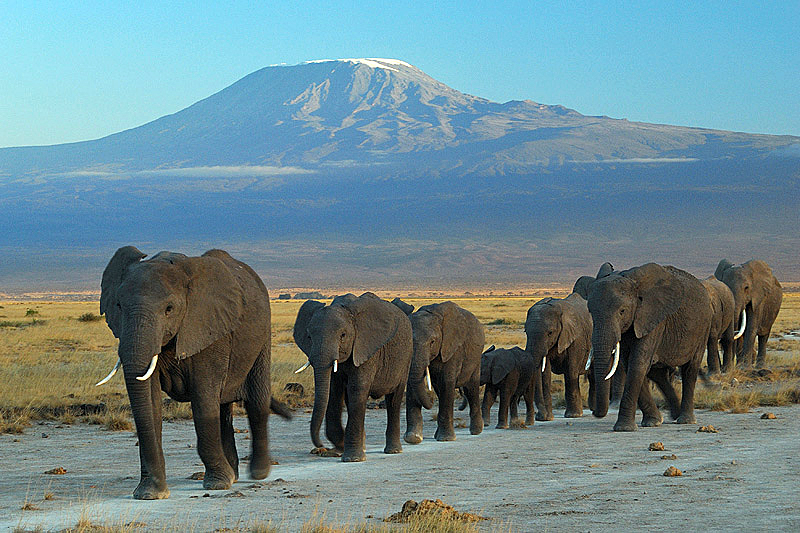
Mount Kilimanjaro is a prominent volcanic massif rising in northeastern Tanzania. Its summit, Uhuru Peak, reaches approximately 5,895 metres (19,340 feet) above sea level and makes Kilimanjaro the highest mountain on the African continent. The name is commonly rendered in Swahili as Kilimanjaro, often translated loosely as "shining mountain"; sources discussing its etymology can be found here. The mountain stands alone above the surrounding plains and is known for its dramatic, multi‑zone profile and accessible trekking routes.
Image gallery
10 Images



Geology and structure
Kilimanjaro is a large volcanic complex composed of three cones: Kibo (the highest and central cone), Mawenzi, and Shira. Kibo contains the summit plateau and the crater that includes Uhuru Peak. The massif is classified as a stratovolcano or volcanic massif with complex eruptive history; its last major eruptive activity occurred during the Pleistocene, and the summit shows no recent historic eruptions. For geological summaries and maps, see this source.
Climate, glaciers and ecological zones
The mountain displays distinct ecological belts as elevation increases: cultivated foothills and savanna give way to montane forest, then heath and moorland, alpine desert, and finally an arctic summit zone where rock, ice and sparse vegetation dominate. Kilimanjaro's summit was long capped by glaciers and ice fields, but these have been retreating rapidly in modern times. Studies have reported that a very large portion of the ice cover, on the order of most of what existed in the early 20th century, disappeared by the early 21st century. The decline of ice on Kilimanjaro is often cited in discussions of climate change and regional environmental shifts.
Routes and human ascent
Because the mountain rises from lowland plains, several established trails lead toward the summit. Popular routes include Marangu, Machame, Lemosho, Rongai and Northern Circuit; each route differs in scenery, difficulty and acclimatisation profile. The first recorded ascent of the summit by European climbers is credited to Hans Meyer and Ludwig Purtscheller in 1889, though local people had long known and traveled on the mountain. Kilimanjaro is a major destination for trekkers; guided climbs are common and the mountain is accessible to non-technical climbers who are prepared for altitude.
Conservation, cultural and economic importance
Kilimanjaro lies within Kilimanjaro National Park, which protects the mountain's unique environments and attracts tens of thousands of visitors annually. The park has cultural significance for the local Chagga and other communities whose livelihoods and traditions are linked to the mountain's forests and watersheds. Tourism and conservation efforts aim to balance visitor access with the protection of fragile high‑elevation ecosystems. Further reading on the park and management appears here.
Notable facts and distinctions
- Height: about 5,895 m (19,340 ft), Africa's highest peak (more on its status).
- Free‑standing profile: Kilimanjaro is widely noted for rising dramatically from surrounding plains rather than forming part of a long mountain chain.
- Glacial retreat: The decline of ice at the summit has been extensively documented and is a subject of scientific and public interest.
- Biological diversity: The mountain's vegetation zones host a range of plants and animals adapted to different altitudes, from rainforest species to high‑alpine specialists.
Kilimanjaro remains both an iconic natural landmark and an important case study in mountain ecology, climate impacts on tropical glaciers, and the interactions of tourism, local communities and conservation policy. For additional authoritative information and visitor guidance, consult resources linked above and dedicated park materials.
Related articles
Author
AlegsaOnline.com Mount Kilimanjaro Leandro Alegsa
URL: https://en.alegsaonline.com/art/67048
Sources
- whc.unesco.org : "Kilimanjaro National Park" · webcitation.org
- peakbagger.com : "Kilimanjaro" · web.archive.org
- peakbagger.com : "World Peaks with 4000 meters of Prominence" · web.archive.org
- maps.ewpnet.com : Kilimanjaro Map and tourist Guide · web.archive.org
- pf.nhk-ep.co.jp : "Kilimanjaro: White Mountain of the Equator -- Tanzania, 5,895 m"
- en.altezza.travel : "Mount Kilimanjaro Climbing"
- en.altezza.travel : "High Altitude Acclimatization on Kilimanjaro | Climbing Tips for Beginners"
- commons.wikimedia.org : Kilimanjaro
- wikidata.org : wikidata.org/wiki/Q7296
- catalogue.bnf.fr : cb12216301m
- data.bnf.fr : (data)