
Mexican standoff: definition, dynamics, history, and cultural use
A Mexican standoff is a multi-party deadlock in which no participant can safely act first without inviting immediate retaliation; used in politics, law enforcement, and fiction.
Overview
A Mexican standoff describes a situation in which three or more parties face each other in a way that prevents any one actor from taking decisive action without exposing themselves to counterattack. Unlike a two-person duel, where the first shot may secure an advantage, a multi-party confrontation creates mutual vulnerability: if one participant strikes another, a third gains the immediate opportunity to neutralize the attacker. The phrase has been used broadly to describe stand-offs in combat, diplomacy, law enforcement, and storytelling.
Image gallery
2 Images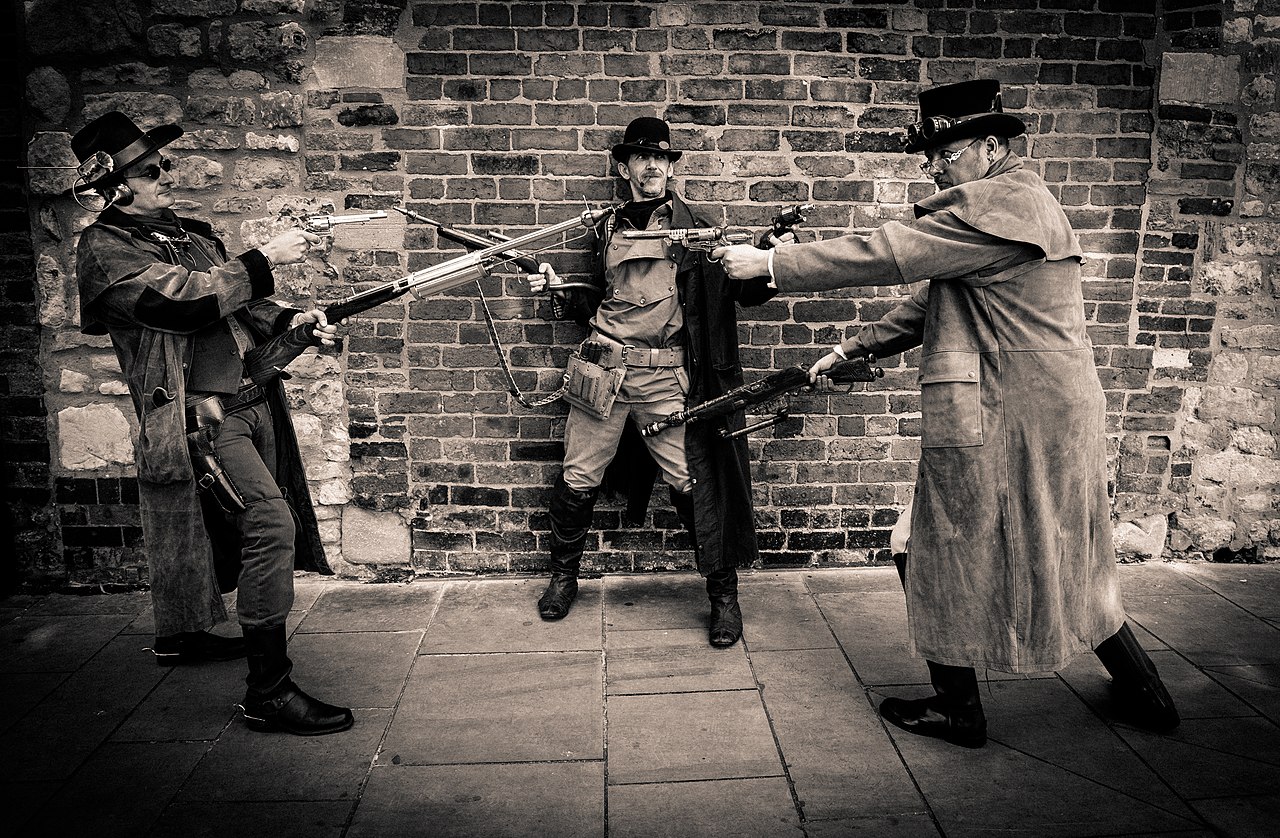

Key characteristics
- Mutual deterrence: Each side's ability to harm the others discourages initiating force.
- Circular risk: Actions provoke responses from parties that remain protected while the attacker is exposed.
- No safe retreat: Backing down can be costly because it may be interpreted as weakness or allow opponents to seize an advantage.
- Stalemate equilibrium: The situation often reaches a tense, temporary equilibrium where inaction is the least dangerous option.
Origins and terminology
The exact origin of the expression is uncertain and debated. It appears in English usage in the 19th and 20th centuries and is associated in popular imagination with cinematic Western shootouts and three-way duels. Because the phrase includes a national adjective, it has also attracted commentary about cultural sensitivity; some prefer neutral alternatives such as "three-way standoff" or "multi-party deadlock." The term has been applied metaphorically to political and strategic contexts where multiple actors hold mutually assured leverage.
Examples and uses
Mexican standoffs appear frequently in fiction and film as dramatic set pieces, with characters arranged so that any movement triggers reciprocal violence. In geopolitics the situation is invoked to describe tense impasses in which no participant will risk escalation—most famously the Cold War, where commentators likened the nuclear stand-off between the United States and the Soviet Union to a Mexican standoff because neither side wanted to be the first to employ nuclear weapons. The basic concept can also apply to hostage crises, negotiations where parties refuse concessions, and certain law-enforcement encounters.
Comparisons and distinctions
A Mexican standoff differs from a simple stalemate in that it implies an immediate tactical risk from any first move rather than a longer-term inability to win. In game‑theory terms, it resembles a Nash equilibrium in which unilateral deviation reduces the deviator's payoff. It is also distinct from two‑party duels or stand-offs because the presence of a third or more actors changes incentives and creates a circular chain of threats. For a concise description of the classic three‑person duel concept, see three-person duel.
Notable facts and considerations
- Writers and filmmakers use Mexican standoffs for tension and moral ambiguity; the staging emphasizes who can see whom and who is exposed.
- Analysts sometimes use the metaphor to explain strategic restraint, deterrence, and the logic behind mutually assured destruction; the Cold War is a common referent and is discussed in many historical treatments of the era (Cold War).
- Because the term can carry cultural overtones, alternatives are available when sensitivity is desired.
Understanding a Mexican standoff therefore involves both the immediate tactical arrangement of actors and the broader strategic incentives that keep all parties locked in a risky equilibrium.
Related articles
Author
AlegsaOnline.com Mexican standoff: definition, dynamics, history, and cultural use Leandro Alegsa
URL: https://en.alegsaonline.com/art/64326