
MG 42: German general-purpose machine gun introduced in 1942
The MG 42 is a German general-purpose machine gun introduced in 1942, noted for its simple stamped construction, quick-change barrel and exceptionally high rate of fire. It influenced many postwar designs.
The MG 42 (German: Maschinengewehr 42) is a belt-fed, air-cooled general-purpose machine gun that entered service with the German armed forces during World War II. Developed in Nazi Germany and adopted by the Wehrmacht in 1942, it supplemented and in many roles replaced the earlier MG 34. The weapon became well known for its rugged reliability, straightforward maintenance and an unusually high cyclic rate of fire that earned it a notorious reputation among Allied troops.
Image gallery
10 Images
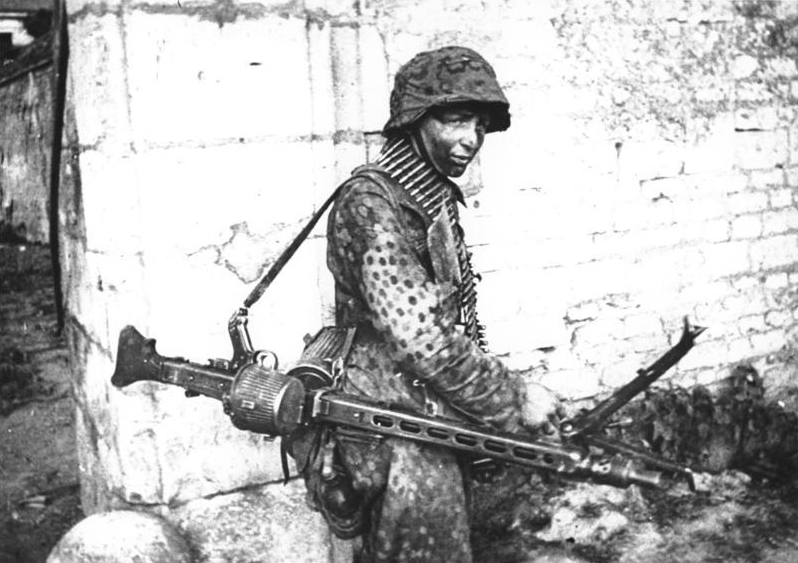


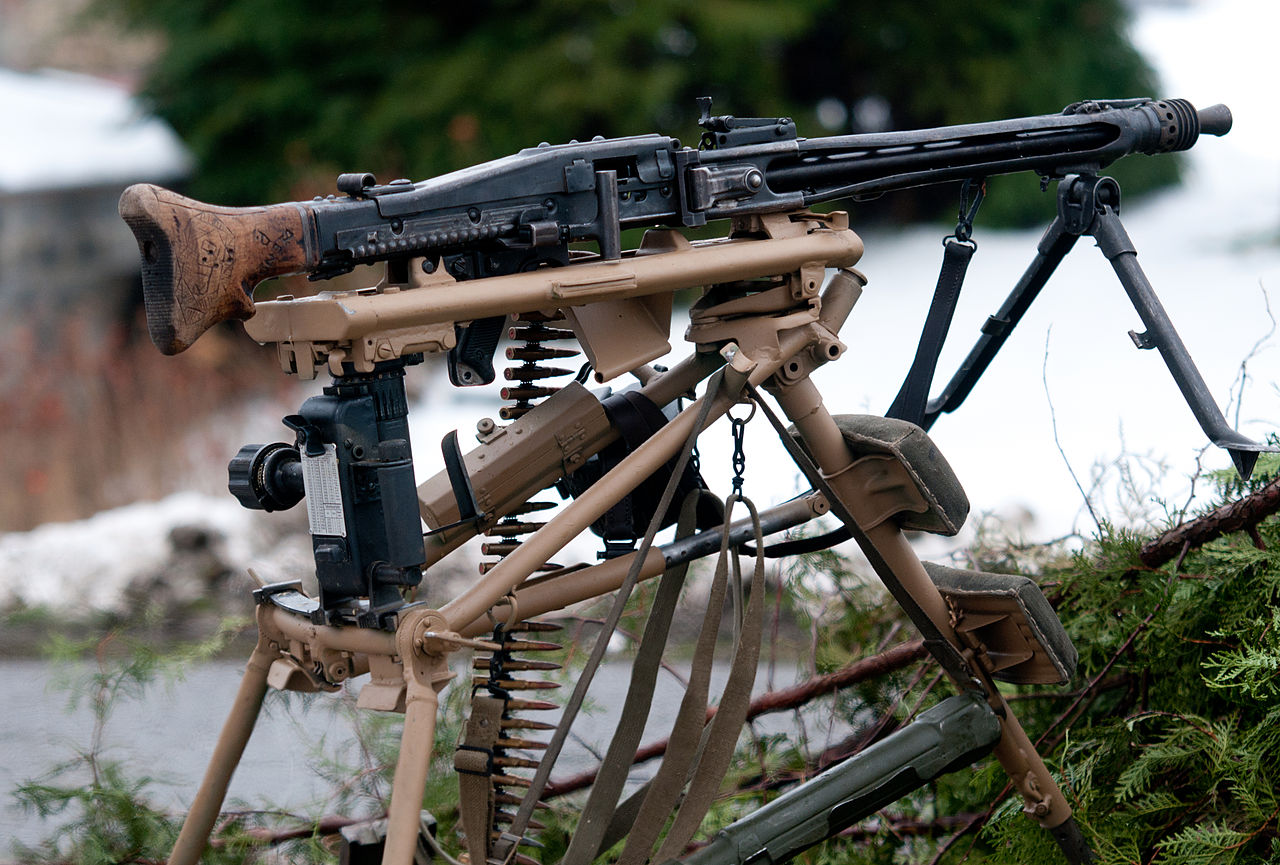
Design and characteristics
The MG 42 combined several practical features that emphasized rapid sustained fire and ease of manufacture. It used stamped steel components and simplified machining to speed production. The gun was recoil-operated with a roller-locking mechanism and fed from a cloth or metal belt, allowing prolonged bursts compared with some contemporary aircraft- or drum-fed designs. A quick-change barrel system let crews replace an overheated barrel in seconds, enabling longer defensive volumes of fire.
Most contemporaries and many historians note the MG 42's exceptionally fast cyclic rate, typically around 1,200–1,500 rounds per minute, which produced a distinctive sound and dense bullet pattern. This high rate increased short-term firepower and suppressive effect but also required careful ammunition supply and frequent barrel changes. Because of its sound and cutting rhythm the weapon gained informal nicknames referencing a mechanical saw or "saw-like" report, a perception that spread among front-line soldiers.
Service history and battlefield use
Introduced in 1942, the MG 42 was used extensively in defensive positions, on machine-gun nests, and mounted on vehicles. Its roles mirrored the later concept of the general-purpose machine gun (GPMG): it could be fired from a bipod for infantry support, from a tripod for sustained barrage fire, or adapted for vehicle use. Crews were trained to manage its high rate of fire and to exploit its rapid barrel-change system during intense combat situations.
Postwar evolution and influence
After 1945 the MG 42's basic design continued to influence many postwar machine guns. German postwar production produced close derivatives such as the MG1 (MG 42/59) which evolved into the modern MG 3. Several countries produced licensed or unlicensed variants: Swiss firms developed the MG 51 and SIG later produced the SIG MG 710-3; Austria and Spain developed local weapons derived from the same principles and stampings, for example the Austrian MG 74 and the Spanish 5.56mm Ameli. Influence is also visible in features adopted by other designs, such as the American M60 and the Belgian MAG, which share ergonomic or feeding characteristics though they differ in action and details.
Variants, users and notable facts
- Variants: original wartime MG 42, postwar MG1/MG3 family and national derivatives adapted to different calibres and mounting systems.
- Users: widely used by German formations in WWII and by many armed forces, police and irregular units globally after the war through surplus and licensed production.
- Notable features: stamped construction for mass production, belt feed for long bursts, quick-change barrel and very high cyclic rate (rate of fire was a defining trait).
Though the MG 42 is a weapon of mid-20th-century origin, its combination of manufacturing economy and battlefield effectiveness made it a template for later general-purpose machine guns. Contemporary studies of small-arms development often cite the MG 42 as a turning point in combining industrial production techniques with a field-proven, flexible weapon concept. For further historical and technical overviews see sources linked here and in specialist literature: terminology and surviving examples are discussed in restoration and museum contexts as well as in military histories (Maschinengewehr 42, GPMG concept, German arms development, Wehrmacht service, MG 34 relation, rate of fire discussion, Swiss MG 51, Spanish Ameli, Belgian MAG).
Questions and answers
Q: What is the MG 42?
A: The MG 42 is a general-purpose machine gun that was created in Nazi Germany and became widely used by the Wehrmacht in 1942.
Q: How did the MG 42 compare to the MG 34?
A: The MG 42 was sometimes used to replace the MG 34, but both weapons were made and used until the end of the war. The MG 42 was known for being reliable, simple, and easy to use, and had a much higher rate of fire.
Q: Why did the Germans call the MG 42 "Hitlersäge"?
A: The Germans called the MG 42 "Hitlersäge" or "Hitler's saw" because of its very high rate of fire.
Q: What other automatic weapon designs had similar firepower to the MG 42?
A: Other automatic weapon designs with similar firepower to the MG 42 include the French Darne, the Hungarian-Gebauer, the Russian 7.62mm ShKAS, and the British Vickers K machine gun.
Q: What made the MG 42 stand out from these other weapons?
A: The MG 42 was able to fire for longer periods of time than these other weapons because it got its ammunition from a belt and its barrel was easy to change.
Q: What new weapons were created from the MG 42 after Nazi Germany surrendered?
A: The MG1 (MG 42/59) was nearly exactly the same as the MG 42, and became the basis for the MG1A3 and eventually the MG 3. Other weapons designed from the MG 42 include the Swiss MG 51, SIG MG 710-3, Austrian MG 74, and the Spanish 5.56mm Ameli light machine gun. The M60 and Belgian MAG also copied some features.
Q: Was the MG 42 still in use after the war?
A: Yes, the MG 42 was still used by many armed groups after the war.
Related articles
Author
AlegsaOnline.com MG 42: German general-purpose machine gun introduced in 1942 Leandro Alegsa
URL: https://en.alegsaonline.com/art/64377
Sources
- books.google.com : "MG 34 and MG 42 Machine Guns"
- books.google.com : "A Global Chronology of Conflict"
- books.google.com : "Beyond The Beachhead: The 29th Infantry Division In Normandy"
- youtube.com : "Automatic Weapons: American vs. German"
- img203.imageshack.us : img203.imageshack.us
- auction-service.com : auction-service.com
- forgottenweapons.com : forgottenweapons.com
- tactical-life.com : "Machine Gun 42"
- en.calameo.com : G3 Defence Magazine August 2010
- zastava-arms.rs : "1945–1970 (Zavodi crvena zastava)"