
MG 34 (Maschinengewehr 34) — German general-purpose machine gun
The MG 34 is an early German general-purpose machine gun introduced in 1934. Noted for versatility, it served as infantry support, vehicle armament and anti-aircraft weapon before being largely superseded by the MG 42.
The Maschinengewehr 34 (MG 34) was introduced by Germany in the 1930s as one of the first practical examples of a general-purpose machine gun. Designed to fill multiple battlefield roles, it combined characteristics of light and heavy machine guns to provide sustained automatic fire for infantry units and mounted platforms. Contemporary accounts and later studies emphasize its technical refinement and tactical flexibility as key to its wartime role. For a general description of its class see general-purpose machine gun; its national origin and early adoption are discussed in sources about German arms development during the 1930s.
Image gallery
10 Images


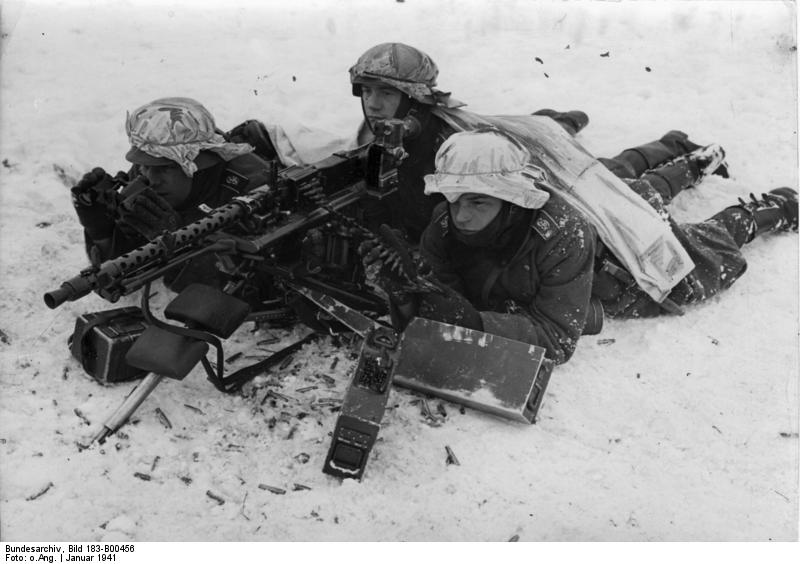


Design and characteristics
The MG 34 is a recoil-operated, air-cooled automatic weapon chambered for the 7.92×57mm Mauser cartridge, a standard German rifle round of the era (7.92×57mm Mauser). It was notable for several practical design features that increased its versatility and battlefield utility:
- Quick-change barrel system to allow repeated sustained fire without permanent barrel damage.
- Dual feed options: it could use a detachable drum magazine for dismounted, mobile use or be belt-fed for prolonged firing from mounts.
- Modular mounting: fitted with a folding bipod for mobile, squad-level fire and adaptable to a tripod for sustained or indirect roles.
- High manufacturing precision and finely machined parts, which produced reliable performance but made the weapon complex and costly to produce.
When employed as a more mobile squad weapon it functioned as a light machine gun with a bipod (light machine gun, bipod), while for sustained, indirect, or crew-served fire it was mounted on a tripod (tripod) and supplied by ammunition belts.
Development and service history
Adopted in 1934 and issued to troops beginning in 1935, the MG 34 became a standard German machine gun in the years leading up to and during the Second World War. Its versatility allowed German units to standardize on a single model for multiple tasks, simplifying training and logistics relative to armies that maintained separate light and heavy machine guns. On the battlefield the MG 34 served in infantry squads, as an anti-aircraft weapon with special mounts and sights, and in vehicles with adapted fittings. Over time, production concerns and the desire for a cheaper, easier-to-produce successor led to development of the MG 42, which gradually replaced the MG 34 in many roles (MG 42).
Uses, variants and tactical importance
The MG 34’s adaptability produced numerous variants and mounts for specific roles: short-barrel and tripod-mounted infantry models, vehicle and tank adaptations, and anti-aircraft configurations. In infantry practice the most common use was as a squad support gun firing from a bipod, delivering suppressive fire and increasing the unit’s effective firepower. On tripods it provided sustained direct or indirect fire; on vehicles and improvised anti-aircraft fittings it offered a higher volume of fire than standard rifles. Its precision construction also made it suitable as a template for further automatic weapon development.
Legacy and notable facts
The MG 34 is often remembered for being technically sophisticated and tactically innovative for its time. Its success illustrated the advantages of a multi-role weapon but also highlighted the trade-offs between performance and mass production. The later MG 42 preserved the tactical concept of a general-purpose machine gun while simplifying manufacture and increasing the rate of fire. Today the MG 34 is studied as an influential step in automatic weapon design and remains a subject of interest for military historians, collectors and restoration experts.
Questions and answers
Q: What is the MG 34?
A: The MG 34 is a general-purpose machine gun developed in Nazi Germany.
Q: When was the MG 34 first made and accepted?
A: The MG 34 was first made and accepted in 1934.
Q: When were soldiers first given the MG 34?
A: Soldiers were first given the MG 34 in 1935.
Q: What kind of cartridge does the MG 34 fire?
A: The MG 34 fires the 7.92 x 57mm Mauser cartridge.
Q: How was the MG 34 designed to be used?
A: The MG 34 was designed to be a light machine gun, but could also be used for other purposes.
Q: What is the difference between using the MG 34 with a bipod versus a tripod?
A: When used with a bipod, the MG 34 is a light machine gun and is mostly used for infantry support. When used with a tripod, it is belt-fed and can be used for other purposes.
Q: What replaced the MG 34?
A: The MG 42 eventually replaced the MG 34.
Related articles
Author
AlegsaOnline.com MG 34 (Maschinengewehr 34) — German general-purpose machine gun Leandro Alegsa
URL: https://en.alegsaonline.com/art/64376
Sources
- books.google.com : "The Encyclopedia of Weapons of World War II"
- books.google.com : "MG 34"
- books.google.com : "MG 34 and MG 42 Machine Guns"
- forum.axishistory.com : forum.axishistory.com/viewtopic.php?f=101&t=152819&start=39
- swallow.com.tw : "WW2 Chinese Army"
- world.guns.ru : "Info on the MG 34 from worldguns.ru"
- armusa.com : "MG-34"
- books.google.com : "The Third Reich, a Revolution of Ideological Inhumanity"
- books.google.com : "King Tiger Vs IS-2: Operation Solstice 1945"
- books.google.com : "MG 81 Machine Gun"