
Mercury-Redstone 3 (Freedom 7) — first U.S. human spaceflight
Mercury-Redstone 3, flown as Freedom 7 on May 5, 1961 and piloted by Alan Shepard, was the United States' first crewed space mission: a short suborbital flight that tested men and machines for later orbital missions.
Overview
Mercury-Redstone 3, commonly called Freedom 7, was the first crewed spaceflight conducted by the United States. Launched on May 5, 1961, the mission carried astronaut Alan Shepard on a brief suborbital trajectory. It is widely remembered as the nation's first successful entry into human spaceflight, following the early unmanned Mercury tests that validated basic capsule systems.
Image gallery
10 Images




Vehicle and mission profile
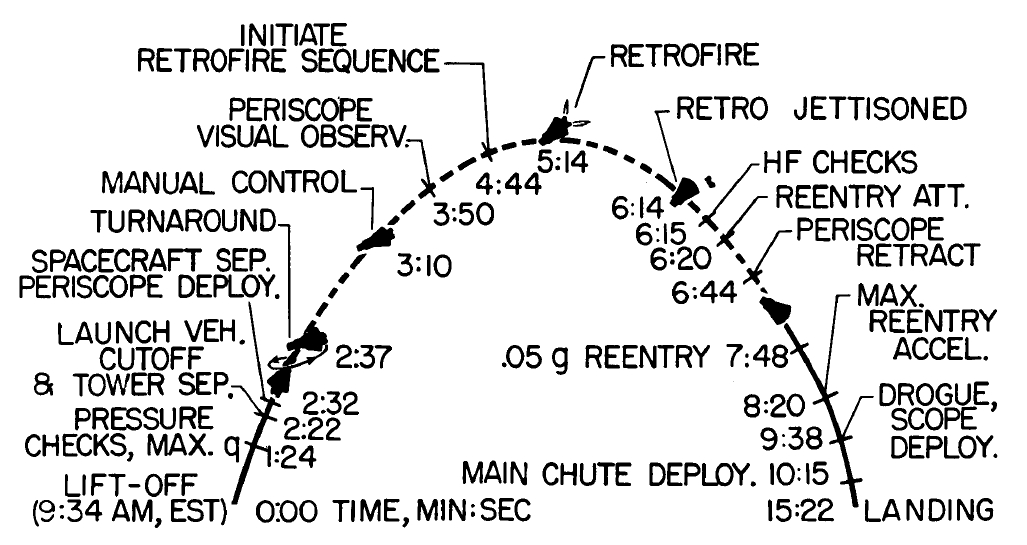
The spacecraft was a Mercury capsule launched atop a modified Redstone rocket. The flight was deliberately suborbital: the capsule reached space and then followed a ballistic arc back toward Earth rather than completing one or more orbits. The mission objectives included demonstrating that a person could survive launch and re-entry, that capsule systems would function with a human aboard, and that recovery operations could be executed. The flight lasted roughly fifteen minutes, and the vehicle reached an altitude of about 116 statute miles (roughly 187 km).
Flight events and recovery
From liftoff through splashdown the flight exercised ascent, parachute deployment and ocean recovery procedures. Shepard experienced the acceleration loads associated with launch and re-entry — commonly described as high g-forces — and performed simple cockpit tasks to check his ability to operate the capsule under flight conditions. After re-entry the capsule splashed down in the Atlantic and was recovered by a helicopter operating from the aircraft carrier that served as recovery ship.
Context and objectives
The flight was part of human spaceflight efforts under Project Mercury, an early U.S. program to learn how to send people into space and return them safely. While Project Mercury aimed ultimately to place an astronaut in orbit, initial missions used suborbital profiles to reduce risk while verifying design choices and human factors.
Legacy and significance
- Served as the United States’ first successful crewed space mission and a direct precursor to later orbital flights.
- Validated life-support, communications, and recovery techniques used in subsequent missions.
- Raised public awareness of spaceflight and accelerated development of follow-on programs.
Mercury-Redstone 3 remains an important milestone in early space history: a short mission with outsized technical and symbolic impact, proving that a human could be launched into space and returned safely and paving the way for orbital human spaceflight and the later Apollo program.
Questions and answers
Q: When was the first United States human spaceflight?
A: The first United States human spaceflight was on May 5, 1961.
Q: Who piloted the first United States human spaceflight?
A: Alan Shepard piloted the first United States human spaceflight.
Q: What was the objective of Project Mercury?
A: The objective of Project Mercury was to put an astronaut into orbit around the Earth and return them safely.
Q: What was the name of the first United States human spaceflight?
A: The name of the first United States human spaceflight was Mercury-Redstone 3, also known as Freedom 7.
Q: What was the duration of Shepard's mission?
A: Shepard's mission was a 15-minute suborbital flight.
Q: What was the primary goal of Shepard's mission?
A: The primary goal of Shepard's mission was to demonstrate his ability to withstand the high g-forces of launch and re-entry.
Q: What was the significance of Mercury-Redstone 3?
A: Mercury-Redstone 3, or Freedom 7, was significant as it marked the first United States human spaceflight and demonstrated the feasibility of manned spaceflight.
Related articles
Author
AlegsaOnline.com Mercury-Redstone 3 (Freedom 7) — first U.S. human spaceflight Leandro Alegsa
URL: https://en.alegsaonline.com/art/63924