
Mantoux test: intradermal tuberculin skin test for tuberculosis screening
The Mantoux test is an intradermal tuberculin skin test used to detect immune sensitization to Mycobacterium tuberculosis. It has diagnostic value and limitations; interpretation depends on risk factors.
Overview
The Mantoux test is a diagnostic skin test used to detect whether a person has developed an immune response to Mycobacterium tuberculosis, the bacterium that causes tuberculosis. It relies on the intradermal injection of a standardized preparation of tuberculin, typically a purified protein derivative (PPD). The test does not directly demonstrate active disease; instead, it indicates prior exposure or immunological sensitization to mycobacterial antigens. For background on the disease it screens for, see tuberculosis.
Image gallery
4 Images


History and development
The biological material used in the test has its roots in 19th-century work by Robert Koch, who prepared tuberculin from cultured tubercle bacilli in an early attempt to treat the disease; although not an effective therapy, tuberculin became useful diagnostically. The intradermal technique commonly referred to as the Mantoux test was developed from later refinements by clinicians including Robert Koch and was popularized by Charles Mantoux, who adapted the method to assess delayed-type hypersensitivity to tuberculin. The antigen is derived from the organism responsible for tuberculosis (the pathogen).
Procedure and reading
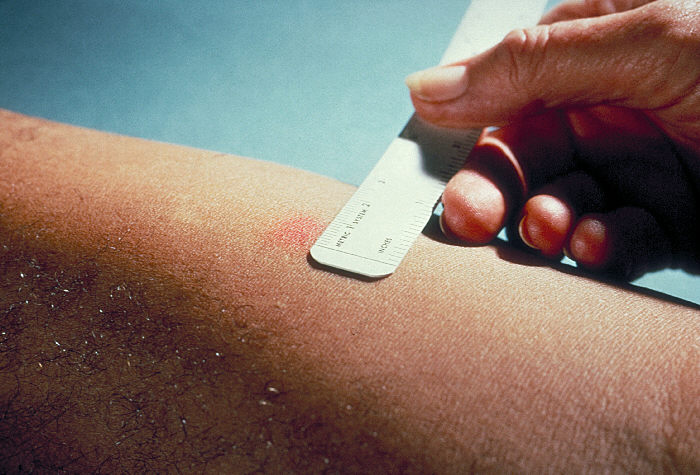
In practice, a small volume of PPD is injected just beneath the skin of the forearm. After 48–72 hours the injection site is examined for induration (a raised, firm area). The diameter of the induration — not redness — is measured across the arm. A trained clinician interprets the size of the reaction in light of the individual’s clinical history and risk factors.
Interpretation and common thresholds
Interpretation depends on risk status: certain groups require a lower threshold to be considered positive. Commonly used cutoffs (which may vary by guideline and country) are:
- 5 mm or more: considered positive in high-risk persons (for example, people with HIV infection, recent contacts of active cases, or those who are immunosuppressed).
- 10 mm or more: considered positive in persons with intermediate risk (recent immigrants from high-prevalence areas, injection drug users, or some healthcare workers).
- 15 mm or more: may be used for individuals with no known risk factors.
These thresholds are intended as clinical guidance; local public health authorities provide definitive criteria.
Uses, advantages and alternatives
The Mantoux test is widely used for screening (for example, occupational health screening, contact investigations, and pre-therapy evaluations). It is relatively inexpensive and simple to perform. Blood-based interferon-gamma release assays (IGRAs) are an alternative testing approach that measures cellular immune responses in vitro; IGRAs are less affected by prior BCG vaccination and avoid the need for a return visit to read the result.
Limitations, false positives and false negatives
A positive Mantoux response indicates that the individual’s immune system has encountered mycobacterial antigens, but it does not distinguish latent infection from active disease. Cross-reaction with non-tuberculous mycobacteria or prior BCG vaccination can produce false-positive reactions. The test depends on a functioning immune system: persons with impaired immunity — for example those with HIV infection, recent viral illnesses, or those receiving immunosuppressive drugs such as steroids — may have diminished skin responses and thus false-negative results. Exposure to environmental Mycobacteria can also affect specificity. A positive test does not prove a current transmissible infection; similarly, a negative test does not absolutely exclude infection, particularly in immunocompromised individuals or soon after exposure (infected persons may take weeks to convert).
Practical considerations and safety
Complications are uncommon and usually limited to local discomfort or small ulcers at the injection site. Severe allergic reactions are rare. Clinicians should document the test site, measure induration accurately, and consider patient history, prior BCG vaccination, and risk factors when deciding on further evaluation (such as chest imaging or microbiological testing) for active disease. For further clinical guidance and public health recommendations, consult local resources and specialist guidance available through appropriate authorities (tuberculosis resources).
Related articles
Author
AlegsaOnline.com Mantoux test: intradermal tuberculin skin test for tuberculosis screening Leandro Alegsa
URL: https://en.alegsaonline.com/art/61442