
Ludvig Dmitrievich Faddeev
Ludvig D. Faddeev (1934–2017) was a Soviet and Russian mathematical physicist known for the Faddeev equations, contributions to path integrals, the Faddeev–Popov method, and the development of quantum integrable systems.
Ludvig Dmitrievich Faddeev (1934–2017) was a Soviet and Russian scientist whose work bridged theoretical physics and mathematics. Trained in Leningrad, he made foundational contributions to quantum mechanics, quantum field theory and mathematical methods used across physics. His name is attached to several central constructs in modern theoretical physics, and he led a prominent school of mathematical physics in St. Petersburg.
Image gallery
1 Image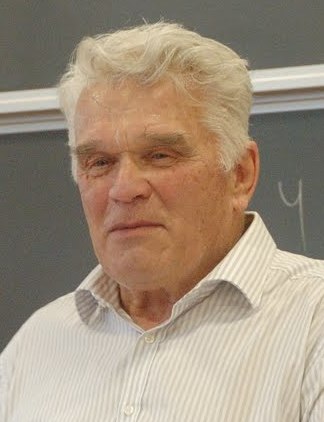
Key contributions and concepts
Faddeev produced a number of techniques and results that remain standard tools for researchers. Among these are:
- Faddeev equations, an approach to the quantum mechanical three-body problem that reorganizes scattering and bound-state calculations into coupled integral equations (the three-body method).
- The Faddeev–Popov procedure, a technique for quantizing gauge theories within the path integral formalism that clarifies how to handle redundant degrees of freedom and led to systematic treatments of gauge fixing and ghost fields.
- Advances in path integral methods and operator approaches that helped connect rigorous mathematics with physically motivated computations.
- Development of the quantum inverse scattering method and related algebraic techniques for solving quantum integrable systems in one spatial and one temporal dimension, work that helped give rise to the theory of quantum groups.
Career and the Leningrad school
Faddeev studied at what is now Saint Petersburg State University and spent much of his academic life in Leningrad (later St. Petersburg). He organized and directed a dynamic research group often called the Leningrad School, where he and his students pursued exact and algebraic methods in mathematical physics. This group produced influential work on integrable models and stimulated the emergence of new algebraic structures; the discoveries of Drinfeld and Jimbo on quantum groups were closely connected to that tradition.
Positions and influence
From 1976 to 2000 Faddeev was head of the St. Petersburg Department of the Steklov Institute of Mathematics of the Russian Academy of Sciences, where he continued to teach, supervise research and shape the direction of mathematical physics in Russia and internationally. His students and collaborators extended his methods to problems in nuclear physics, condensed matter, statistical mechanics and pure mathematics.
Legacy and relevance
Faddeev's methods remain part of the standard toolkit in theoretical physics: the three-body formalism is used in scattering theory, the Faddeev–Popov method underpins modern gauge theory quantization, and the inverse scattering approach and related algebraic structures inform exact solutions of many-body models. His blend of rigorous mathematical thinking with physically motivated problems helped create a sustained dialogue between mathematics and physics.
Faddeev died in St. Petersburg in February 2017. His work continues to be cited and taught in graduate programs, and his influence persists through the research programs and texts he and his students produced. For further introductory materials and historical context see sources on his research and the development of quantum integrable systems (overview).
Related articles
Author
AlegsaOnline.com Ludvig Dmitrievich Faddeev Leandro Alegsa
URL: https://en.alegsaonline.com/art/59776
Sources
- pdmi.ras.ru : "St. Petersburg Department of V. A. Steklov Institute of Mathematics of the Russian Academy of Sciences"
- vladtime.ru : Академик Людвиг Фаддеев ушел из жизни на 83-м году жизни
- wikidata.org : wikidata.org/wiki/Q1030228
- catalogue.bnf.fr : cb12407388w
- data.bnf.fr : (data)
- cantic.bnc.cat : a11252066
- dblp.org : 94/7420
- d-nb.info : 120897288
- isni.org : 0000 0001 1036 9985
- id.loc.gov : n80123047
- genealogy.math.ndsu.nodak.edu : 46697
- aleph.nkp.cz : xx0045284
- data.bibliotheken.nl : 070163324
- idref.fr : 033181411
- viaf.org : 7476034