
Little Orphan Annie
American newspaper comic strip created by Harold Gray in 1924, following the adventures of Annie, her guardian Daddy Warbucks, and dog Sandy; spawned radio, films, books, merchandise and the musical Annie.
Overview
Little Orphan Annie began as a newspaper comic strip created by Harold Gray. First published on August 5, 1924 in the New York Daily News, it chronicled the exploits of a spirited young orphan known simply as Annie. The strip ran for many decades as a daily feature and became one of the most recognizable American comic properties of the 20th century.
Image gallery
7 Images


Main characters and style
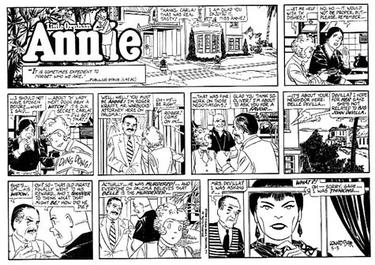
The central figures are Little Orphan Annie herself, the wealthy industrialist Oliver "Daddy" Warbucks, and Annie's dog, Sandy. Visually the strip was distinctive: Annie was typically drawn with a shock of curly hair and simplified, pupil-less eyes that became a signature of Harold Gray's style. Stories mixed adventure, melodrama and occasional moral or political commentary, with Annie portrayed as plucky, loyal and optimistic despite hardship.
History and publication
Harold Gray wrote and drew the strip through much of its formative period. After his death the feature continued under other artists and writers and remained in syndication for decades. The original run of the strip ended in June 2010. Throughout its life it appeared in daily newspapers and sometimes in a separate Sunday edition, adapting characters and storylines to changing times while keeping the basics of the premise intact.
Adaptations and spin-offs
- Radio: a popular 1930s radio series expanded Annie's audience and introduced serial dramas to households.
- Early films: cinematic adaptations appeared in the 1930s, with feature films that drew on the strip's plots and characters (film adaptations).
- Print and merchandise: the property produced chapter books, juvenile paraphernalia and various comic-book versions (comic books and publications).
- Stage and screen musicals: the Broadway musical Annie brought the character to a new generation, and that stage show later inspired a filmed movie adaptation of the musical.
Impact and legacy
Little Orphan Annie left a broad cultural legacy: the character and her motifs have been referenced in literature, music, film and advertising. The Broadway musical in particular produced enduring songs and reintroduced Annie to international audiences. The strip is also studied for Harold Gray's often conservative social views, which sometimes surfaced in storylines and set it apart from contemporaneous comic strips that leaned more toward lighthearted humor.
Notable facts and distinctions
Unlike many comic characters that remain static, Annie's portrayals have varied widely across media — from the hard-edged child in Gray's strips to the more sentimental heroine of the stage and screen musicals. The strip's long run, extensive merchandising and cross-media adaptations make it a clear example of early American transmedia franchising, moving from newspapers into radio, film, books and live theater.
Related articles
Author
AlegsaOnline.com Little Orphan Annie Leandro Alegsa
URL: https://en.alegsaonline.com/art/58510