
Line dance: group choreographies, structure, history and social role
Line dance is a choreographed social dance in rows facing the same direction, built from repeating step patterns (counts, walls, tags) and found in country, pop and hip‑hop contexts for recreation, performance, and fitness.
Overview
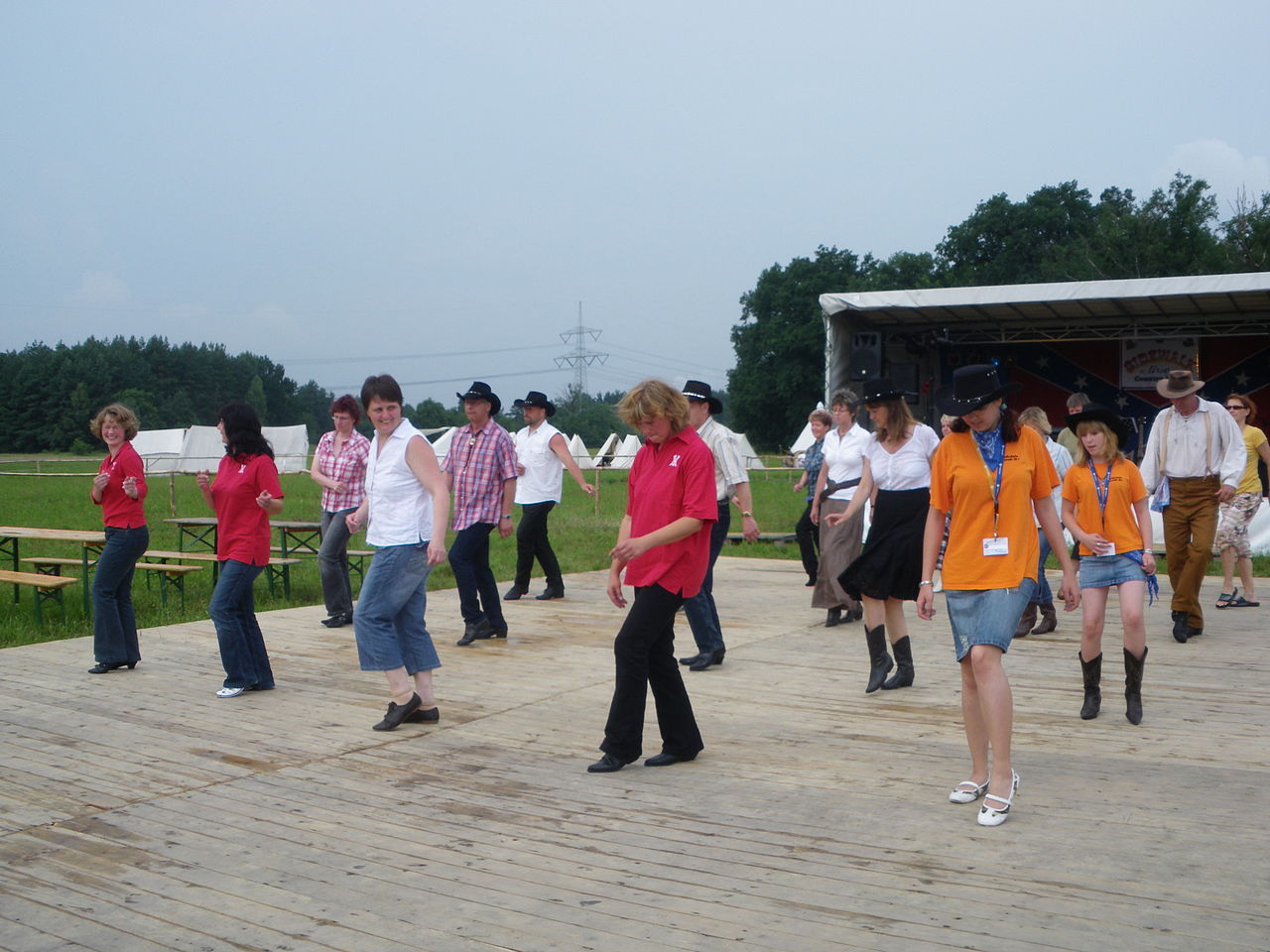
Line dance is a form of group choreography in which individuals perform the same sequence of steps while arranged in lines or rows and facing the same direction. Dancers act independently rather than as partnered pairs, but they move synchronously so the formation creates coordinated patterns. Routines are built from repeated phrases and counts; as the phrase repeats, dancers may turn to face different walls of the room so the sequence appears to travel through the space.
Image gallery
5 Images


Characteristics and structure
Most line dances are described by the number of counts in the repeating phrase and by how many walls the routine addresses. A common example is a 32‑count, 4‑wall dance: a 32‑count sequence that repeats and, through turns, brings dancers to face each of the four walls of the room in turn. Other common formats include 8, 16, 48 or longer counts and 2‑wall or 3‑wall patterns. Choreographies may include tags (extra counts appended at the end of a phrase), restarts (a command to begin the phrase again from a specific point), and directional cues or turns that change which wall dancers face.
Music, tempo and style
Line dances are set to many musical styles: traditional country music, pop, R&B, and hip‑hop are commonly used. Tempos vary widely, from slow ballads to upbeat dance tracks; instructors and choreographers choose music whose phrasing supports the step counts. The same step pattern may be danced to different songs if the tempo and phrasing match closely enough.
Common step vocabulary
- Basic moves: walks, steps, weight shifts and taps that form the backbone of phrases.
- Patterns: grapevines, jazz boxes, chassés (side steps), rock steps and pivots.
- Accents and styling: heel or toe touches, kicks, stomps and arm variations that reflect musical accents or stylistic genre.
Types and contexts
Line dances appear in social settings (clubs, weddings, community halls), fitness classes, and staged performances. Some dances are created as novelty or pop routines that spread through radio and video; others are part of country/western traditions and local communities. Modern choreographers often fuse elements from hip‑hop, Latin or contemporary dance to create hybrid routines.
History and development
The idea of many people performing coordinated steps in formation has roots in folk and communal dances from many cultures. In the 20th century in North America the form associated with country venues and community halls developed into the modern social line dance. From the late 20th century onward, popular songs and recorded music helped spread named routines across clubs and communities, and the internet later accelerated the sharing of step sheets and video tutorials.
Teaching, notation and learning
Instructors teach line dances by demonstrating the sequence, breaking counts into phrases, and showing turns, tags and restarts. Step sheets summarize a choreography with counts, directional cues and brief movement names so learners can follow practice and rehearsal. Video tutorials and group classes are common learning formats; beginners are usually advised to start with simple 32‑count, 4‑wall dances to learn timing and orientation.
Community, performance and competition
Line dancing supports active local communities, with regular social dances, clubs and classes. Some groups host performances or competitive events where choreographies are judged for timing, precision and creativity. The communal nature of the dance makes it accessible across ages and skill levels and encourages participation rather than strict virtuosity.
Benefits and etiquette
Line dancing offers cardiovascular exercise, balance and coordination practice, and social interaction. Typical etiquette includes observing spatial spacing so others have room to move, facing the indicated front wall, learning basic steps before joining advanced routines, and respecting leaders or callers during group instruction. New dancers are encouraged to watch and learn the pattern before joining in to reduce collisions and improve timing.
Continuing evolution
Line dance remains a living form: choreographers continue to invent new patterns, adapt older routines to contemporary songs, and blend styles. The format's simplicity — many dancers performing identical sequences — makes it adaptable and easy to share, which helps the form persist in social and recreational life worldwide.
Examples and notable routines
- Many widely known routines became popular through association with specific songs and social events; such routines often become staples at community dances and celebrations.
- New routines continue to spread through classes and online video platforms, enabling rapid adoption and variation across regions.
Related articles
Author
AlegsaOnline.com Line dance: group choreographies, structure, history and social role Leandro Alegsa
URL: https://en.alegsaonline.com/art/58236