
Army of Tennessee (Confederate)
Primary Confederate force in the Western Theater during the American Civil War, formed from the Army of Mississippi in 1862 and surrendering in 1865 in North Carolina.
The Army of Tennessee was the principal Confederate force operating in the Western Theater during the American Civil War. Established in November 1862 from units reorganized out of the Army of Mississippi, it served as the Confederacy's main army west of the Appalachian Mountains until its surrender in April 1865 in North Carolina. The formation is often described as a field army—a multi-corps military organization assembled for large-scale campaigning.
Image gallery
5 Images


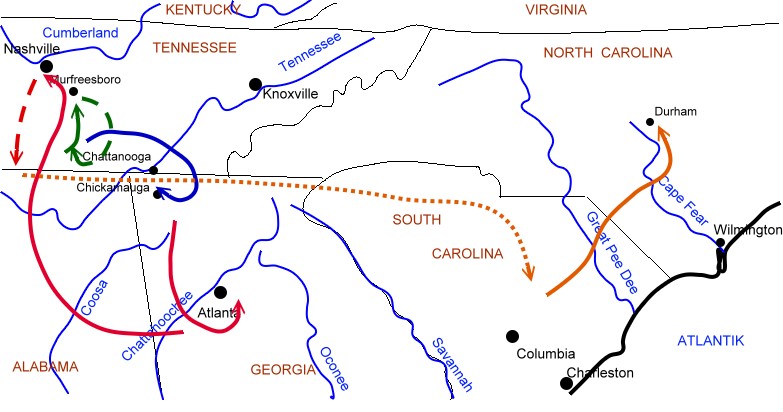

Organization and commanders
The army was composed of infantry corps, cavalry detachments, and artillery, and its leadership passed through several prominent Confederate generals. Early commanders included generals who sought to coordinate operations across a wide geographic area. Command changed hands multiple times; the army's senior officers and corps commanders became focal points for both praise and criticism as campaigns unfolded. Logistics, recruitment, and attrition affected its size and combat effectiveness throughout the war.
Major campaigns and battles
The Army of Tennessee fought in many of the Western Theater's decisive actions. It saw heavy combat at engagements such as Murfreesboro (Stones River), Chickamauga—one of the Confederacy's most significant victories in the West—and the subsequent fights around Chattanooga. In 1864 it bore the brunt of the Atlanta Campaign and later fought in the Franklin and Nashville encounters that severely weakened its fighting capacity. The army's final operations ended with its surrender in the spring of 1865.
Notable facts and distinctions
- It is distinct from the Union's similarly named Army of the Tennessee, an important source of confusion in popular accounts.
- Historians note recurring issues: leadership disputes, supply shortages, and the strain of long supply lines in the western theater.
- Despite setbacks, the army delivered several tactical victories that delayed Union advances for critical periods.
Assessments of the Army of Tennessee emphasize its strategic importance to the Confederacy west of the Appalachians and its mixed record: capable units and commanders produced notable battlefield performances, yet organizational challenges and sustained attrition ultimately reduced its effectiveness. Its campaigns and commanders remain subjects of study for their impact on the wider course of the Civil War.
Related articles
Author
AlegsaOnline.com Army of Tennessee (Confederate) Leandro Alegsa
URL: https://en.alegsaonline.com/art/5759