
Landjäger: a traditional smoked, semi-dried sausage from Central Europe
Landjäger is a smoked, semi-dried sausage from southern Germany, Austria and Switzerland. Durable and energy-dense, it is a classic snack for travel, hiking and outdoor use.
Landjäger (often written Landjaeger) is a firm, smoked and partially dried sausage originating in parts of southern Germany, Austria and Switzerland. Its name is commonly translated as "hunter's sausage" or "country hunter," reflecting its traditional role as a portable, ready-to-eat meat. The product is characterized by a compact texture, a slightly flattened rectangular cross-section and a seasoning profile that emphasizes salt, pepper and warming spices.
Image gallery
2 Images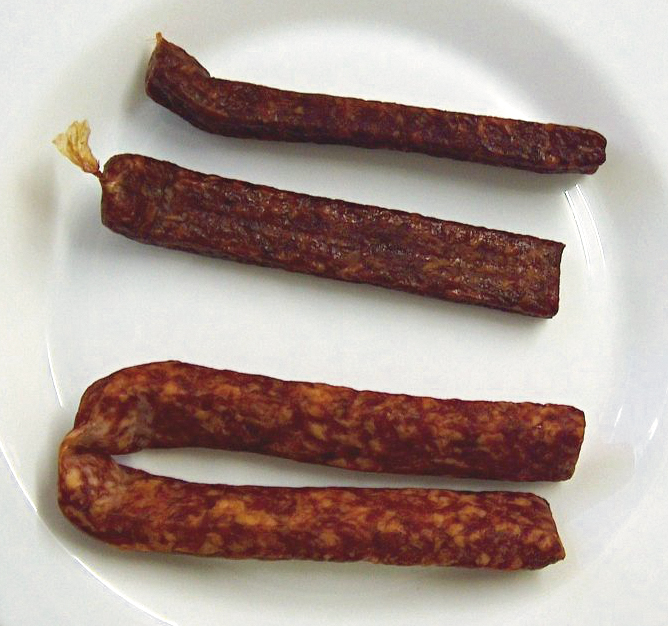
Production and characteristics
Typical Landjäger is made from a mixture of beef and pork, with added fat and spices. The meat is ground, seasoned, formed into sticks and then smoked and air-dried until some moisture has been removed. Smoking and dehydration make the sausage reasonably shelf-stable: it can be carried without refrigeration for limited periods and serves as a long-lasting, high-energy snack. For more on traditional recipes and variations, see regional sausage types.
Landjäger sticks are often sold in pairs or linked lengths and are convenient to eat without cooking. The texture is firm but sliceable; flavor ranges from mildly savory to robustly spiced depending on local custom. Because of the salt and fat content it is high in calories and protein, making it popular for outdoor activities.
History and cultural uses
Although precise origins are unclear, Landjäger has a long presence in Alpine and surrounding regions where preserved meats were important for travelers and laborers. It became a common component of picnic and hiking food, as well as an item in market and household charcuterie. Today it appears both in traditional delis and as a convenience snack for cyclists, mountaineers and campers. For consumer advice on storage and safety, consult food preservation guidance.
- Serving: eaten raw, sliced on bread, with pickles or as a snack.
- Storage: smoked and dried to reduce spoilage; refrigeration recommended after opening.
- Variants: recipes vary by region in spice mix, meat ratio and smoking intensity.
Landjäger remains a recognizable element of Central European charcuterie. Its combination of portability, preservability and bold taste continues to make it a favored choice for outdoor sustenance and as a flavorful component of casual meals. For comparative details with other preserved sausages, see charcuterie comparisons.
Related articles
Author
AlegsaOnline.com Landjäger: a traditional smoked, semi-dried sausage from Central Europe Leandro Alegsa
URL: https://en.alegsaonline.com/art/55821