
Klein bottle
A Klein bottle is a closed, non‑orientable surface with no boundary that cannot be embedded in ordinary 3D space without self‑intersection; it is an important example in topology and visualization.
Overview
The Klein bottle is a classic example in topology of a closed surface that is non‑orientable and has no boundary. First described by the German mathematician Felix Klein, it is often introduced alongside the Möbius strip because both surfaces share the striking property of having only one side. In formal terms the Klein bottle is a geometric surface of two dimensions that cannot be given a consistent choice of "left" and "right" across the whole surface, a feature summarized by calling it non‑orientable.
Image gallery
7 Images



Construction and properties
A standard way to describe the Klein bottle is by identifying edges of a square: glue one pair of opposite edges in the same direction and glue the other pair with a reversal of orientation. This identification produces a compact surface without boundary. Key topological properties include an Euler characteristic of 0 and the fact that the Klein bottle is equivalent (up to connected sum) to the connected sum of two real projective planes. Its fundamental group can be presented by two generators with a single relation that encodes the twist characteristic of the surface.
Because of non‑orientability there is no well‑defined "inside" or "outside" on a Klein bottle: continuous transport of a two‑dimensional arrow around certain loops will return it reversed. One concrete relation to the Möbius strip is that removing an open disk from a Klein bottle yields a Möbius strip; conversely, capping a Möbius strip appropriately (identifying its boundary) produces a Klein bottle.
Embedding and visualization
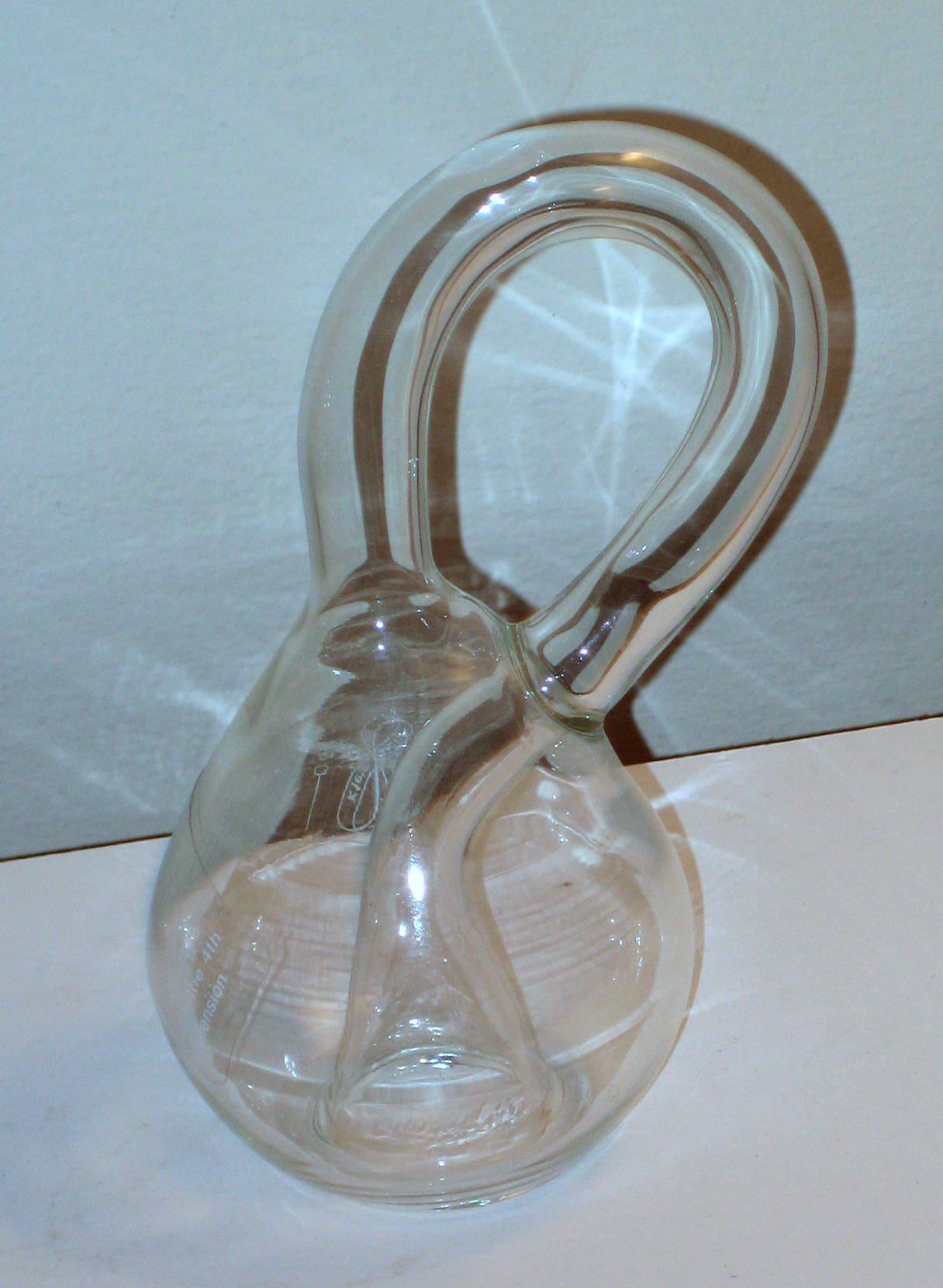
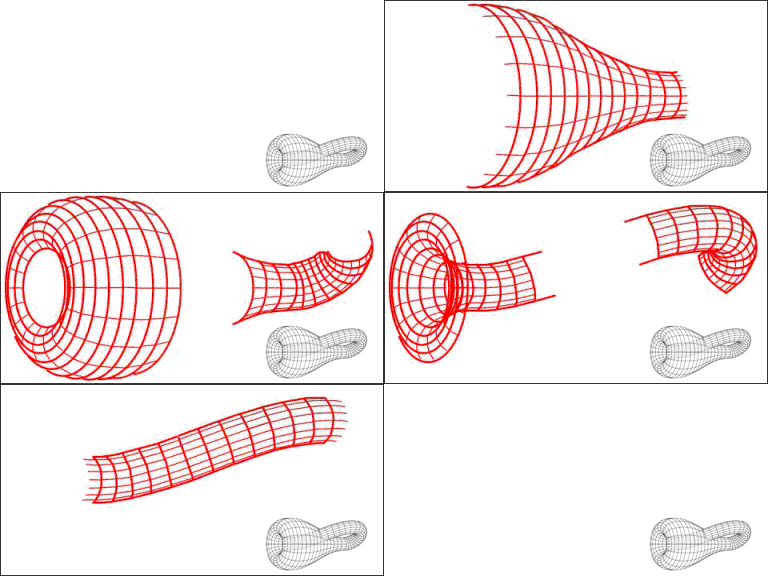
The Klein bottle cannot be embedded in ordinary three‑dimensional Euclidean space without self‑intersection. Any three‑dimensional model therefore either intersects itself or is only an immersion of the true object. In four dimensions the surface can be embedded without self‑intersections. Physical or sculptural models in 3D often show a tube that appears to pass through itself; makers sometimes use different colors on different regions to suggest how a true 4D embedding would separate those parts visually. See a typical 3D model.
Uses, examples and importance
- Pedagogy: the Klein bottle is a standard example used to illustrate non‑orientability and boundaryless surfaces in undergraduate topology courses.
- Mathematics: it provides test cases in algebraic topology, differential topology and in classification of surfaces.
- Art and popular culture: sculptors and designers build Klein bottles as striking objects that challenge intuitive notions of inside and outside.
Notable facts and distinctions
The Klein bottle differs from the Möbius strip in that it is closed (no boundary) while the Möbius strip has one boundary curve. An everyday heuristic sometimes says a Klein bottle has "one side and no edges," while a Möbius strip has "one side and one edge." The inability to embed the Klein bottle in three dimensions highlights how topological phenomena often require higher dimensions for faithful representation. For more background on surfaces and related examples, consult resources on two‑dimensional surfaces and non‑orientable manifolds; historical context and original descriptions can be found through discussions of Felix Klein and his work on surfaces and later expositions of the Möbius family of objects in topology.
For accessible introductions and visualizations, many popular math sites and museum exhibits provide interactive models and step‑by‑step constructions; see educational material and galleries referenced by institutions that curate mathematical objects and models about geometric surfaces and about physical models.
Related articles
Author
AlegsaOnline.com Klein bottle Leandro Alegsa
URL: https://en.alegsaonline.com/art/53928
Sources
- plus.maths.org : "Imaging maths - Inside the Klein bottle"