
Möbius strip (Möbius band)
A Möbius strip is a simple non‑orientable surface with only one side and one boundary component, created by giving a strip a half‑twist before joining its ends. It is a fundamental example in topology.
The Möbius strip, often called the Möbius band, is a familiar object that illustrates a basic topological idea: a compact surface with only one side and a single boundary curve. It can be produced with an ordinary rectangular strip of paper by giving one end a half‑twist and attaching it to the other end. Unlike a ring formed without twisting, the Möbius strip reverses orientation as you move around it, so what begins as the "inside" becomes the "outside" without crossing an edge.
Image gallery
10 Images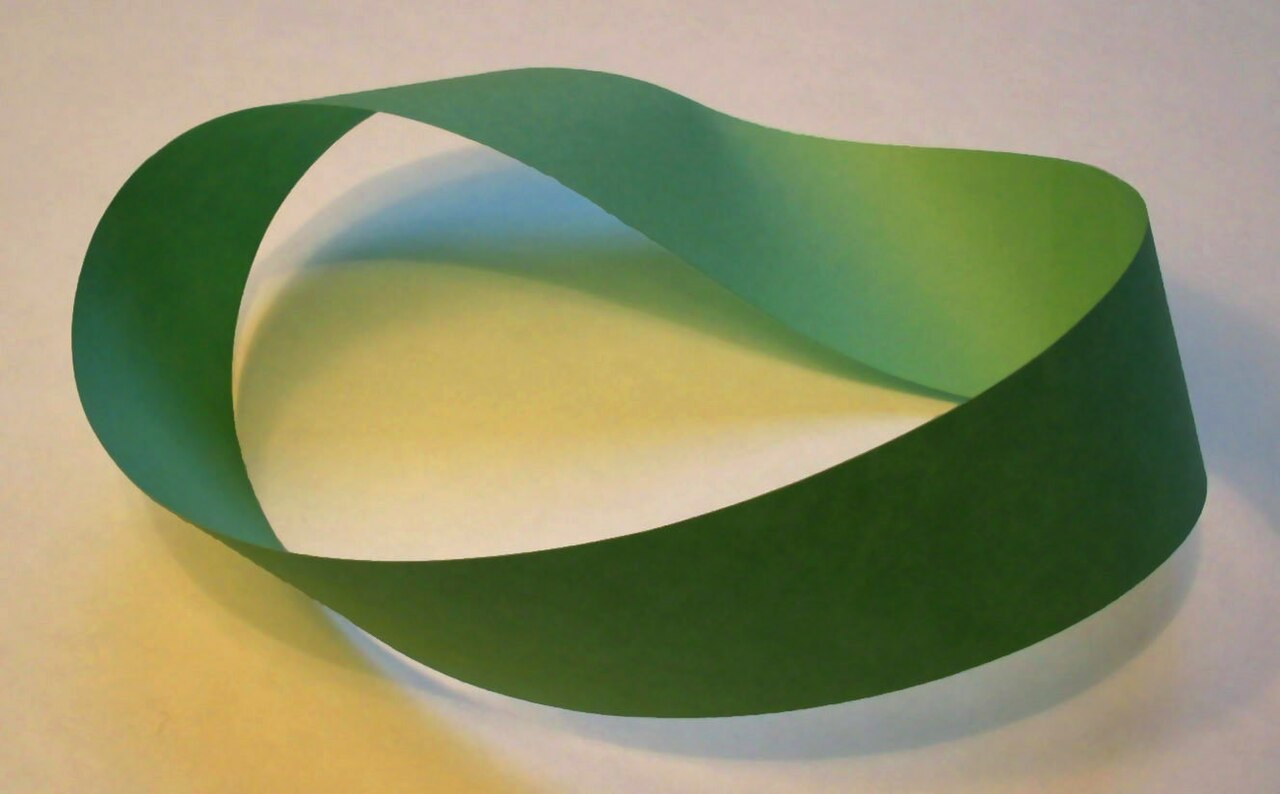


Defining characteristics
The Möbius strip is notable for several simple but striking properties that make it a standard example in topology and geometry:
- One-sidedness: A continuous path that travels around the surface can return to its starting point having covered what would be both sides of an ordinary band, demonstrating that it has only one side.
- Single boundary: The boundary of a Möbius strip is a single closed curve (one edge), in contrast with a normal cylinder that has two boundary circles.
- Non‑orientability: It is a compact non‑orientable surface with boundary; there is no consistent choice of normal direction globally on the surface.
- Topological invariants: The Möbius strip deformation retracts to a circle, so its Euler characteristic is 0 and it is not homeomorphic to a cylinder.
For a concise external description of the surface and related constructions, see looped surfaces.
Construction and simple experiments
The usual hands‑on construction uses a paper strip: give one end a single half‑twist and glue the ends together. Twisting in the opposite sense produces the mirror image of the same basic object; both are Möbius strips but differ by orientation in three‑dimensional space. Simple experiments with cutting reveal surprising behavior. If you cut the strip lengthwise down the center, rather than producing two separate rings you obtain a single longer band with two full twists (an orientable loop topologically equivalent to a cylinder). Other cuts, made at different offsets from the edge, produce different outcomes — often yielding two pieces that are linked or one Möbius piece and one ordinary band — and the precise result depends on where the cut is made.
History and naming
The Möbius strip was discovered independently in 1858 by two German mathematicians working in the same period. Scholars credit German mathematicians for identifying the surface; the name honors August Ferdinand Möbius, and the related contribution by Johann Benedict Listing is also recognized. The object soon became an instructive illustration in the emerging field of topology as mathematicians formalized notions of orientation and equivalence of surfaces.
Uses, examples, and cultural significance
The Möbius strip appears in mathematics, art, and engineering. In education it is prized for providing an intuitive example of non‑orientability. Artists and sculptors have used its continuous one‑sided form as a motif in public works and jewelry. In practical devices, variants of the Möbius idea have been used to lengthen the life of conveyor belts and printer ribbons by allowing the material to wear on both faces; designers exploit the strip’s symmetry to achieve even wear in continuous loops.
Related concepts and notable facts
The Möbius strip is closely related to other non‑orientable surfaces: for instance, attaching a disk to the boundary of a Möbius strip produces the real projective plane, a closed non‑orientable surface without boundary. The Klein bottle can be obtained by gluing together two Möbius strips along their boundary circles in an appropriate way (in an abstract topological sense; an embedding without self‑intersection requires four dimensions). Because of its simplicity and counterintuitive properties, the Möbius strip remains one of the most accessible and frequently cited examples in introductory topology and popular descriptions of geometric ideas.
For further reading and visual demonstrations, follow resources on surface topology and geometric models at demonstrations and historical summaries of 19th‑century mathematics at historical surveys or the biographies of Möbius and Listing.
Related articles
Author
AlegsaOnline.com Möbius strip (Möbius band) Leandro Alegsa
URL: https://en.alegsaonline.com/art/65676
Sources
- patft.uspto.gov : U.S. Patent 512,340
- pat2pdf.org : pat2pdf.org/pat2pdf/foo.pl?number=512340
- livescience.com : Clara Moskowitz, Music Reduced to Beautiful Math, LiveScience
- doi.org : 10.1126/science.1126287
- patft.uspto.gov : U.S. Patent 3.267.406
- pat2pdf.org : pat2pdf.org/pat2pdf/foo.pl?number=3.267.406
- arxiv.org : here