
Khaled Asaad — Syrian archaeologist and guardian of Palmyra's heritage
Khaled Asaad (1934–2015) was a Syrian archaeologist who served as head of antiquities in Palmyra for over forty years. Captured and killed by ISIL in 2015, he is remembered for scholarship and protecting artifacts.
Overview
Khaled Asaad (1934 – 18 August 2015) was a Syrian archaeologist best known for his long stewardship of the ruins and museum of Palmyra. His name is also rendered in Arabic; see the Arabic spelling for reference. Asaad served as the head of antiquities in Palmyra for more than forty years and combined curatorial duties, fieldwork and local administration to document and preserve one of the Middle East's major archaeological sites.
Image gallery
2 Images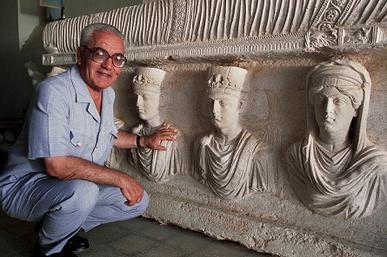

Early life and career
Born in 1934, Asaad devoted nearly his entire professional life to Palmyra and its material culture. Working within Syria's heritage institutions, he supervised excavations, maintained the Palmyra Museum collection and trained local staff. Over decades he collaborated with national and international teams to research and conserve monuments that span Greco-Roman, Parthian and local Near Eastern traditions.
Scholarly contributions
Asaad was respected for his detailed knowledge of Palmyrene inscriptions, funerary monuments and architectural decoration. He helped catalogue inscriptions and portable finds, produced studies and reports used by later scholars, and contributed to public presentation of the site for visitors and researchers. His work supported interpretation of Palmyra's role as a caravan city and a cultural crossroads in antiquity.
Conflict, capture and death
When the Syrian civil war put archaeological sites at risk, Palmyra and its museum became vulnerable. The city is located in central Syria and changed hands during the conflict. In May 2015 Palmyra came under the control of the militant group commonly known as the Islamic State (ISIL). Reports indicate that Asaad remained in Palmyra after the occupation and assisted efforts to move portable artifacts to safer locations. According to widely reported accounts, he was captured and executed on 18 August 2015; many accounts say his killing followed his refusal to disclose the whereabouts of hidden antiquities.
Legacy and significance
Asaad's death prompted widespread international condemnation and brought renewed attention to the protection of cultural heritage in armed conflict. UNESCO and many museums, universities and heritage organisations described the killing as a tragic loss for archaeology and cultural preservation. He is remembered both for his scholarship and for actions taken to safeguard Palmyra's antiquities under difficult and dangerous circumstances.
Context and broader issues
The events surrounding Palmyra during the Syrian conflict highlighted persistent risks: deliberate destruction of monuments, looting and illicit trafficking of artefacts, and the vulnerability of local custodians. The case of Khaled Asaad is widely cited in discussions of ethical responsibilities for museum professionals and archaeologists, the need for contingency planning, and international cooperation to protect and recover cultural property.
Notable facts
- Asaad served as head of antiquities in Palmyra for more than four decades, combining research, curation and site management.
- He contributed to the cataloguing of inscriptions and the documentation of funerary monuments central to understanding Palmyrene society.
- His death in 2015 became a focal point for international advocacy on the protection of heritage and for measures to prevent illicit trade in antiquities.
For further context on the country and the organisations involved, see resources concerning Syria, international cultural heritage law and responses to threats against archaeological sites. The story of Khaled Asaad remains an important reference for heritage professionals and policymakers working to protect the archaeological record in times of conflict.
Related articles
Author
AlegsaOnline.com Khaled Asaad — Syrian archaeologist and guardian of Palmyra's heritage Leandro Alegsa
URL: https://en.alegsaonline.com/art/53167
Sources
- bbc.co.uk : "Syrian archaeologist 'killed in Palmyra' by IS militants"
- uk.reuters.com : Islamic State militants behead archaeologist in Palmyra - Syrian official
- tagesschau.de : IS tötet früheren Chef-Archäologen von Palmyra
- usnews.com : "Islamic State beheads Syrian antiquities scholar in ancient town of Palmyra"
- theguardian.com : "Beheaded Syrian scholar refused to lead Isis to hidden Palmyra antiquities"
- nytimes.com : "ISIS Beheads Syrian Antiquities Scholar in Palmyra"
- worldcat.org : 0362-4331