
Archimedes' principle: buoyancy, displaced fluid, and practical applications
Archimedes' principle states that a body immersed in a fluid experiences an upward buoyant force equal to the weight of the fluid it displaces. Explains concept, origin, limits, and applications.
Overview
Archimedes' principle describes how fluids exert an upward force on objects placed in them. In plain terms, any object wholly or partly submerged in a liquid or gas is pushed upward by a force equal to the weight of the fluid that the object displaces. This phenomenon is commonly called buoyancy and explains why some things float while others sink.
Image gallery
4 Images


Statement of the principle
More formally, the buoyant force on a submerged body equals the weight of the displaced fluid. In classical mechanics this is expressed using density, displaced volume and gravity: buoyant force = fluid density × displaced volume × gravitational acceleration. The principle applies to objects completely submerged as well as to those that float with only part of their volume underwater.
Physical basis and limitations
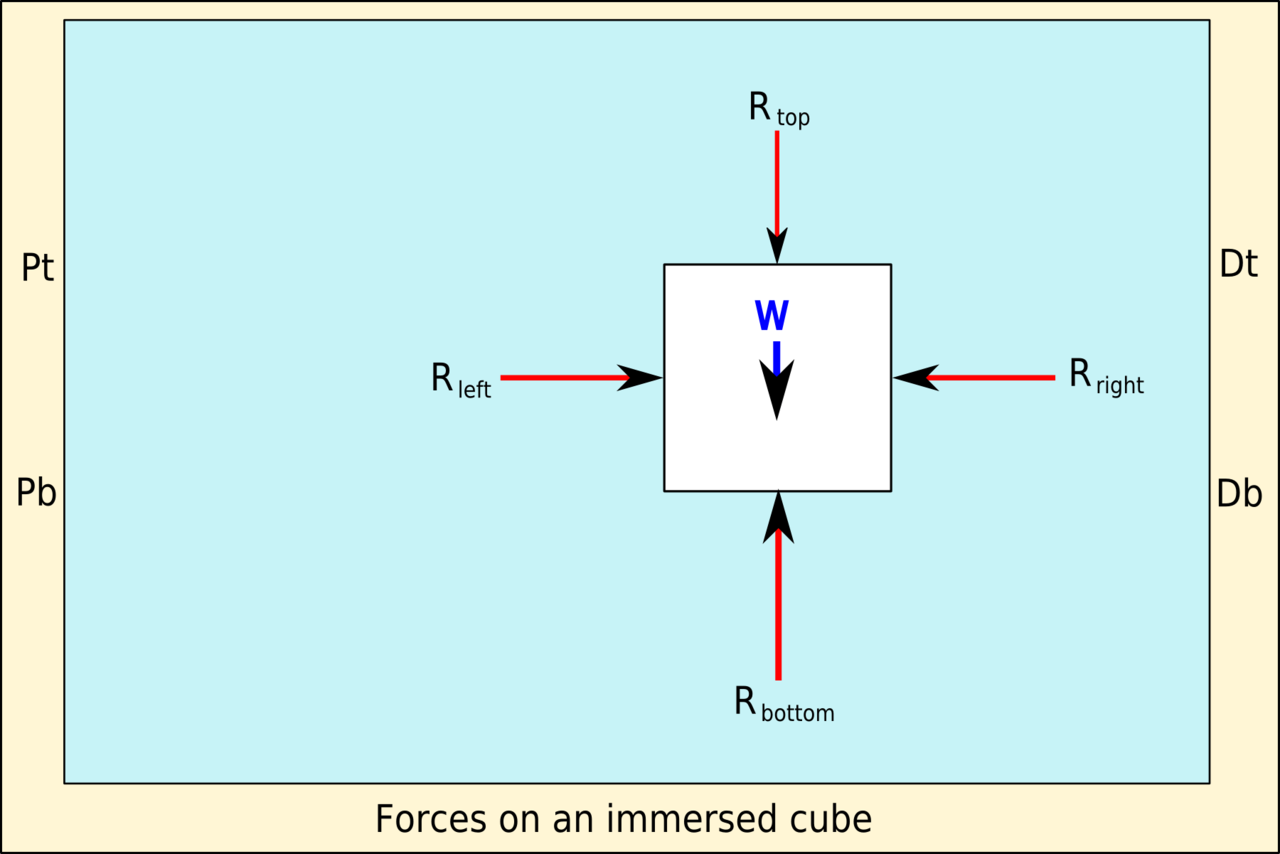
The effect arises from the pressure variation with depth in a static fluid: pressure increases with depth, producing a larger upward force on the lower surface than the downward force on the upper surface. Archimedes' principle assumes the fluid behaves as a continuum, and it is formulated for hydrostatic conditions. In accelerating frames or strongly nonuniform fluids extra considerations are needed; corrections apply when compressibility, surface tension or viscosity play a dominant role.
History and attribution
The law is named after the ancient Greek mathematician and inventor Archimedes. Classical accounts attribute the discovery to him and record a colorful anecdote in which he reputedly exclaimed a word of joy upon realizing the idea while bathing. Whether literal or apocryphal, the story underlines the principle's long-known importance in both practical and theoretical work.
Applications and examples
Archimedes' principle underpins ship and submarine design, the operation of hot-air balloons and hydrometers, and methods for measuring density and specific gravity. Typical uses include:
- Predicting whether a hull will float by comparing displaced water weight and vessel mass.
- Using a hydrometer to determine liquid density by observing how deeply it sinks.
- Adjusting ballast in submersibles to change buoyancy and depth.
Notable distinctions
Archimedes' principle tells only the magnitude of the buoyant force as determined by displaced fluid weight; it does not by itself guarantee stability. Stability of floating bodies depends on the relative positions of the center of gravity and the center of buoyancy. The principle remains a fundamental, widely applicable result in fluid mechanics and engineering, bridging simple observations and precise calculations in design and measurement.
Related articles
Author
AlegsaOnline.com Archimedes' principle: buoyancy, displaced fluid, and practical applications Leandro Alegsa
URL: https://en.alegsaonline.com/art/5314
Sources
- archive.rubicon-foundation.org : "The diving "Law-ers": A brief resume of their lives"
- worldcat.org : 0813-1988
- worldcat.org : 16986801 · archive.org