
Archimedes of Syracuse: Life, Work, and Legacy
Archimedes (c. 287–c. 212 BC) was an ancient Greek mathematician, inventor and scientist from Syracuse, known for foundational work in geometry, hydrostatics, mechanics and practical devices.
Archimedes of Syracuse is one of antiquity's most influential thinkers. Active in the third century BC, he combined rigorous mathematical reasoning with practical invention. Born in the Greek city of Syracuse on the island of Sicily, he spent much of his life producing theoretical demonstrations and designing machines intended to solve engineering problems of his day. Scholars remember him for both abstract contributions to geometry and for physical insights such as the principle of buoyancy.
Image gallery
10 Images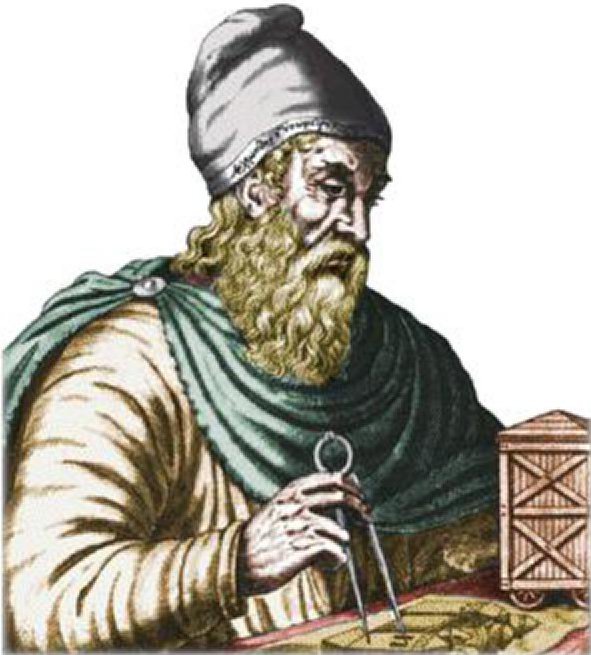






Background and education
Details of Archimedes' life are known mainly through later ancient biographies and references by other authors, so some points remain uncertain. According to tradition he was the son of Phidias, described by some sources as an astronomer. At a young age he is said to have travelled to study in the intellectual center of Alexandria, where he would have encountered the mathematical legacy of earlier scholars. Later accounts link him with figures such as Euclid and other Hellenistic scientists, but precise teacher‑student relationships are not firmly established.
Major contributions
Archimedes made lasting advances across several areas of knowledge. In mathematics he developed methods that anticipated integral calculus by using geometric dissections and sums to determine areas and volumes; his work on the measurement of a circle led to improved bounds on pi. In physics he formulated principles of levers and buoyancy; the latter is commonly known as Archimedes' principle and is traditionally associated with the "Eureka" story describing discovery by displacement in a bath.
He is also credited with inventing or refining practical devices: the Archimedean screw for lifting water, compound pulleys and block-and-tackle systems to multiply mechanical advantage, and a range of war machines and defenses reputedly used to protect Syracuse during siege. Ancient writers ascribe to him cranes, catapults and a grappling device called the "Claw of Archimedes," though the exact form and effectiveness of those devices are debated.
Works and surviving texts
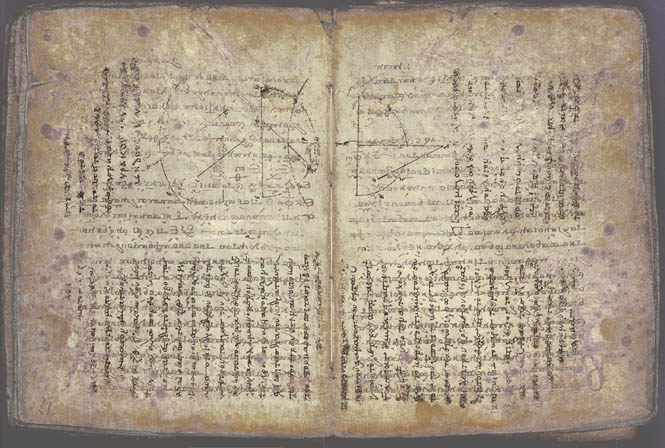
Several treatises attributed to Archimedes survive, often in Greek or in later Latin translations. Notable titles include works on spheres and cylinders, on the equilibrium of planes, on floating bodies, and the investigatory treatise sometimes called The Method, which reveals how geometric results could be discovered heuristically. These texts display both rigorous proof and ingenious computation techniques that influenced later mathematicians and the eventual development of calculus.
Legacy and notable facts
Archimedes' blend of theory and practice made him a model for engineers and scientists through the centuries. He is remembered in anecdotes—such as reputed last words asking his killer not to disturb his diagrams—and in maxims about leverage and mechanics. Modern students encounter his name in elementary physics and geometry, and historical interest in his manuscripts has inspired critical editions and translations.
- archaeological and biographical sources often supply the framework for his life story.
- Inventive devices such as the water screw are attributed to him.
- Ancient accounts describe his defensive engineering during sieges.
- Astronomical observations and instruments appear in references to his family or milieu.
- Mathematical works remain central to the history of geometry.
- Syracuse is the city most closely associated with him.
- Phidias is named in some ancient notices as his father.
- Alexandria is cited as a place where he studied or worked.
- Hellenistic Egypt provided the scholarly environment for his education.
- Euclid represents the mathematical tradition that influenced him.
- Later biographies and translations have shaped modern understanding of his achievements.
While some details of Archimedes' life and some attributions remain subjects for historians to evaluate carefully, his intellectual influence is unmistakable: he left a legacy bridging pure mathematics and applied mechanics that continues to be taught and admired today.
Questions and answers
Q: Who was Archimedes?
A: Archimedes of Syracuse was a Greek scientist, inventor, astronomer and mathematician who lived in the town of Syracuse in Sicily.
Q: Where did Archimedes study?
A: He studied in Alexandria, Egypt at the school of Euclid, a famous mathematician.
Q: What is known about his personal life?
A: Not much is known about the personal life of Archimedes such as whether he was married or had children.
Q: How did he die?
A: When the Romans invaded Syracuse they captured him so they could learn all that he knew. About two years later when he was drawing a mathematical diagram in the sand and refused to go meet with the Roman general until he finished working on it, a soldier became enraged and killed him.
Q: What were his last words?
A: His last words are supposed to have been "Do not disturb my circles!"
Q: Who was his father?
A: His father was Phidias, an astronomer.
Q: Was Archimedes from a royal family?
A: It is possible that he may have been related to a king of Syracuse since it was a rich Greek city on the seashore in Sicily.
Related articles
Author
AlegsaOnline.com Archimedes of Syracuse: Life, Work, and Legacy Leandro Alegsa
URL: https://en.alegsaonline.com/art/114511
Sources
- doi.org : 10.1016/0315-0860(78)90134-9
- mathworld.wolfram.com : Sphere · web.archive.org
- math.nyu.edu : math.nyu.edu/Archimedes/Crown/bilancetta.html
- wikidata.orgQ8739.html : wikidata.orgq8739.html
- authority.bibsys.no : 90080448
- catalogo.bne.es : XX874130
- catalogue.bnf.fr : cb12026533n
- data.bnf.fr : (data)
- cantic.bnc.cat : a10487384
- ci.nii.ac.jp : DA01926703
- d-nb.info : 118503863
- isni.org : 0000 0001 2277 8575
- id.loc.gov : n80104666
- kopkatalogs.lv : 000061159