
Astrodynamics: Motion, Orbits, and Spacecraft Navigation
Astrodynamics studies the motion of spacecraft and natural bodies under gravity and other forces, covering orbital mechanics, maneuvers, trajectory design, and applications from satellites to interplanetary missions.
Astrodynamics is the scientific and engineering discipline concerned with the motion of objects in space under the influence of gravity and other perturbing forces. It applies the principles of classical mechanics and gravitation to predict trajectories, design transfers, and control spacecraft. For a broad introduction to the physical background see fundamentals of physics.
Image gallery
5 Images


Core principles
The simplest model is the two-body problem, which yields conic-section orbits described by Kepler's laws and can be derived from Newton's laws of motion and universal gravitation. Real missions, however, must account for perturbations such as atmospheric drag, non-spherical gravity, third-body effects, and solar radiation pressure. Numerical integration and state estimation techniques are used to handle these complexities. For material on motion concepts consult motion in space.
Orbits are commonly specified by a set of orbital elements that capture size, shape and orientation. Typical elements include:
- semi-major axis (size) and orbital period
- eccentricity (shape) and inclination (tilt)
- arguments that locate periapsis and the ascending node, and the current position along the orbit
Techniques and maneuvers
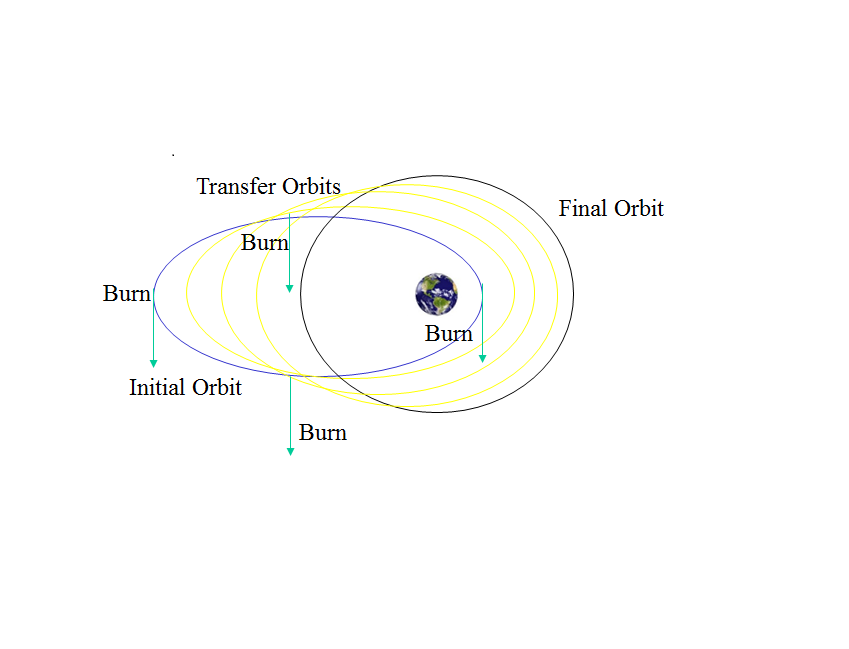
Astrodynamics provides methods for transferring between orbits and for controlling spacecraft trajectories. Classical maneuvers include impulsive burns such as Hohmann transfers, plane changes, and bi-elliptic transfers. More advanced approaches employ gravity assists, low-thrust spiral transfers, and continuous-thrust optimization. Mission designers often use patched-conic approximations early in planning and then refine solutions with full dynamical models; introductory resources on mechanics are available at mechanics resources and on orbit concepts at orbit basics.
Computation, navigation and applications
Modern astrodynamics relies heavily on numerical methods, orbit determination from tracking data, and onboard guidance algorithms. Applications include satellite constellation design, station-keeping, rendezvous and docking, reentry prediction, space debris mitigation, and interplanetary mission planning. Understanding the space environment and operational constraints is essential; see further notes on the environment at space environment.
Historically, astrodynamics evolved from celestial mechanics as rocketry and spaceflight matured, becoming a computationally intensive field that integrates physics, applied mathematics, and engineering. The discipline continues to adapt with advances in propulsion, autonomous systems, and observation technology, supporting both scientific exploration and practical satellite services.
Tags
Related articles
Author
AlegsaOnline.com Astrodynamics: Motion, Orbits, and Spacecraft Navigation Leandro Alegsa
URL: https://en.alegsaonline.com/art/6831