
Arc de Triomphe (Paris)
Neoclassical triumphal arch in Paris commemorating French military victories; site of the Tomb of the Unknown Soldier and panoramic terrace at the western end of the Champs-Élysées.
The Arc de Triomphe stands at the center of the large circular plaza historically called the Place de l'Étoile (now Place Charles de Gaulle) and marks the western terminus of the Champs-Élysées. It is one of Paris's best-known monuments and a focal point for national commemorations. Visitors reach the monument by an underground pedestrian passage because vehicular traffic circulates around the plaza rather than under the arch. For an introduction to its location and significance see overview and local maps here.
Image gallery
10 Images


Design, scale, and artistic program
Conceived in a neoclassical idiom inspired by ancient Roman triumphal arches, the Arc de Triomphe was designed by Jean-François Chalgrin. It measures roughly 50 metres tall and presents a monumental façade with a deep central vault and smaller side openings. Access to the roof is by a stairway of approximately 280 steps, which leads to a terrace offering panoramic views over the twelve avenues that radiate from the plaza and toward central Paris.
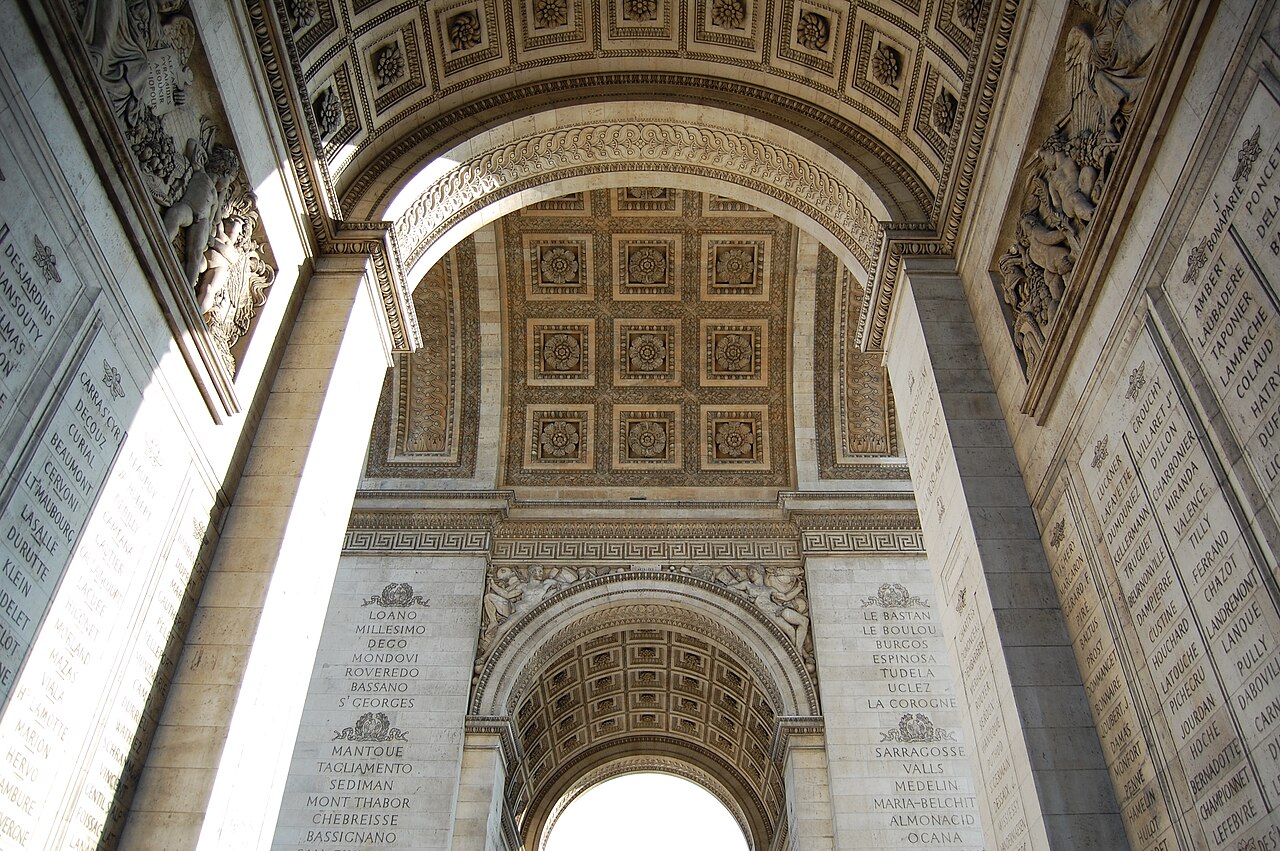
The arch's sculptural program blends high-relief panels and large sculptural groups that embody patriotic and military themes. Four principal sculptural groups occupy the piers, most famously François Rude's dynamic La Marseillaise (often called The Departure of the Volunteers). Other major works include Jean-Pierre Cortot's celebration of triumph and Antoine Étex's paired works on Resistance and Peace. In addition to these groups, a series of reliefs and carved inscriptions recount battles and the names of generals, forming a continuous commemorative register around the structure.
History and symbolic role
The monument was commissioned by Emperor Napoléon I in 1806 after his victory at Austerlitz and completed more than three decades later amid changing political circumstances; it was formally dedicated in July 1836. Its meaning and use evolved over the 19th and 20th centuries, shifting from an imperial memorial to a broader national symbol. After the First World War a Tomb of the Unknown Soldier was interred beneath the vault, and an eternal flame now rekindled each evening marks the site of remembrance. For details on the commission and early history consult this historical summary Napoleonic commissions and the date of inauguration anniversary.
Uses, ceremonies, and visitor experience
The Arc de Triomphe remains a central stage for official ceremonies: military parades, national remembrance events on Armistice Day, and wreath-laying services at the Tomb of the Unknown Soldier. For visitors, the monument combines memorial function with sightseeing — a museum area explains its construction and iconography, while the rooftop terrace provides a notable vantage point over Paris. Practical visitor information and planning resources are available here.
Notable facts and distinctions
- The arch was inspired by classical models such as the Arch of Titus but reinterpreted in a 19th-century monumental vocabulary.
- Its inscriptions name important French victories and military leaders, making the fabric of the stone itself a historical record.
- The site brings together commemorative ritual and everyday urban life; traffic, tourism, and ceremony coexist around the plaza.
Whether approached as architecture, history, or public memorial, the Arc de Triomphe remains central to Parisian identity and national memory. Further reading, guided tours, and conservation updates can be found through the linked resources above.
Related articles
Author
AlegsaOnline.com Arc de Triomphe (Paris) Leandro Alegsa
URL: https://en.alegsaonline.com/art/5241