
Jurassic (geological period)
Middle period of the Mesozoic Era (about 201 to 145 million years ago), noted for dinosaur dominance, breakup of Pangaea, rich marine life and important fossil formations.
Overview — The Jurassic is the second and middle geological period of the Mesozoic Era and the eighth period of the Phanerozoic eon. It began near 201.3 million years ago and ended about 145 million years ago. The Jurassic follows the Triassic and precedes the Cretaceous. The name derives from rock sequences first studied in the Jura Mountains of central Europe, applied in the early 19th century to distinctive sedimentary strata.
Image gallery
10 Images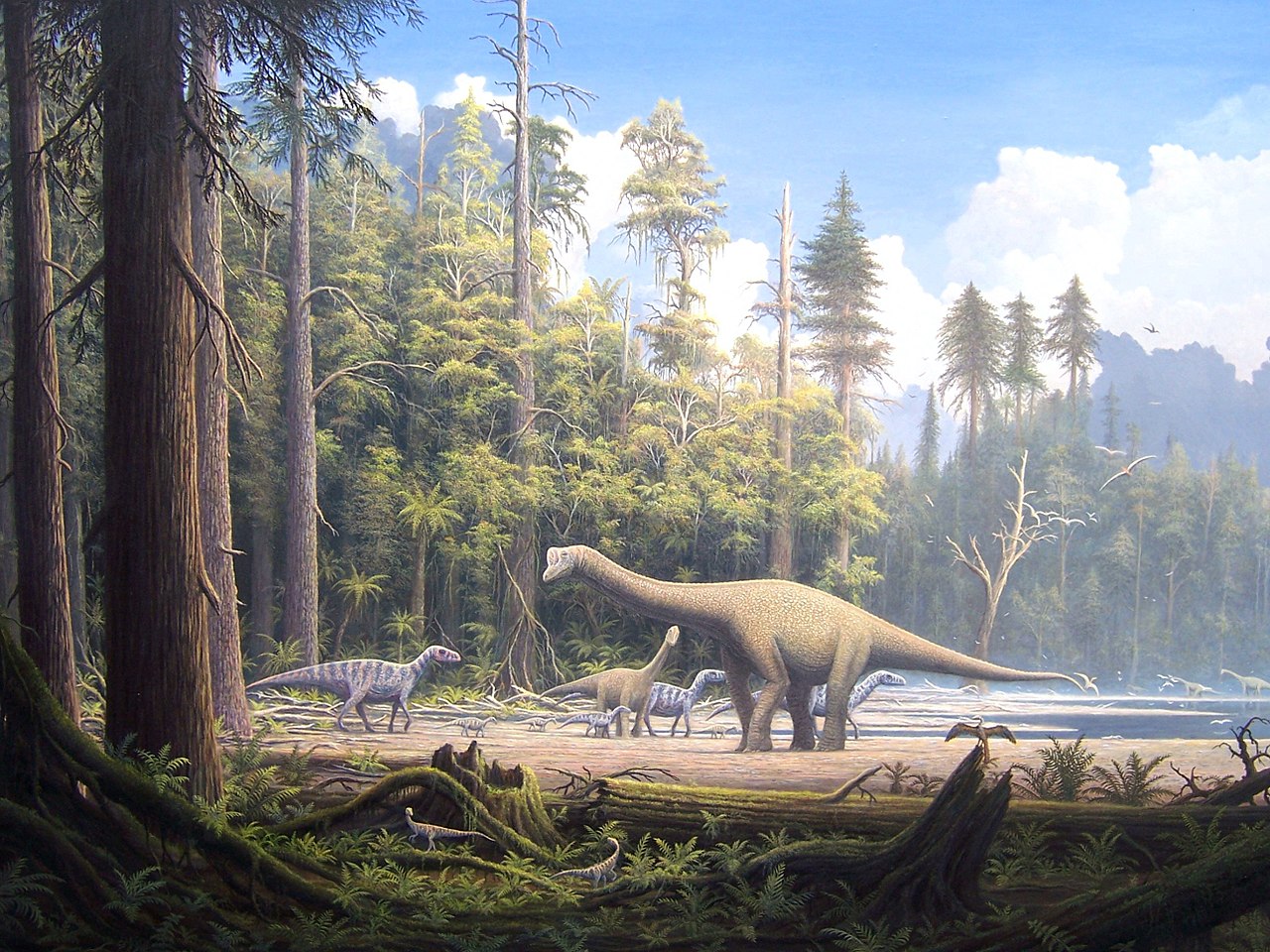


Stratigraphy and subdivisions
Stratigraphically, the Jurassic is divided into three major epochs: Early (Lower), Middle and Late (Upper) Jurassic. Each epoch contains a series of stages that are used worldwide for correlation. These subdivisions are identified by characteristic fossil assemblages and rock types, and are tied to the international geologic period timescale through biostratigraphy and radiometric calibration.
Climate, sea level and plate tectonics
The Jurassic climate was generally warmer and more humid than present, with little or no polar ice and higher global sea levels. Extensive shallow seas formed epicontinental shelves that supported rich marine ecosystems and carbonate deposition. During the Jurassic, the supercontinent Pangaea continued to fragment: rifting widened ocean basins, including the early Atlantic, and the Tethys Seaway separated major landmasses. These tectonic changes rearranged coastlines and continental connections, influencing migration and evolution.
Life and ecosystems
Terrestrial ecosystems were dominated by dinosaurs, which diversified into a wide range of forms from large sauropods to predatory theropods. The Late Jurassic yields the first clear bird-like fossils, indicating the early stages of avian evolution. Plant life was dominated by gymnosperms such as conifers, cycads and ginkgoes, with ferns and seed ferns common in many environments.
Marine environments supported abundant ammonites and other molluscs that are important index fossils. Marine reptiles such as plesiosaurs and ichthyosaurs were common, and numerous fish groups flourished. Flying reptiles (pterosaurs) occupied aerial niches, often along coastlines and inland lakes.
Fossils, significance and research history
The Jurassic period is among the best documented intervals in the fossil record, with extensive fossil-bearing formations across Europe, North America, Africa and Asia. Famous deposits include lithographic limestones and continental sediments that have yielded complete skeletons and exceptional preservation. Iconic localities such as Solnhofen in Germany and the Morrison Formation in North America have provided key specimens that illuminate dinosaur anatomy, behaviour and environment. Research in the 19th and 20th centuries established many stratigraphic frameworks; modern studies combine fieldwork with geochemistry, isotope analysis and refined dating techniques.
Economic and scientific importance
Jurassic rocks are important as sources of building stone and host sediments that can form hydrocarbon reservoirs and mineral deposits. Scientifically, Jurassic strata and fossils are central to understanding Mesozoic life, major evolutionary transitions (including the origin of birds) and the environmental consequences of plate-tectonic reconfiguration.
Key points
- Often called the "age of dinosaurs" because dinosaurs were the dominant large terrestrial animals.
- Marked by high sea levels and extensive marine deposits rich in ammonites and other index fossils.
- Important interval for studying the breakup of Pangaea and early Atlantic rifting.
For general context, see entries on the geologic period concept and the international geological timescale. The Jurassic sits between the Triassic and the Cretaceous in the Mesozoic Era, and is a major unit within the Phanerozoic eon, whose numeric ages are constrained by fossils and radiometric methods.
Questions and answers
Q: What is the Jurassic period?
A: The Jurassic period is the second and middle geological period in the Mesozoic era and the eighth period in the Phanerozoic eon.
Q: When did the Jurassic period begin?
A: The Jurassic period began 201.3 million years ago.
Q: When did the Jurassic period end?
A: The Jurassic period ended 145 million years ago.
Q: What other two periods did the Jurassic period happen between?
A: The Jurassic period happened between the Triassic and Cretaceous periods.
Q: What is the Mesozoic era?
A: The Mesozoic era is a geological era that lasted from about 252 million years ago to about 66 million years ago.
Q: What is the Phanerozoic eon?
A: The Phanerozoic eon is the current geological eon, which began about 542 million years ago and continues today.
Q: Why is the Jurassic period significant?
A: The Jurassic period is significant because it was a time of great evolution and diversification of dinosaurs, as well as the emergence of many modern groups of plants and animals.
Related articles
Author
AlegsaOnline.com Jurassic (geological period) Leandro Alegsa
URL: https://en.alegsaonline.com/art/51719
Sources
- fortunecity.com : fortunecity.com
- bbc.co.uk : bbc.co.uk/news/extra/nxVbFidDbs/mission-jurassic